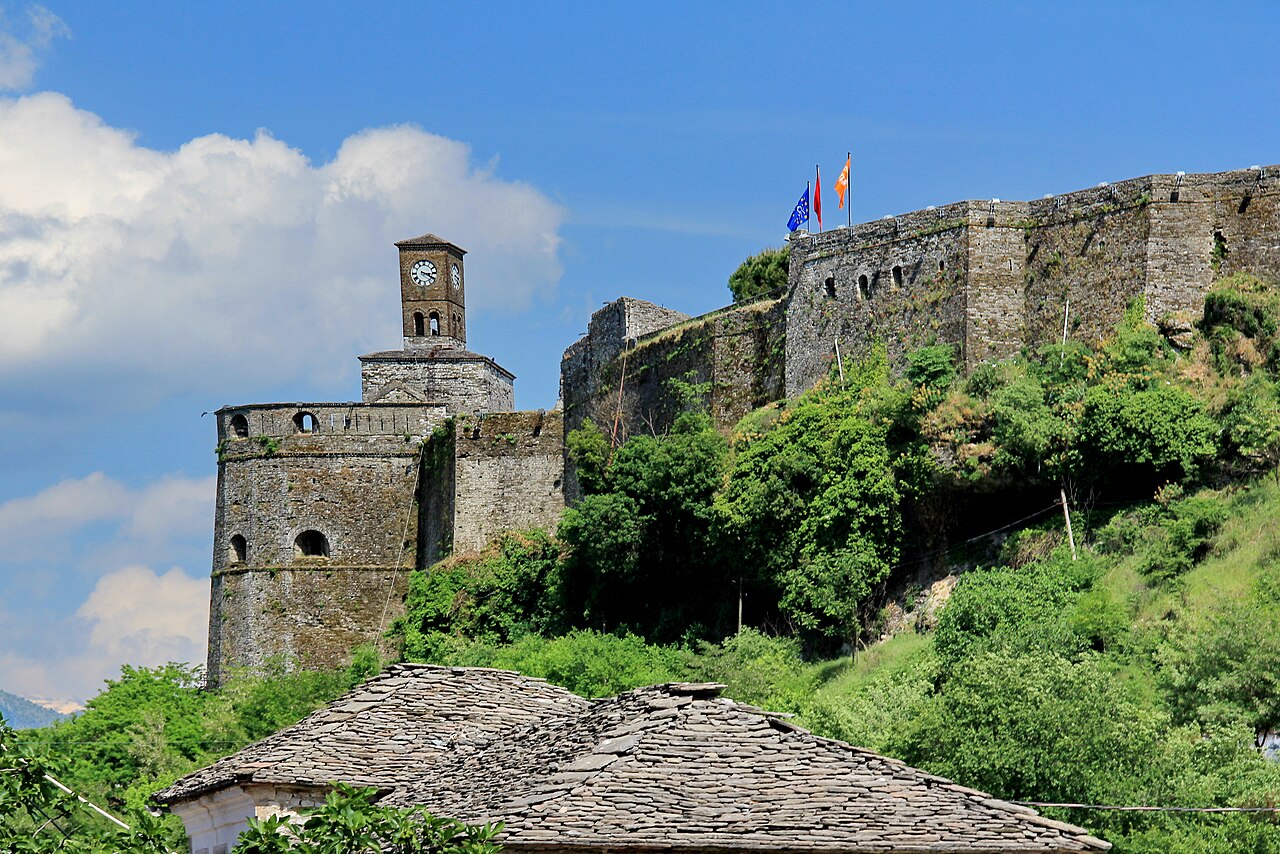
Shëndërjadhës Castle
Shëndërjadhës Castle, also known locally as Kalaja e Shëndërjadhës or Shën Triadhës, is a historic fortress located east of the village of Topullaraj in the county of Gjirokastër, Albania. This castle occupies a strategic position on a hilly ridge overlooking the valley, nearly opposite the well-known Gjirokastër Castle. Its location provided a commanding view of the surrounding terrain, essential for surveillance and defense during its period of use.
The castle was constructed around 1800 by Ali Pasha of Ioannina, a prominent Albanian ruler who exercised considerable autonomy within the Ottoman Empire. Ali Pasha is noted for his quasi-independent governance and military prowess in the region. Shëndërjadhës Castle served primarily as a resting place and a minor stronghold during Ali Pasha's travels between his administrative center in Ioannina and his birthplace in Tepelenë.
Architectural features and layout
The castle exhibits a rectangular plan with polygonal corner towers, a design characteristic shared with other fortifications commissioned by Ali Pasha, such as the Libohovë Castle. These towers would have enhanced the defensive capabilities of the fortress by providing overlapping fields of fire and improved vantage points for sentries. The main entrance was located on the eastern wall, controlling access to the interior courtyard.
Constructed primarily from local stone, the castle's walls were robust enough to withstand small-scale assaults. Although much of the structure has fallen into ruin, remnants of the walls and towers remain visible, offering insight into the military architectural style of the early 19th century in the region.
The Holy Trinity Church
Outside the castle walls stands a small church known as the Holy Trinity Church, which gave the castle its name. This church was built to serve the garrison stationed at the castle, which consisted mainly of Greek Orthodox soldiers loyal to Ali Pasha. The presence of this church highlights the religious diversity and the pragmatic alliances of the period, as Ali Pasha integrated different ethnic and religious groups into his military forces.
Historical significance and usage
During Ali Pasha's rule, Shëndërjadhës Castle functioned as a minor military post and a convenient stopover point. Its strategic placement facilitated control over the surrounding area and ensured communication lines between Ioannina and Tepelenë remained secure.
Following Ali Pasha's death in 1822, the castle lost its strategic importance and gradually fell into disuse and decay. However, its military relevance was briefly revived during the communist era in Albania between the 1960s and 1980s. During this period, the castle's ruins were repurposed as a military base and equipped with anti-aircraft artillery, reflecting the shifting defense priorities of the 20th century.
Visiting Shëndërjadhës Castle today
Today, Shëndërjadhës Castle is freely accessible to visitors interested in exploring Albania's rich historical heritage. The site offers a glimpse into early 19th-century military architecture and the complex history of the region under Ottoman rule.
The castle is reached by a dirt road that requires a 4WD vehicle for safe passage, although many visitors opt to walk the approximately 40-minute trek from nearby villages. Visitors are advised to bring water, especially during the hot summer months, as the area is exposed and lacks facilities.
Despite its ruined state, the castle remains a compelling destination for those interested in the military history of the Balkans, Ottoman-era fortifications, and the legacy of Ali Pasha. Its proximity to Gjirokastër, a city known for its own impressive castle and UNESCO World Heritage status, makes it a worthwhile addition to regional historical tours.
Architectural context and comparison
Shëndërjadhës Castle's design reflects the transitional military architecture of the late Ottoman period in the Balkans. The use of polygonal towers and a rectangular layout was typical of smaller fortresses built for regional control rather than large-scale defense. Similarities with other Ali Pasha castles, such as Libohovë, suggest a standardized approach to fortification construction during his rule.
While not as large or as well-preserved as some of Albania's medieval castles, Shëndërjadhës offers valuable insights into the military and political strategies employed by local rulers in the early 19th century. Its integration of a religious building within the military complex also illustrates the intertwining of faith and governance in the Ottoman provincial context.
Frequently asked questions (FAQ)
- How do I get to Shëndërjadhës Castle?
- Shëndërjadhës Castle is accessible via a dirt road that requires a 4WD vehicle for safe passage. Alternatively, visitors can reach it on foot with a 40-minute walk from nearby villages.
- What is the historical significance of Shëndërjadhës Castle?
- Built by Ali Pasha around 1800, the castle served as a resting place and military post during his travels between Ioannina and Tepelenë, reflecting the regional power dynamics of the Ottoman period.
- Can I visit the Holy Trinity Church near the castle?
- Yes, the small Holy Trinity Church located just outside the castle walls is accessible to visitors and represents the religious heritage connected to the castle's garrison.
- Is Shëndërjadhës Castle suitable for a summer visit?
- Visitors should bring water and prepare for exposed conditions when visiting in summer, as the castle is on a hilly ridge with no shade or facilities nearby.
- What architectural features characterize Shëndërjadhës Castle?
- The castle features a rectangular plan with polygonal corner towers and an eastern entrance, typical of Ali Pasha's fortifications like Libohovë Castle, designed for regional defense.
Information
Loading map...
Visitor reviews
No reviews yet. Been here? Write the first review and help other travelers!
Write the first reviewVisited this castle? Share your experience
Your review helps other travelers and adds first-hand knowledge to our encyclopedia.