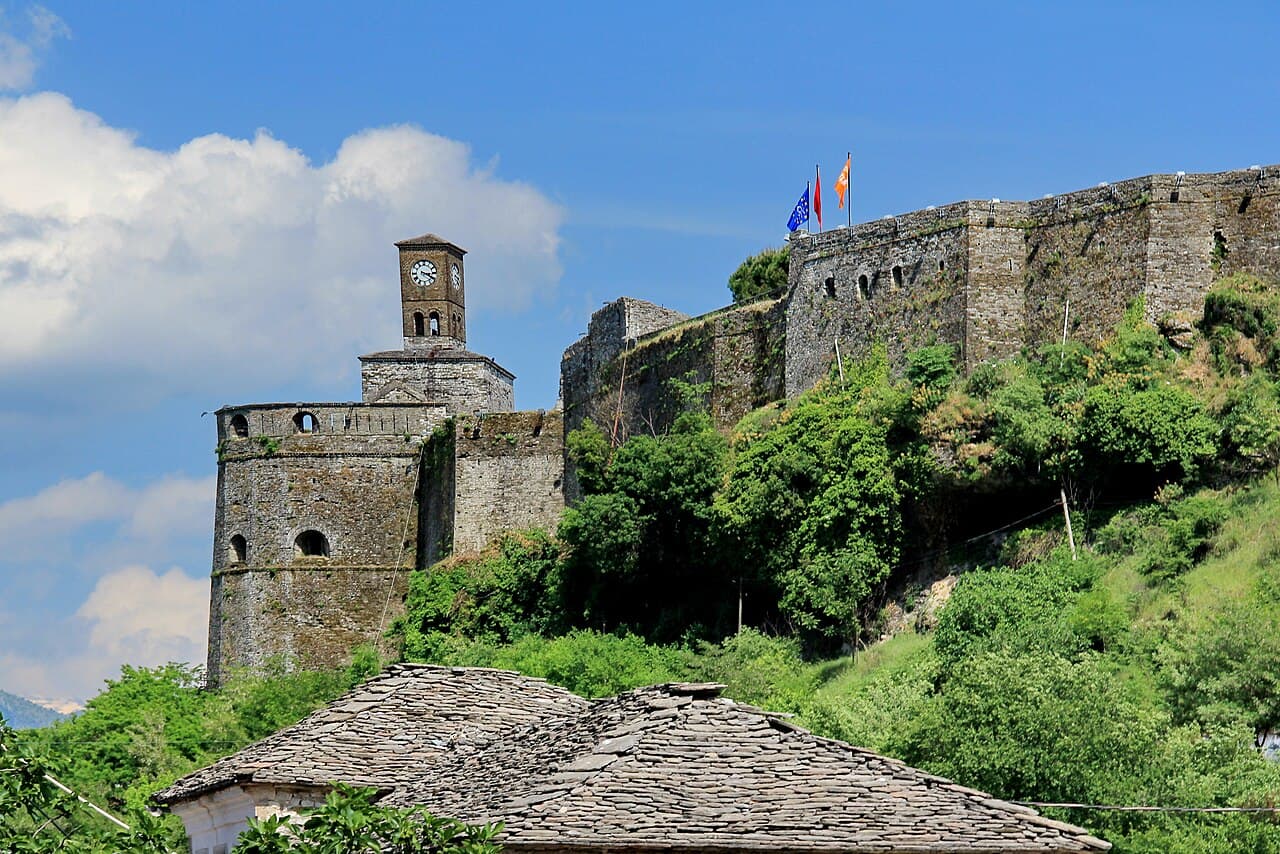
Gjirokastër Castle — Albania castle

Gjirokastër Castle

Gjirokastër Castle: historic fortress in southern Albania
Gjirokastër, Gjirokaster, Albania
Late Medieval (14th–15th c.)
Well Preserved

Gjirokastër Castle, locally known as Kalaja e Gjirokastër, is a monumental fortress dominating the town of Gjirokastër in southern Albania. Perched on a ridge overlooking the strategic Drino River valley, this late-medieval castle has witnessed centuries of history, from ancient settlements to Ottoman rule and 20th-century political upheavals. Its imposing walls and towers offer a glimpse into Albania's turbulent past and its cultural heritage.

Ancient origins and early fortifications

Archaeological evidence indicates that the site of Gjirokastër Castle has been inhabited since the Stone Age, highlighting its long-standing strategic importance. The earliest fortifications date back to the Hellenistic period, when the ridge was first fortified to control the surrounding region. The castle was first documented in Byzantine records in 1336, marking its significance during the medieval era.

Medieval history and the feudal era

During the medieval period, Gjirokastër Castle served as the seat of the feudal lords of Zenevisë, a local ruling family. In 1417, the castle endured a prolonged siege by the expanding Ottoman Empire. Despite a valiant defense lasting several months, the defenders ultimately capitulated. A poignant legend from this siege tells of a local princess who leapt from one of the castle towers with her child to avoid capture, symbolizing the fierce resistance of the local population.

Ottoman restoration and ali pasha's reconstruction

Following its capture, the castle was restored and expanded under the orders of Sultan Bayezid II in the late 15th century. This restoration marked the beginning of the castle's transformation into a formidable Ottoman fortress. In 1812, the castle came under the control of Ali Pasha of Ioannina, an influential Albanian ruler who governed with considerable autonomy within the Ottoman Empire. Ali Pasha undertook extensive rebuilding, enlargement, and fortification of the castle, shaping much of the structure visible today.

Among his contributions was the construction of an aqueduct that brought water from the nearby mountains to the castle, a vital feature for sustaining the garrison and inhabitants. Although the aqueduct was demolished in the 1930s, its historical significance remains noteworthy. Ali Pasha used the castle as a residence and military stronghold, housing a garrison of approximately 5,000 soldiers and storing supplies.

20th-century use and political significance

In 1932, King Zog of Albania expanded the castle's prison facilities, which were used extensively during his reign. The prison later held political prisoners during the Communist regime until its closure in 1968. The castle's prison is a stark reminder of Albania's complex political history throughout the 20th century.

Architectural features and layout

Gjirokastër Castle is situated on a ridge on the west side of the Drino River valley, commanding panoramic views of the town and surrounding landscape. The fortress stretches approximately 500 meters in length, with a maximum width of about 90 meters, tapering to just over 10 meters at its narrowest point. The castle complex includes five towers, a clock tower, a church, a cistern, and several fortified walls and gates.

The castle's design reflects its evolution over centuries, combining elements of medieval military architecture with later Ottoman and 19th-century enhancements. The robust walls and battlements were designed to withstand sieges and artillery attacks, while internal spaces served both residential and military functions.

Military museum and cultural attractions

Today, Gjirokastër Castle houses a military museum featuring captured artillery, weapons, and memorabilia related to Albania's resistance during World War II and the Communist era. Notably, the museum displays a captured United States Air Force plane, symbolizing the Communist regime's narrative of struggle against Western imperialism. The castle also hosts the National Folk Festival stage, highlighting its cultural importance.

Unesco world heritage status and tourism

The castle and the historic center of Gjirokastër are recognized as a UNESCO World Heritage Site for their outstanding cultural and architectural value. Visitors can explore the extensive castle grounds, including the prison museum, which requires a separate entry fee. The town itself is renowned for its well-preserved Ottoman-era houses and cobbled streets, making it a picturesque destination.

Access to the castle is available for a fee, and it offers visitors a rich experience with numerous areas to explore, from defensive structures to museums. The commanding views and historical ambiance make Gjirokastër Castle a must-see landmark in Albania.

Historical legacy and symbolic importance

Gjirokastër Castle stands as a testament to the region's layered history, reflecting influences from ancient times through Byzantine, Ottoman, and modern Albanian periods. Its role as a military fortress, noble residence, prison, and cultural venue illustrates the complex narratives of power, resistance, and identity in southern Albania.

The castle's preservation and continued use as a museum and cultural site ensure that its history remains accessible to future generations, offering insights into the architectural ingenuity and historical resilience of the region.

Frequently asked questions (FAQ)

How do I get to Gjirokastër Castle?
Gjirokastër Castle is located on a hill overlooking the town of Gjirokastër in southern Albania. It is accessible by foot from the town center via a steep path or road. Visitors can also take local taxis or guided tours that include transportation to the castle.
What is the best time to visit Gjirokastër Castle?
The best time to visit Gjirokastër Castle is during the spring and autumn months when the weather is mild and the crowds are smaller. Summer can be hot, and winter may bring colder temperatures and occasional snow, which can affect accessibility.
Can I visit the museums inside the castle?
Yes, the castle houses several museums, including a military museum and a prison museum. These museums have separate entry fees but offer valuable insights into the castle's history and Albania's military past.
Is Gjirokastër Castle wheelchair accessible?
Due to its historic nature and hillside location, Gjirokastër Castle has limited wheelchair accessibility. The steep paths and uneven surfaces may pose challenges for visitors with mobility impairments.
What are the opening hours and ticket prices for Gjirokastër Castle?
The castle is open daily from 9:00 to 18:00. Entrance fees are €3 for adults and €1.5 for children. Museum tickets inside the castle may require additional fees.

Photo gallery

Gjirokastër Castle
Click to view

Photo by ShkelzenRexha•CC BY-SA 4.0

1 photo • Click any image to view in full screen

Information

Hill Castle

Opening hours

9:00-18:00, daily

Ticket prices

€3 adult, €1.5 child

Current owner

State museum

Loading map...

Visitor reviews

No reviews yet. Been here? Write the first review and help other travelers!

Write the first review

Visited this castle? Share your experience

Your review helps other travelers and adds first-hand knowledge to our encyclopedia.

Write a review

(5/5)

0/2000 characters

Your review will be visible after admin approval

Nearby castles

3.6 km

Shëndërjadhës Castle

Topullaraj, Albania

Shëndërjadhës Castle, also known locally as Kalaja e Shëndërjadhës or Shën Triadhës, is a historic fortress located east of the village of Topullaraj in the county of Gjirokastër, Albania. This castle occupies a strategic position on a hilly ridge overlooking the valley, nearly opposite the well-known Gjirokastër Castle. Its location provided a commanding view of the surrounding terrain, essential for surveillance and defense during its period of use.The castle was constructed around 1800 by Ali Pasha of Ioannina, a prominent Albanian ruler who exercised considerable autonomy within the Ottoman Empire. Ali Pasha is noted for his quasi-independent governance and military prowess in the region. Shëndërjadhës Castle served primarily as a resting place and a minor stronghold during Ali Pasha's travels between his administrative center in Ioannina and his birthplace in Tepelenë.Architectural features and layoutThe castle exhibits a rectangular plan with polygonal corner towers, a design characteristic shared with other fortifications commissioned by Ali Pasha, such as the Libohovë Castle. These towers would have enhanced the defensive capabilities of the fortress by providing overlapping fields of fire and improved vantage points for sentries. The main entrance was located on the eastern wall, controlling access to the interior courtyard.Constructed primarily from local stone, the castle's walls were robust enough to withstand small-scale assaults. Although much of the structure has fallen into ruin, remnants of the walls and towers remain visible, offering insight into the military architectural style of the early 19th century in the region.The Holy Trinity ChurchOutside the castle walls stands a small church known as the Holy Trinity Church, which gave the castle its name. This church was built to serve the garrison stationed at the castle, which consisted mainly of Greek Orthodox soldiers loyal to Ali Pasha. The presence of this church highlights the religious diversity and the pragmatic alliances of the period, as Ali Pasha integrated different ethnic and religious groups into his military forces.Historical significance and usageDuring Ali Pasha's rule, Shëndërjadhës Castle functioned as a minor military post and a convenient stopover point. Its strategic placement facilitated control over the surrounding area and ensured communication lines between Ioannina and Tepelenë remained secure.Following Ali Pasha's death in 1822, the castle lost its strategic importance and gradually fell into disuse and decay. However, its military relevance was briefly revived during the communist era in Albania between the 1960s and 1980s. During this period, the castle's ruins were repurposed as a military base and equipped with anti-aircraft artillery, reflecting the shifting defense priorities of the 20th century.Visiting Shëndërjadhës Castle todayToday, Shëndërjadhës Castle is freely accessible to visitors interested in exploring Albania's rich historical heritage. The site offers a glimpse into early 19th-century military architecture and the complex history of the region under Ottoman rule.The castle is reached by a dirt road that requires a 4WD vehicle for safe passage, although many visitors opt to walk the approximately 40-minute trek from nearby villages. Visitors are advised to bring water, especially during the hot summer months, as the area is exposed and lacks facilities.Despite its ruined state, the castle remains a compelling destination for those interested in the military history of the Balkans, Ottoman-era fortifications, and the legacy of Ali Pasha. Its proximity to Gjirokastër, a city known for its own impressive castle and UNESCO World Heritage status, makes it a worthwhile addition to regional historical tours.Architectural context and comparisonShëndërjadhës Castle's design reflects the transitional military architecture of the late Ottoman period in the Balkans. The use of polygonal towers and a rectangular layout was typical of smaller fortresses built for regional control rather than large-scale defense. Similarities with other Ali Pasha castles, such as Libohovë, suggest a standardized approach to fortification construction during his rule.While not as large or as well-preserved as some of Albania's medieval castles, Shëndërjadhës offers valuable insights into the military and political strategies employed by local rulers in the early 19th century. Its integration of a religious building within the military complex also illustrates the intertwining of faith and governance in the Ottoman provincial context.

Post-Renaissance (17th–18th c.)
Details
10.6 km

Paleokastrë Castle

Palokastër, Albania

Paleokastrë Castle, locally known as Kalaja e Paleokastrës, is situated north of the village of Palokastër in the Gjirokastër county of southern Albania. This site represents an important example of an early medieval Roman military fortification, originally constructed during the late 3rd or early 4th century AD. The castle occupies a strategic position on a river terrace formed at the confluence of the Drino and Kardhiq rivers, which provided natural defensive advantages and control over the surrounding landscape. Roman origins and strategic importance The castle began its life as a Roman castrum, a fortified military camp designed to secure Roman territorial control in the region. Its construction in the 4th century aligns with a period of increasing military fortifications across the Roman Empire, as external pressures from migrating tribes and internal instability prompted enhanced defensive measures. The location on the river terrace was carefully chosen to oversee key waterways and facilitate communication and supply routes. Destruction and reconstruction during the late antiquity Paleokastrë Castle suffered significant damage in 378 AD when it was destroyed by invading Goths during their incursions into the Balkans. This event coincided with the broader period of turmoil known as the Migration Period, which saw numerous barbarian invasions that contributed to the weakening of Roman authority in the region. Despite this destruction, the castle was rebuilt in the 5th century, reflecting its continued strategic value. The reconstruction phase included adaptations typical of late Roman military architecture, possibly incorporating early Byzantine influences as the Eastern Roman Empire sought to maintain control over the area. The site remained inhabited and functioned as a defensive stronghold until approximately the 6th century. Archaeological discoveries and religious significance Excavations conducted in the 1970s revealed important archaeological remains, including the foundations of two churches dating from the 5th and 6th centuries. These findings highlight the site's dual military and religious roles during late antiquity. The presence of churches within the castle complex suggests a settled community with established Christian practices, reflecting the broader Christianization of the Roman Empire during this period. Architectural features and layout While much of the original structure of Paleokastrë Castle lies in ruins, the archaeological evidence points to a typical Roman castrum layout, likely rectangular or trapezoidal in shape, with defensive walls enclosing the interior space. The walls would have been constructed of stone, reinforced with towers and gates positioned to maximize defensive capabilities. The castle's elevated position on the river terrace enhanced its natural defenses against attackers. The uncovered churches within the castle indicate the inclusion of religious architecture integrated into the military complex, a feature common in late Roman and early Byzantine fortifications. The churches' foundations suggest basilica-style structures with apses, consistent with ecclesiastical architecture of the time. Current condition and visitor experience Today, Paleokastrë Castle is classified as an archaeological site. The remains are partially preserved, with visible foundations and some wall segments accessible to visitors. The site is freely accessible, allowing visitors to explore the ruins and appreciate the castle's strategic location amidst the fields and rivers. Although the visible remains are limited, the castle's setting offers a tranquil atmosphere and a glimpse into the region's early medieval history. Its solitude and natural surroundings provide a unique experience for those interested in Roman military architecture and late antiquity archaeology. Historical context and regional significance Paleokastrë Castle serves as a valuable example of the military and religious transformations that occurred in the Balkans during the transition from Roman to Byzantine control. Its history reflects the broader patterns of conflict, reconstruction, and cultural change in the region during the early medieval period. The castle's strategic riverside location underscores the importance of controlling waterways for defense and communication in late antiquity. It also illustrates the Roman Empire's efforts to fortify its borders against increasing external threats during the 4th and 5th centuries. Nearby archaeological and cultural sites The Gjirokastër region, where Paleokastrë Castle is located, is rich in historical and archaeological sites, including Ottoman-era castles and traditional settlements. Visitors to Paleokastrë can also explore these nearby landmarks to gain a broader understanding of the area's layered history.

Early Medieval (5th–10th c.)
Details
11 km

Kardhiq Castle

Kardhiq, Albania

Kardhiq Castle, known locally as Kalaja e Kardhiqit, is a late medieval fortress located in the hamlet of Kardhiq in the Gjirokastër county of southern Albania. This hill castle stands prominently overlooking the valley of the Kardhiq River, commanding strategic views of the surrounding landscape. Constructed between the late 14th and early 15th centuries, it was originally built by the feudal Zenebishi family as a defensive stronghold against the expanding Ottoman Empire. Historical context and origins The castle first appears in historical records in the 1431–32 register of the Sanjak of Albania, by which time it had already fallen under Ottoman control. The Zenebishi family, notable local feudal lords, initiated the construction to protect their domain from Ottoman incursions during a period of intense military and political upheaval in the Balkans. The castle's early history is closely tied to the struggle between local Albanian nobility and the advancing Ottoman forces. Architectural features and layout Kardhiq Castle is a hill castle with a distinctive pentagonal plan featuring five corner towers. Of these towers, two are polygonal in shape, while the remaining three are rectangular. The walls of the castle are approximately 1.7 metres thick and include turrets that would have served defensive purposes such as providing vantage points for archers or artillery. The main tower is notable for its polygonal form and a unique smooth band encircling it. This feature is uncommon and its exact purpose remains uncertain; it may represent a later repair or the site of a former inscription. The main tower's design bears resemblance to other fortifications associated with Ali Pasha of Ioannina, who undertook restoration work on the castle in the early 19th century. Restoration by Ali Pasha In the early 1800s, Ali Pasha of Ioannina, an influential Albanian Ottoman ruler known for his quasi-independent governance, restored Kardhiq Castle. His renovations aligned the castle's architectural style with other fortresses under his control, such as the nearby Libohovë Castle. The polygonal towers and robust defensive features reflect the military architectural trends of his era. Location and accessibility Situated on a hill, Kardhiq Castle offers commanding views over the Kardhiq River valley, an important geographical feature that contributed to its strategic significance. The castle is now a ruined fortress, partially overgrown but still accessible to visitors. Access requires locating a small path through the village structures, which can be somewhat challenging due to the terrain and vegetation. Cultural and historical significance Kardhiq Castle exemplifies the late medieval military architecture of the region and reflects the turbulent history of Albania during the Ottoman expansion. Its association with the Zenebishi family and later Ali Pasha of Ioannina connects it to significant historical figures and events in Albanian and Ottoman history. The castle's design and restoration highlight the evolution of defensive strategies in the Balkans from the 15th to the 19th centuries. Preservation status Today, Kardhiq Castle remains a ruined hill fortress with several towers still standing. The site is not extensively restored but retains important architectural elements that allow for study and appreciation of its historical context. The castle's walls, towers, and layout provide valuable insight into the military architecture of the period. Visiting Kardhiq Castle Visitors to Kardhiq Castle can explore the ruins freely, though the site is somewhat overgrown and requires careful navigation. The castle's remote location and natural surroundings offer a unique experience for those interested in medieval fortifications and Albanian history. While facilities are limited, the castle's evocative ruins and scenic setting make it a worthwhile destination for history enthusiasts and hikers alike.

Late Medieval (14th–15th c.)
Details
