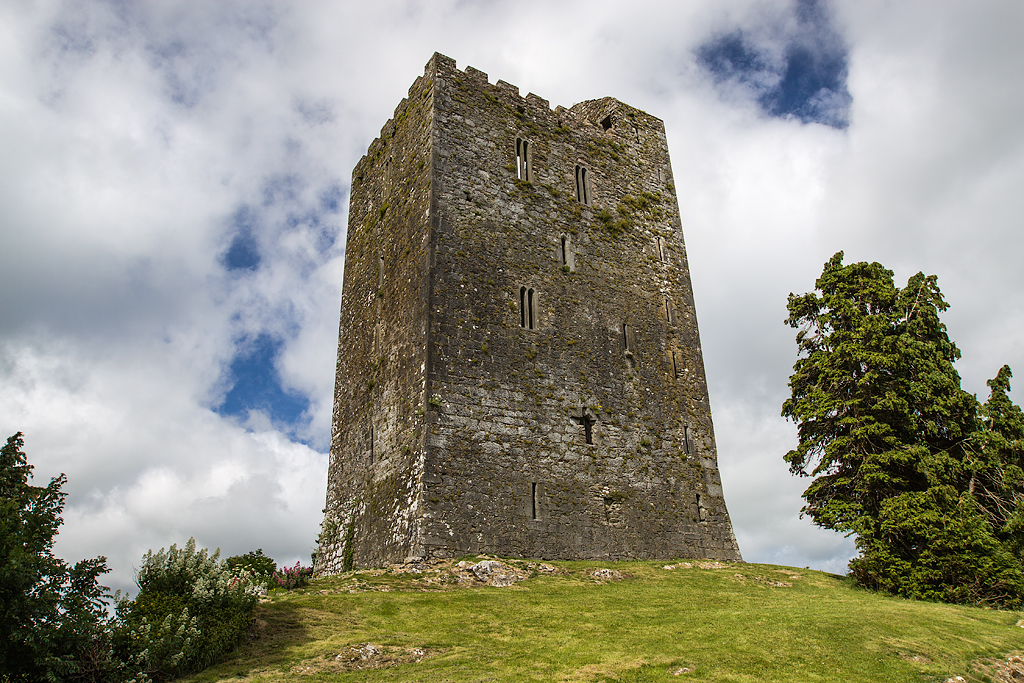
Sheanmore Castle

Sheanmore Castle: late medieval tower house in County Waterford
Shean More, United Kingdom
Late Medieval (14th–15th c.)

Sheanmore Castle is a late medieval tower house located in the townland of Shean More, within County Waterford, Ireland. This historic castle stands as a solitary ruin on private farmland, embodying the turbulent history of the region during the 15th and 16th centuries.

Historical background and ownership

The castle was likely constructed in the late 14th or early 15th century by the prominent Fitzgerald family, a powerful Anglo-Norman dynasty influential in Munster. The first documentary mention of Sheanmore Castle dates to 1420, confirming its existence as a fortified residence during the late medieval period.

Originally, Sheanmore Castle was a tower house surrounded by a bailey, a typical defensive feature of Irish castles of the era. Tower houses were fortified stone residences that combined domestic living quarters with defensive capabilities, reflecting the unsettled nature of the region at the time.

Architecture and defensive features

The castle's design as a tower house suggests a vertical, multi-storey structure with thick stone walls, narrow windows, and battlements or machicolations for defense. The surrounding bailey would have included ancillary buildings and a protective enclosure, enhancing the castle's defensibility against attacks.

Though now in ruins, Sheanmore Castle would have originally featured typical elements such as a great hall, private chambers, a spiral staircase, and possibly a bawn (walled courtyard). Its strategic location on farmland provided control over the surrounding territory.

Conflicts and sieges during the 16th century

Sheanmore Castle's history is marked by repeated conflicts during the Desmond Rebellions, a series of uprisings by the Fitzgeralds against English rule in Ireland. In 1571, during the First Desmond Rebellion, the castle was burnt by the forces of the Earl of Ormond, a rival noble aligned with the English crown.

Following this destruction, Maurice Fitzgerald of Shean rebuilt the castle, only for it to be sacked and burned again in 1580 by the same Earl of Ormond. These attacks reflect the intense local power struggles and the castle's significance as a stronghold.

Transition of ownership and further conflicts

In February 1587, the castle, along with its town and lands, came into the possession of Sir Walter Raleigh, a prominent English explorer and courtier. Raleigh began leasing the property to tenants, indicating a shift from direct noble residence to rental estate.

However, in 1598, during another period of rebellion, Gerald Fitzjames, son of James Fitzmaurice Fitzgerald, seized Sheanmore Castle from the tenant and re-established it as his home. Gerald's involvement in the rebellion placed him on the losing side, and by 1601 he surrendered the castle to obtain a pardon, returning ownership to Sir Walter Raleigh.

Decline and present condition

Despite several attempts by the Fitzgerald family to reclaim Sheanmore Castle in the following decades, the fortress fell into disuse and ruin by the mid-17th century. The castle's decline mirrors the broader political and social changes in Ireland during this period, including the consolidation of English control and the diminishing power of Gaelic and Anglo-Norman lords.

Today, Sheanmore Castle remains a lonely ruin on private farmland, accessible only with permission. Its surviving stonework offers a glimpse into the architectural style and defensive needs of a late medieval Irish tower house.

Significance and heritage

Sheanmore Castle is an important example of 15th-century Irish tower house architecture, illustrating the adaptation of fortifications to local conditions and the social status of the Fitzgerald family. Its history of destruction and rebuilding highlights the violent conflicts that shaped Ireland's late medieval and early modern periods.

As a ruin, it contributes to the cultural landscape of County Waterford and serves as a tangible link to the region's medieval past, reflecting the complex interplay between native Irish families and English colonial forces.

Frequently asked questions (FAQ)

How do I get to Sheanmore Castle?
Sheanmore Castle is located in Shean More, United Kingdom. You can reach the castle by car, with ample parking available nearby, or by public transport with local bus services operating in the area. Be sure to check the latest travel schedules for convenience.
What is the historical significance of Sheanmore Castle?
Sheanmore Castle has a rich history dating back to the early medieval period, serving as a stronghold for local clans. It played a significant role in regional conflicts and was a center of power in the area. Today, it stands as a testament to the architectural styles and historical narratives of its time.
When was Sheanmore Castle built?
Sheanmore Castle was constructed in the late 15th century, showcasing the defensive architecture of its era. Over the centuries, it has undergone various renovations, maintaining its historical charm while adapting to modern needs. Visitors can see remnants of its original structure alongside later additions.
Can I take guided tours of Sheanmore Castle?
Yes, guided tours are available at Sheanmore Castle, providing visitors with insightful information about its history and architecture. Tours typically run throughout the day, but it is advisable to book in advance during peak tourist seasons. Check the official website for specific times and tour details.
Why is the architecture of Sheanmore Castle noteworthy?
The architecture of Sheanmore Castle is noteworthy for its blend of medieval and Renaissance styles, reflecting the evolution of castle design in Britain. Its imposing towers and intricate stonework highlight the craftsmanship of the period. Visitors can appreciate the strategic layout that was designed for both defense and aesthetic appeal.
Is it possible to host events at Sheanmore Castle?
Yes, Sheanmore Castle offers facilities for hosting special events such as weddings, corporate gatherings, and private tours. The picturesque backdrop combined with the historical ambiance makes it a unique venue. Interested parties should contact the management for availability and booking options.
What are the opening hours for Sheanmore Castle?
Sheanmore Castle is open to visitors from 10 AM to 5 PM, Monday through Sunday. During peak seasons, hours may be extended, so it's a good idea to check for seasonal variations. Always verify the hours before your visit to ensure you have ample time to explore.
What are the ticket prices for visiting Sheanmore Castle?
Ticket prices for Sheanmore Castle are generally affordable, with discounts available for children, seniors, and families. Admission fees help maintain the castle and support preservation efforts. Check the official website for the most current pricing and any special offers.
What is the best time to visit Sheanmore Castle?
The best time to visit Sheanmore Castle is during the spring and autumn months when the weather is mild and the crowds are smaller. These seasons offer beautiful scenery, making your visit even more enjoyable. However, summer also attracts many tourists, so plan accordingly if you prefer a quieter experience.
What nearby attractions should I visit while at Sheanmore Castle?
While visiting Sheanmore Castle, consider exploring nearby attractions such as local museums, nature trails, and historical landmarks. The surrounding area offers scenic views and outdoor activities, perfect for a full day of adventure. Be sure to ask at the castle for recommendations tailored to your interests.

Loading map...

Visitor reviews

No reviews yet. Been here? Write the first review and help other travelers!

Write the first review

Visited this castle? Share your experience

Your review helps other travelers and adds first-hand knowledge to our encyclopedia.

Write a review

(5/5)

0/2000 characters

Your review will be visible after admin approval

Nearby castles

2.5 km

Ballyduff Barracks

Ballyduff Lower, United Kingdom

Ballyduff Barracks is situated just south of the village of Ballyduff in County Waterford, Ireland. Constructed in 1869, this building was originally designed as a barracks for the Royal Irish Constabulary (R.I.C.) during a period of significant agrarian unrest in Ireland. The barracks served as a small but strategic police station, intended to house a head constable and five men, and was positioned on an elevation overlooking the south bank of the River Blackwater. Its location was chosen to guard the southern approach to a nearby bridge, providing a defensive vantage point. Architectural style and design The barracks was designed by the Jacobs Brothers in the distinctive Scottish Baronial style, which is characterized by features reminiscent of medieval castles and tower houses. The building is rectangular in plan, with two square protruding turrets located at opposite corners. These turrets are notable for their machicolations—openings between the supporting corbels of the parapet used historically for defensive purposes—and several gun loops that allowed defenders to fire upon attackers while remaining protected. These defensive architectural elements underscore the building's function as a fortified police barracks rather than a traditional military fortress. Scottish Baronial influences The Scottish Baronial style was popular in the 19th century and often incorporated medieval motifs such as battlements, turrets, and ornamental stonework. At Ballyduff Barracks, the style was adapted to a modest scale suitable for a policing facility, combining practicality with a visually imposing presence intended to assert authority and security in a rural area experiencing social tensions. Historical context and use The construction of Ballyduff Barracks took place during a turbulent period in Irish history marked by agrarian agitation and unrest. The Royal Irish Constabulary, a paramilitary police force, was tasked with maintaining order, particularly in rural areas where tensions between tenant farmers and landlords were high. The barracks provided a secure base for law enforcement personnel charged with overseeing this sensitive region. There is a local legend that the plans for Ballyduff Barracks were originally intended for a building in India, but due to a mix-up, the barracks was constructed in Ballyduff instead. A similar story is associated with the R.I.C. barracks at Cahersiveen in County Kerry, known today as The Old Barracks. Transition to An Garda Síochána Following the establishment of the Irish Free State in 1922, Ballyduff Barracks continued to serve as a police station, this time under the newly formed An Garda Síochána, Ireland's national police service. The term "barracks" was gradually replaced in official use, reflecting the shift from a military-style force to a civilian police organization. Despite this change, the building remained an important local law enforcement facility for many decades. Physical features and current condition The barracks is a simple yet defensible structure, primarily constructed of stone with the characteristic turrets providing a fortified appearance. The machicolations and gun loops are functional defensive features that highlight the building's original role in security and policing. Currently, Ballyduff Barracks is no longer in active use. The last Garda personnel vacated the premises in 2013. Since then, the building has been maintained by the Office of Public Works, ensuring its preservation despite its empty status. The barracks stands as a well-preserved example of a late 19th-century police fortification in rural Ireland. Significance and legacy Ballyduff Barracks represents a unique example of Scottish Baronial architecture applied to a policing facility rather than a noble residence or military castle. Its construction reflects the social and political challenges of 19th-century Ireland, particularly the efforts of the Royal Irish Constabulary to maintain order during periods of unrest. The building's continued maintenance by the Office of Public Works underscores its cultural and historical importance. It offers insight into the architectural and law enforcement history of Ireland during a transformative era, bridging the gap between medieval-style fortifications and modern policing infrastructure.

Modern (19th–20th c.)
Details
4 km
Conna Castle — Ireland castle

Conna Castle

, Ireland

Conna Castle (Irish: Caisleán Chonaithe) is a 16th-century Renaissance tower house situated near the village of Conna in County Cork, Ireland. This castle exemplifies the typical Irish tower house construction of the late medieval period, serving both as a fortified residence and a symbol of local power during a turbulent era in Irish history. Historical context and significance Built in the 16th century, Conna Castle was constructed during a period marked by political unrest and frequent clan conflicts in Ireland. Tower houses like Conna were common across the Irish countryside, providing defensive strongholds for local chieftains and gentry. The castle’s location near Conna allowed control over the surrounding lands and served as a base for managing agricultural estates and local affairs. Conna Castle reflects the broader trend of Renaissance influence on Irish castle architecture, blending traditional defensive features with more comfortable residential elements. The castle’s construction corresponds with the late medieval to early modern transition in Ireland, a time when tower houses were adapted to new military technologies and social needs. Architectural features and construction Conna Castle is classified as a hill castle, positioned strategically on elevated ground to maximize defensive advantage and visibility over the surrounding landscape. The castle is a tower house, a vertical stone structure typically several storeys high, designed to be easily defensible while providing living quarters. The castle’s walls are constructed of thick stone masonry, characteristic of the period, with narrow slit windows that served both for light and arrow defense. The entrance is fortified, often featuring a heavy wooden door reinforced with iron. Inside, the castle would have contained a great hall, private chambers, a kitchen, and storage rooms arranged vertically. Defensive architectural elements likely include battlements, machicolations, and a bawn or enclosed courtyard, which would have provided additional protection and space for domestic activities. While specific details of Conna Castle’s layout are less documented, its typology aligns with other Irish Renaissance tower houses known for combining defense with residential comfort. Preservation and current condition Today, Conna Castle stands as a partially preserved ruin, retaining significant portions of its stone walls and tower structure. Its state reflects centuries of weathering and historical events, including possible damage from conflicts or neglect. Despite this, the castle remains an important cultural and architectural landmark in County Cork. The castle’s ruins attract visitors interested in Irish history and medieval architecture. Efforts to maintain the site focus on preserving its structural integrity while allowing public access to appreciate its historical context. Visiting Conna Castle and surrounding area Visitors to Conna Castle can explore the remains of this 16th-century tower house and enjoy views of the surrounding countryside. The castle’s rural setting offers insight into the defensive strategies and residential lifestyles of Irish gentry during the Renaissance. Nearby attractions in County Cork include other historic castles, natural landscapes, and cultural sites that complement a visit to Conna Castle. While facilities at the castle may be limited, the site’s historical significance and scenic location make it a worthwhile destination for enthusiasts of Irish heritage.

Renaissance (15th–17th c.)
Details
4 km

Conna Castle

Next to the R-628 road, United Kingdom

Conna Castle is a striking example of a 16th-century Irish tower house located in the village of Conna, County Cork, Ireland. Perched atop a limestone outcrop overlooking a bend in the River Bride, the castle's strategic position provided commanding views and defensive advantages over the surrounding landscape. Built primarily from locally quarried limestone, the castle stands as a testament to the turbulent history and architectural traditions of Renaissance-era Ireland. The origins of Conna Castle date back to the early 16th century, likely constructed in the first half of the century by the powerful FitzGerald family, the Earls of Desmond, who were influential Anglo-Norman nobles in Munster. The castle was established as a fortified residence and stronghold, featuring a sturdy five-storey tower house typical of the period. This tower was originally enclosed by a bawn, a defensive walled courtyard designed to protect inhabitants and livestock during attacks, although only fragments of the bawn remain today. Historical significance and ownership The fitzgerald dynasty and early history The castle was built by Thomas Ruadh fitz James FitzGerald, an illegitimate son of the 13th Earl of Desmond, around 1560-1561. Thomas resided at Conna Castle during the 16th century, and his son, James FitzThomas FitzGerald, known as the Sugán Earl or "Straw Earl," was born here. James played a prominent role in the Nine Years' War (1594–1603), a major Irish conflict opposing English rule. After his capture, James was imprisoned in the Tower of London, where he died in 1608, marking the decline of the FitzGeralds' control over the castle. 17th-century conflicts and changes in ownership Following the fall of the FitzGeralds, King James I granted Conna Castle to Sir Richard Boyle, Earl of Cork, who undertook repairs around 1620. The castle endured military action during the Irish Confederate Wars, withstanding a siege in 1642 and falling to Lord Castlehaven in 1645. In 1650, it resisted cannon fire from Cromwellian troops, but a devastating fire in 1653 caused significant damage. Despite this, the castle was repaired and may have remained roofed until the late 19th century. Later history and modern era In the 19th century, the castle changed hands to private owners, including the L’Estrange family. Notably, Alfred G.K. L’Estrange donated the castle to the Local Government Board of Ireland, marking an early example of historic preservation under public stewardship. In the late 20th century, Conna Castle served as a venue for outdoor concerts, reflecting its role as a community landmark. However, since 2015, the castle has been closed for restoration by the Office of Public Works and remains inaccessible to the public as of early 2022. Architectural features and remains Tower house construction and layout The castle is a classic example of a Renaissance Irish tower house, characterized by its vertical emphasis and defensive features. The main structure is a five-storey tower constructed of thick limestone walls, designed to withstand sieges and harsh weather. The tower includes narrow windows and defensive elements such as battlements and machicolations, typical of fortified residences of the period. Bawn and defensive structures Surrounding the tower was a bawn, a fortified enclosure that provided additional protection for inhabitants and their livestock. Although only small fragments of the bawn survive, its presence is indicative of the castle's role as both a military stronghold and a domestic residence. Adjacent remains of a smaller corner tower suggest layered defenses around the perimeter. Strategic location and natural defenses Conna Castle's placement atop a limestone outcrop overlooking the River Bride afforded natural defensive advantages. The river's bend below the castle created a natural moat-like feature, enhancing security and control over river traffic and surrounding lands. This strategic siting reflects the military and administrative importance of the castle during its active use. Cultural and heritage importance Today, Conna Castle stands as a significant monument to the history of Munster and the legacy of the FitzGerald family. It embodies the architectural and historical complexities of Irish tower houses during the Renaissance period, showcasing the blend of domestic comfort and military fortification. The castle's enduring stone walls and historical associations contribute to its status as a cherished heritage site. The castle is located within a small public park in the village of Conna, freely accessible to visitors who can explore its exterior and surrounding grounds. However, the castle itself remains closed to the public, with its interior and upper floors inaccessible, preserving its fragile state while restoration efforts continue. Conna Castle's history of sieges, ownership changes, and survival through conflict reflects the broader narrative of Ireland's turbulent past. Its preservation offers valuable insights into the social, political, and architectural developments of the 16th and 17th centuries. Visitors interested in Irish history and medieval architecture will find Conna Castle a compelling site, rich with stories of noble families, military struggles, and cultural transformation.

Renaissance (15th–17th c.)
Details