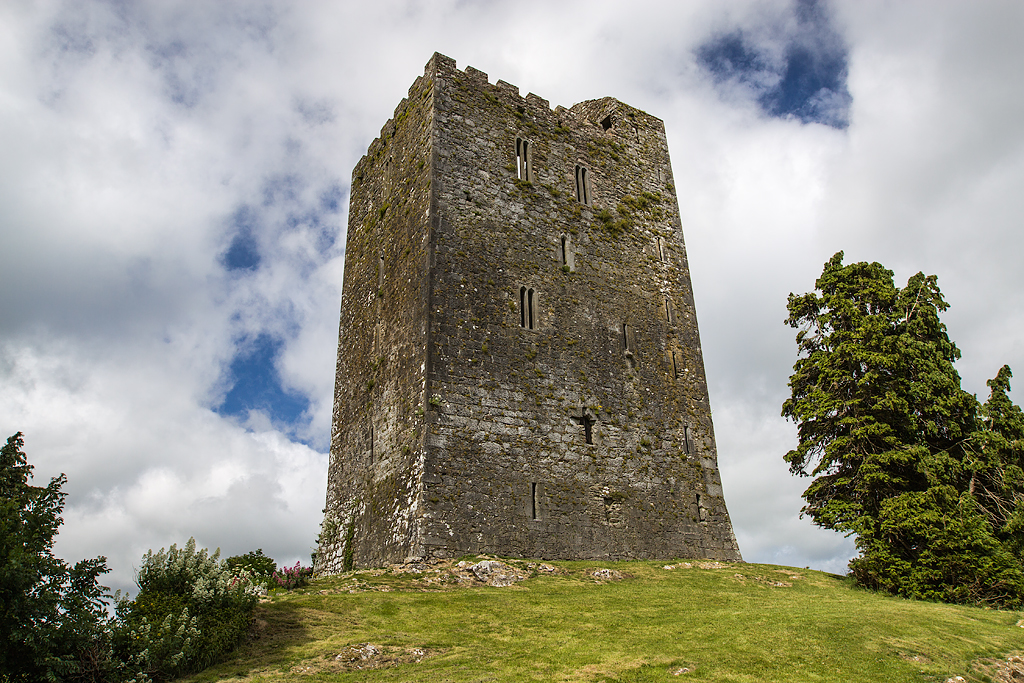
Conna Castle
Conna Castle is a striking example of a 16th-century Irish tower house located in the village of Conna, County Cork, Ireland. Perched atop a limestone outcrop overlooking a bend in the River Bride, the castle's strategic position provided commanding views and defensive advantages over the surrounding landscape. Built primarily from locally quarried limestone, the castle stands as a testament to the turbulent history and architectural traditions of Renaissance-era Ireland.
The origins of Conna Castle date back to the early 16th century, likely constructed in the first half of the century by the powerful FitzGerald family, the Earls of Desmond, who were influential Anglo-Norman nobles in Munster. The castle was established as a fortified residence and stronghold, featuring a sturdy five-storey tower house typical of the period. This tower was originally enclosed by a bawn, a defensive walled courtyard designed to protect inhabitants and livestock during attacks, although only fragments of the bawn remain today.
Historical significance and ownership
The fitzgerald dynasty and early history
The castle was built by Thomas Ruadh fitz James FitzGerald, an illegitimate son of the 13th Earl of Desmond, around 1560-1561. Thomas resided at Conna Castle during the 16th century, and his son, James FitzThomas FitzGerald, known as the Sugán Earl or "Straw Earl," was born here. James played a prominent role in the Nine Years' War (1594–1603), a major Irish conflict opposing English rule. After his capture, James was imprisoned in the Tower of London, where he died in 1608, marking the decline of the FitzGeralds' control over the castle.
17th-century conflicts and changes in ownership
Following the fall of the FitzGeralds, King James I granted Conna Castle to Sir Richard Boyle, Earl of Cork, who undertook repairs around 1620. The castle endured military action during the Irish Confederate Wars, withstanding a siege in 1642 and falling to Lord Castlehaven in 1645. In 1650, it resisted cannon fire from Cromwellian troops, but a devastating fire in 1653 caused significant damage. Despite this, the castle was repaired and may have remained roofed until the late 19th century.
Later history and modern era
In the 19th century, the castle changed hands to private owners, including the L’Estrange family. Notably, Alfred G.K. L’Estrange donated the castle to the Local Government Board of Ireland, marking an early example of historic preservation under public stewardship. In the late 20th century, Conna Castle served as a venue for outdoor concerts, reflecting its role as a community landmark. However, since 2015, the castle has been closed for restoration by the Office of Public Works and remains inaccessible to the public as of early 2022.
Architectural features and remains
Tower house construction and layout
The castle is a classic example of a Renaissance Irish tower house, characterized by its vertical emphasis and defensive features. The main structure is a five-storey tower constructed of thick limestone walls, designed to withstand sieges and harsh weather. The tower includes narrow windows and defensive elements such as battlements and machicolations, typical of fortified residences of the period.
Bawn and defensive structures
Surrounding the tower was a bawn, a fortified enclosure that provided additional protection for inhabitants and their livestock. Although only small fragments of the bawn survive, its presence is indicative of the castle's role as both a military stronghold and a domestic residence. Adjacent remains of a smaller corner tower suggest layered defenses around the perimeter.
Strategic location and natural defenses
Conna Castle's placement atop a limestone outcrop overlooking the River Bride afforded natural defensive advantages. The river's bend below the castle created a natural moat-like feature, enhancing security and control over river traffic and surrounding lands. This strategic siting reflects the military and administrative importance of the castle during its active use.
Cultural and heritage importance
Today, Conna Castle stands as a significant monument to the history of Munster and the legacy of the FitzGerald family. It embodies the architectural and historical complexities of Irish tower houses during the Renaissance period, showcasing the blend of domestic comfort and military fortification. The castle's enduring stone walls and historical associations contribute to its status as a cherished heritage site.
The castle is located within a small public park in the village of Conna, freely accessible to visitors who can explore its exterior and surrounding grounds. However, the castle itself remains closed to the public, with its interior and upper floors inaccessible, preserving its fragile state while restoration efforts continue.
Conna Castle's history of sieges, ownership changes, and survival through conflict reflects the broader narrative of Ireland's turbulent past. Its preservation offers valuable insights into the social, political, and architectural developments of the 16th and 17th centuries.
Visitors interested in Irish history and medieval architecture will find Conna Castle a compelling site, rich with stories of noble families, military struggles, and cultural transformation.
Frequently asked questions (FAQ)
- How do I visit Conna Castle?
- Conna Castle is located in a small public park in the village of Conna, County Cork, Ireland. While the park is freely accessible, the castle itself is currently closed to the public for restoration. Visitors can explore the exterior and surrounding grounds at any time.
- What is the historical significance of Conna Castle?
- Conna Castle was built in the 16th century by the FitzGerald family, Earls of Desmond, and played a key role in Irish history, including the Nine Years' War and the Irish Confederate Wars. It reflects the turbulent history of Munster and the legacy of powerful Anglo-Norman nobles.
- When was Conna Castle built?
- Conna Castle was constructed in the first half of the 16th century, around 1560-1561, by Thomas Ruadh fitz James FitzGerald, an illegitimate son of the 13th Earl of Desmond.
- Is Conna Castle accessible inside?
- Currently, Conna Castle is closed to the public and its interior is not accessible due to ongoing restoration efforts. Visitors can view the castle's exterior and grounds but cannot enter the building.
- What architectural features does Conna Castle have?
- Conna Castle is a five-storey Renaissance Irish tower house built of limestone, featuring defensive elements such as battlements, narrow windows, and a surrounding bawn. These features reflect its dual role as a residence and a fortress.
Information
Address
Next to the R-628 road, United Kingdom of Great Britain and Northern Ireland
Loading map...
Visitor reviews
No reviews yet. Been here? Write the first review and help other travelers!
Write the first reviewVisited this castle? Share your experience
Your review helps other travelers and adds first-hand knowledge to our encyclopedia.