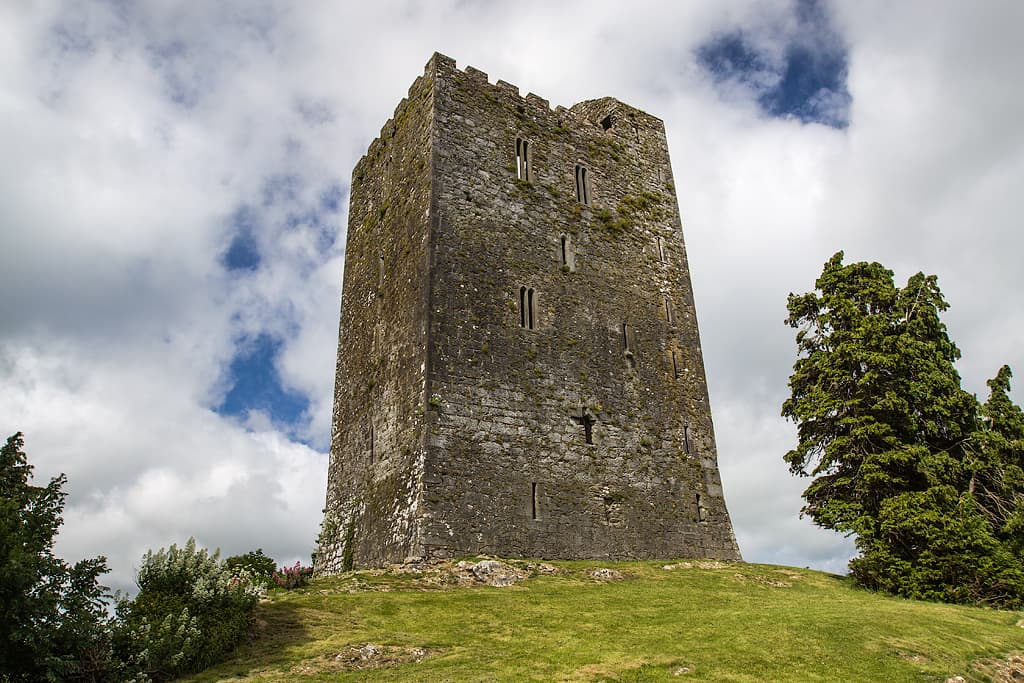
Conna Castle
Conna Castle (Irish: Caisleán Chonaithe) is a 16th-century Renaissance tower house situated near the village of Conna in County Cork, Ireland. This castle exemplifies the typical Irish tower house construction of the late medieval period, serving both as a fortified residence and a symbol of local power during a turbulent era in Irish history.
Historical context and significance
Built in the 16th century, Conna Castle was constructed during a period marked by political unrest and frequent clan conflicts in Ireland. Tower houses like Conna were common across the Irish countryside, providing defensive strongholds for local chieftains and gentry. The castle’s location near Conna allowed control over the surrounding lands and served as a base for managing agricultural estates and local affairs.
Conna Castle reflects the broader trend of Renaissance influence on Irish castle architecture, blending traditional defensive features with more comfortable residential elements. The castle’s construction corresponds with the late medieval to early modern transition in Ireland, a time when tower houses were adapted to new military technologies and social needs.
Architectural features and construction
Conna Castle is classified as a hill castle, positioned strategically on elevated ground to maximize defensive advantage and visibility over the surrounding landscape. The castle is a tower house, a vertical stone structure typically several storeys high, designed to be easily defensible while providing living quarters.
The castle’s walls are constructed of thick stone masonry, characteristic of the period, with narrow slit windows that served both for light and arrow defense. The entrance is fortified, often featuring a heavy wooden door reinforced with iron. Inside, the castle would have contained a great hall, private chambers, a kitchen, and storage rooms arranged vertically.
Defensive architectural elements likely include battlements, machicolations, and a bawn or enclosed courtyard, which would have provided additional protection and space for domestic activities. While specific details of Conna Castle’s layout are less documented, its typology aligns with other Irish Renaissance tower houses known for combining defense with residential comfort.
Preservation and current condition
Today, Conna Castle stands as a partially preserved ruin, retaining significant portions of its stone walls and tower structure. Its state reflects centuries of weathering and historical events, including possible damage from conflicts or neglect. Despite this, the castle remains an important cultural and architectural landmark in County Cork.
The castle’s ruins attract visitors interested in Irish history and medieval architecture. Efforts to maintain the site focus on preserving its structural integrity while allowing public access to appreciate its historical context.
Visiting Conna Castle and surrounding area
Visitors to Conna Castle can explore the remains of this 16th-century tower house and enjoy views of the surrounding countryside. The castle’s rural setting offers insight into the defensive strategies and residential lifestyles of Irish gentry during the Renaissance.
Nearby attractions in County Cork include other historic castles, natural landscapes, and cultural sites that complement a visit to Conna Castle. While facilities at the castle may be limited, the site’s historical significance and scenic location make it a worthwhile destination for enthusiasts of Irish heritage.
Frequently asked questions (FAQ)
- What is the historical significance of Conna Castle?
- Conna Castle, built in the 15th century, is a remarkable example of medieval architecture in Ireland. It played a vital role during the tumultuous times of the English and Irish conflicts, serving as a stronghold for various noble families throughout its history.
- When was Conna Castle built?
- Conna Castle was constructed in the late 1400s, likely around 1460. Its strategic location and robust design were key to its purpose as a defensive structure during its early years.
- What are the opening hours for Conna Castle?
- Conna Castle is open to visitors from 10 AM to 6 PM daily during the peak tourist season, which typically runs from April to October. During the off-peak season, hours may vary, so it's advisable to check ahead before planning your visit.
- Is it possible to access Conna Castle with mobility aids?
- While Conna Castle has some areas accessible for visitors with mobility aids, the uneven terrain and narrow passages may pose challenges. It is recommended to contact the castle management in advance to discuss any specific accessibility needs and available accommodations.
- Can I purchase tickets in advance for Conna Castle?
- Yes, tickets for Conna Castle can be purchased online in advance to avoid queues and ensure entry during busy periods. It's a convenient option, especially during peak tourist seasons when visitor numbers can be high.
- What is the best time to visit Conna Castle?
- The best time to visit Conna Castle is during the spring and early autumn months, from April to June and September to October. During these times, the weather is generally mild, and the castle is less crowded, allowing for a more enjoyable experience.
- Are there any nearby attractions to visit along with Conna Castle?
- Yes, visitors to Conna Castle can explore several nearby attractions, including the picturesque village of Conna and the scenic landscapes of County Cork. Additionally, the historic towns of Youghal and Fermoy are just a short drive away, offering more insights into the region's rich heritage.
- How do I get to Conna Castle?
- Conna Castle is easily accessible by car, located just off the N8 road, which connects Cork and Dublin. Public transportation options are limited, so driving or arranging a taxi may be the most convenient way to reach the castle.
Photo gallery

Information
Loading map...
Visitor reviews
No reviews yet. Been here? Write the first review and help other travelers!
Write the first reviewVisited this castle? Share your experience
Your review helps other travelers and adds first-hand knowledge to our encyclopedia.



