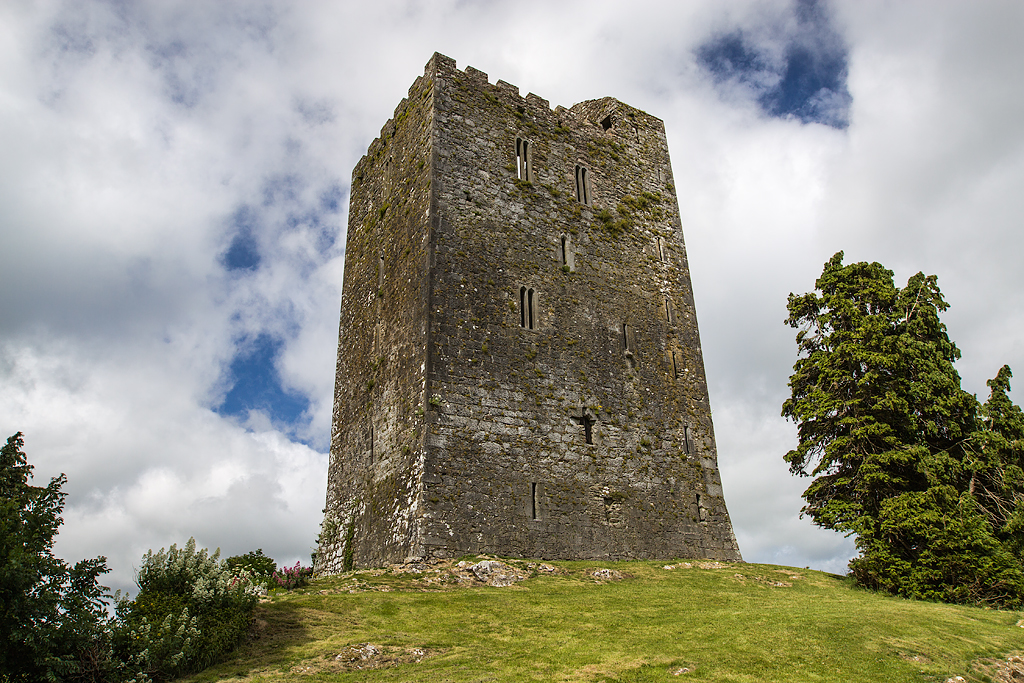
Ballyduff Barracks
Ballyduff Barracks is situated just south of the village of Ballyduff in County Waterford, Ireland. Constructed in 1869, this building was originally designed as a barracks for the Royal Irish Constabulary (R.I.C.) during a period of significant agrarian unrest in Ireland. The barracks served as a small but strategic police station, intended to house a head constable and five men, and was positioned on an elevation overlooking the south bank of the River Blackwater. Its location was chosen to guard the southern approach to a nearby bridge, providing a defensive vantage point.
Architectural style and design
The barracks was designed by the Jacobs Brothers in the distinctive Scottish Baronial style, which is characterized by features reminiscent of medieval castles and tower houses. The building is rectangular in plan, with two square protruding turrets located at opposite corners. These turrets are notable for their machicolations—openings between the supporting corbels of the parapet used historically for defensive purposes—and several gun loops that allowed defenders to fire upon attackers while remaining protected. These defensive architectural elements underscore the building's function as a fortified police barracks rather than a traditional military fortress.
Scottish Baronial influences
The Scottish Baronial style was popular in the 19th century and often incorporated medieval motifs such as battlements, turrets, and ornamental stonework. At Ballyduff Barracks, the style was adapted to a modest scale suitable for a policing facility, combining practicality with a visually imposing presence intended to assert authority and security in a rural area experiencing social tensions.
Historical context and use
The construction of Ballyduff Barracks took place during a turbulent period in Irish history marked by agrarian agitation and unrest. The Royal Irish Constabulary, a paramilitary police force, was tasked with maintaining order, particularly in rural areas where tensions between tenant farmers and landlords were high. The barracks provided a secure base for law enforcement personnel charged with overseeing this sensitive region.
There is a local legend that the plans for Ballyduff Barracks were originally intended for a building in India, but due to a mix-up, the barracks was constructed in Ballyduff instead. A similar story is associated with the R.I.C. barracks at Cahersiveen in County Kerry, known today as The Old Barracks.
Transition to An Garda Síochána
Following the establishment of the Irish Free State in 1922, Ballyduff Barracks continued to serve as a police station, this time under the newly formed An Garda Síochána, Ireland's national police service. The term "barracks" was gradually replaced in official use, reflecting the shift from a military-style force to a civilian police organization. Despite this change, the building remained an important local law enforcement facility for many decades.
Physical features and current condition
The barracks is a simple yet defensible structure, primarily constructed of stone with the characteristic turrets providing a fortified appearance. The machicolations and gun loops are functional defensive features that highlight the building's original role in security and policing.
Currently, Ballyduff Barracks is no longer in active use. The last Garda personnel vacated the premises in 2013. Since then, the building has been maintained by the Office of Public Works, ensuring its preservation despite its empty status. The barracks stands as a well-preserved example of a late 19th-century police fortification in rural Ireland.
Significance and legacy
Ballyduff Barracks represents a unique example of Scottish Baronial architecture applied to a policing facility rather than a noble residence or military castle. Its construction reflects the social and political challenges of 19th-century Ireland, particularly the efforts of the Royal Irish Constabulary to maintain order during periods of unrest.
The building's continued maintenance by the Office of Public Works underscores its cultural and historical importance. It offers insight into the architectural and law enforcement history of Ireland during a transformative era, bridging the gap between medieval-style fortifications and modern policing infrastructure.
Frequently asked questions (FAQ)
- What is the historical significance of Ballyduff Barracks?
- Ballyduff Barracks was built in 1869 for the Royal Irish Constabulary during a period of agrarian unrest in Ireland. It later served as a station for An Garda Síochána, reflecting the transition from British to Irish policing.
- Can visitors tour Ballyduff Barracks?
- Currently, Ballyduff Barracks is not open to the public as it has been vacant since 2013. However, it is maintained by the Office of Public Works for preservation.
- What architectural style is Ballyduff Barracks built in?
- The barracks was designed in the Scottish Baronial style, featuring characteristic turrets with machicolations and gun loops, blending medieval defensive elements with 19th-century police architecture.
- Where is Ballyduff Barracks located?
- Ballyduff Barracks is located south of the village of Ballyduff, in County Waterford, Ireland, on the south bank of the River Blackwater.
- When was Ballyduff Barracks constructed?
- The barracks was constructed in 1869, during the late 19th century, as part of efforts to strengthen law enforcement in rural Ireland.
Information
Architect
Jacobs Brothers
Current owner
Office of Public Works
Loading map...
Visitor reviews
No reviews yet. Been here? Write the first review and help other travelers!
Write the first reviewVisited this castle? Share your experience
Your review helps other travelers and adds first-hand knowledge to our encyclopedia.