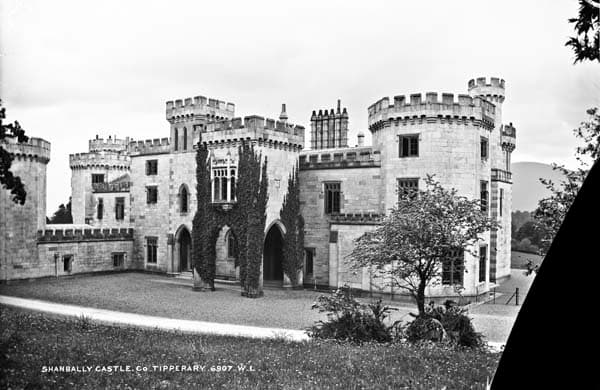
Shanbally Castle
Shanbally Castle was a prominent 19th-century hill castle located near Clogheen in County Tipperary, Ireland. Constructed around 1810, it was commissioned by Cornelius O'Callaghan, 1st Viscount Lismore, a notable Irish nobleman. The castle was designed by the renowned English architect John Nash, famed for his work on London's Regent Street and Buckingham Palace enhancements. Shanbally Castle was distinguished as the largest house ever built in Ireland by Nash, exemplifying the grandeur and scale of early 19th-century aristocratic residences.
Architectural design and style
Shanbally Castle was a remarkable example of early 19th-century architecture blending elements of the neo-gothic and romantic revival styles popular at the time. Nash incorporated castellated features such as battlemented parapets, towers, and turrets that gave the building a fortress-like appearance, while maintaining the comfort and elegance of a stately home. The castle's layout included expansive drawing rooms, ballrooms, and extensive service wings, reflecting the lifestyle of the Irish aristocracy during the period.
Notable architectural features
- Grand entrance gate with ornate stonework and heraldic motifs
- High crenellated towers providing panoramic views of the surrounding countryside
- Large windows with pointed arches typical of the neo-gothic style
- Spacious courtyards and formal gardens surrounding the castle
Historical context and ownership
The castle was built during a period when the Irish aristocracy sought to express their wealth and status through grand country houses designed in revivalist styles. Cornelius O'Callaghan, the 1st Viscount Lismore, was a prominent landowner and politician, and Shanbally Castle served as the family seat for several decades.
In the mid-20th century, the castle's fate changed dramatically. The Irish Land Commission acquired the property in 1954 as part of land redistribution efforts following Irish independence. Despite its architectural significance, Shanbally Castle was controversially demolished on 21 March 1960. The demolition reflected the broader decline of many aristocratic estates in Ireland during this era, driven by economic changes and shifting social structures.
Legacy and cultural significance
Although Shanbally Castle no longer stands, it remains an important part of Ireland's architectural heritage. Its design by John Nash links it to the broader narrative of British and Irish aristocratic architecture in the 19th century. The castle's demolition is often cited as a significant loss to Ireland's built heritage, illustrating the challenges faced in preserving large country houses during the 20th century.
Today, the site of Shanbally Castle is a subject of historical interest, with remnants and landscape features still visible to visitors and researchers. The story of Shanbally Castle contributes to understanding the social, political, and architectural history of Ireland during a period of profound change.
Visiting the site
While the castle itself was demolished, the surrounding area near Clogheen in County Tipperary offers scenic views and opportunities for exploring the Irish countryside. Visitors interested in Ireland's castle heritage can explore nearby historic sites and enjoy the natural landscape that once framed Shanbally Castle.
Frequently asked questions (FAQ)
- When was Shanbally Castle built and by whom?
- Shanbally Castle was built around 1810 for Cornelius O'Callaghan, 1st Viscount Lismore, and designed by the English architect John Nash.
- What architectural style characterizes Shanbally Castle?
- The castle showcased a blend of neo-gothic and romantic revival styles, featuring battlemented parapets, towers, and pointed arch windows.
- Why was Shanbally Castle demolished?
- Despite its architectural significance, Shanbally Castle was demolished in 1960 after being acquired by the Irish Land Commission, reflecting economic and social shifts in mid-20th-century Ireland.
- Can visitors see Shanbally Castle today?
- The castle itself no longer exists, but visitors can explore the surrounding landscape near Clogheen, County Tipperary, where remnants and the castle's site remain visible.
- Who currently owns the Shanbally Castle site?
- The site is owned by the Irish Land Commission, which acquired the property in 1954 during land redistribution efforts.
Photo gallery

Public domain
Information
Current owner
Irish Land Commission
Loading map...
Visitor reviews
No reviews yet. Been here? Write the first review and help other travelers!
Write the first reviewVisited this castle? Share your experience
Your review helps other travelers and adds first-hand knowledge to our encyclopedia.


