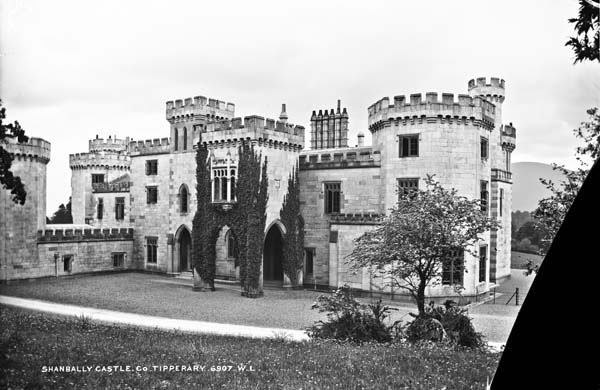
Burncourt Castle
Burncourt Castle is a notable 17th-century fortified house located east of the village of Burncourt in County Tipperary, Ireland. Constructed beginning in 1639, it was built for Richard Everard, 1st Baronet of Ballyboy, and originally known as Everard's Castle. This castle exemplifies the architectural transition from medieval defensive structures to more comfortable fortified residences during the early modern period in Ireland.
Construction and architectural features
The castle was designed as a rectangular main block flanked by square corner towers, a common feature in fortified houses of the period, combining residential comfort with defensive capabilities. Both the front and back gables of the main block were fitted with corbels that supported machicolations, openings through which defenders could drop projectiles or boiling substances on attackers below. This defensive feature reflects the turbulent times during which the castle was built.
The structure's symmetry and layout suggest a careful balance between aesthetic considerations and military utility. The use of machicolations, along with thick stone walls, was intended to deter or withstand assaults, while the overall design allowed for a more domestic lifestyle than earlier medieval castles.
Historical context and significance
Burncourt Castle was completed just as Ireland was entering a period of intense conflict. Richard Everard moved into the castle in 1641, the year the Irish Rebellion of 1641 broke out. This rebellion led to a prolonged period of warfare and political upheaval across Ireland.
Sir Richard Everard aligned himself with the Catholic Confederates based in Kilkenny in 1642, a faction that sought to defend Catholic interests during the rebellion. Meanwhile, his wife, Lady Catherine, remained at Burncourt Castle during these turbulent years.
The castle's fate was sealed during the Cromwellian conquest of Ireland. There are differing accounts of its destruction: one states that Lady Catherine deliberately set fire to the castle in 1649 to prevent its capture by Oliver Cromwell's advancing forces. Another account suggests the castle was seized by Cromwell's troops in January 1650, who then garrisoned it and may have been responsible for its burning. Regardless of the exact circumstances, the castle was never restored and has remained a ruin ever since.
The castle's name evolved from "Everard's Castle" to Burncourt, a contraction referencing the burning that led to its ruinous state.
Current condition and access
Today, Burncourt Castle stands as a well-preserved ruin on private property, surrounded by a farm and residence. The ruins retain significant elements of the original structure, including the main block and corner towers, allowing visitors to appreciate its symmetrical design and defensive features.
Access to the castle is restricted as it is situated on private land and is not open for general public visitation. However, permission from the owners has occasionally allowed visitors to explore the site and photograph the ruins, which remain a striking example of early 17th-century fortified house architecture in Ireland.
Architectural and cultural importance
Burncourt Castle represents a significant phase in Irish castle architecture, marking the shift from medieval fortresses to fortified houses that combined defense with domestic comfort. Its machicolations and corner towers demonstrate the lingering need for protection during a period of political instability.
The castle's history is closely tied to the Irish Confederate Wars and the Cromwellian conquest, events that reshaped Ireland's political and social landscape in the mid-17th century. As such, Burncourt Castle is not only an architectural landmark but also a witness to a pivotal era in Irish history.
Frequently asked questions (FAQ)
- How do I visit Burncourt Castle?
- Burncourt Castle is located on private property and is not open to the public. Visitors can only access the site with permission from the owners, so it is recommended to arrange visits in advance.
- What is the historical significance of Burncourt Castle?
- Burncourt Castle was built in 1639 for Richard Everard and played a role during the Irish Rebellion of 1641 and the Cromwellian conquest. It reflects the turbulent history of 17th-century Ireland.
- What architectural features does Burncourt Castle have?
- The castle features a rectangular main block with square corner towers and machicolations supported by corbels on the gables, typical of fortified houses designed for both defense and residence.
- When was Burncourt Castle destroyed?
- The castle was burned down around 1649 or 1650 during the Cromwellian conquest, either by Lady Catherine Everard to prevent its capture or by Cromwell's garrison after seizure.
- Is Burncourt Castle accessible for photography?
- Photography is possible only with the permission of the private owners, as the castle is on private land and not freely accessible to visitors.
Information
Current owner
Private owner
Loading map...
Visitor reviews
No reviews yet. Been here? Write the first review and help other travelers!
Write the first reviewVisited this castle? Share your experience
Your review helps other travelers and adds first-hand knowledge to our encyclopedia.