Ballyboy Castle
Ballyboy Castle is a medieval ruin located in the townland of Ballyboy East, County Tipperary, Ireland. Constructed in the 13th century, this structure is believed to have functioned primarily as a hall house rather than a traditional fortified castle. It is situated on a steep natural rise on the north bank of the River Tar, a strategic position that provided both defensive advantage and control over the surrounding landscape.
Architectural characteristics and site layout
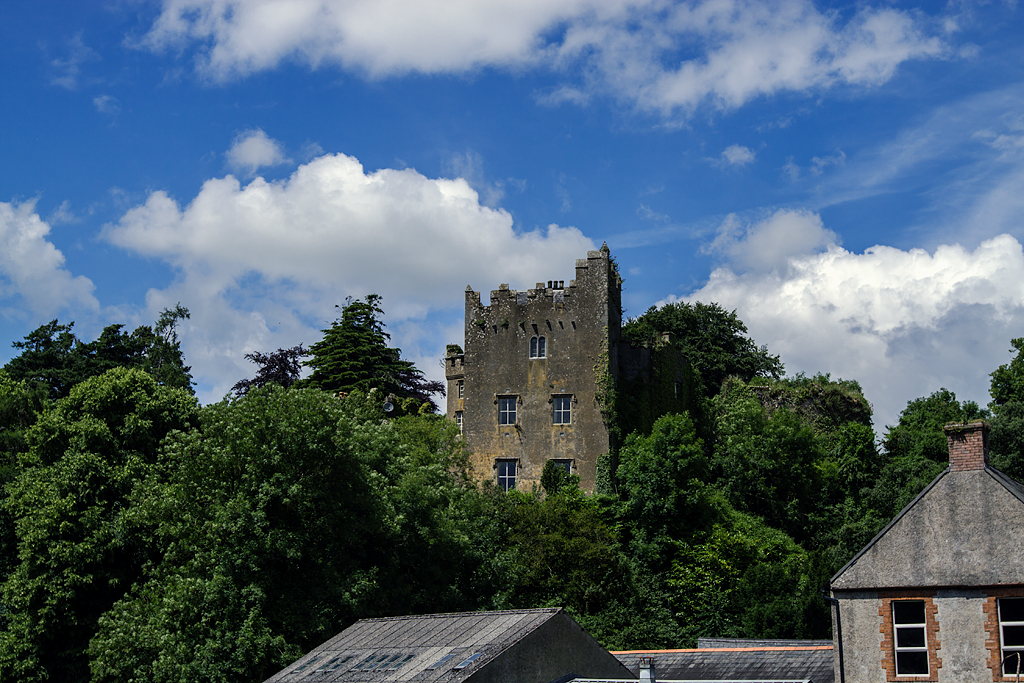
The remains of Ballyboy Castle today are heavily overgrown, which obscures many of its original architectural features. However, the castle's elevated position on a natural rise is typical of High Medieval defensive constructions in Ireland, designed to maximize visibility and protection. The castle likely consisted of a central hall structure, which was common in the 13th century for residences of local lords or important families. Unlike larger stone fortresses, hall houses combined living quarters with some defensive elements but were not primarily military strongholds.
Adjacent to the castle ruins is a bawn wall, an enclosure wall typical of Irish castles, which would have provided an additional layer of defense or demarcated the castle's immediate grounds. The castle's stone was later repurposed as a quarry, contributing to the current ruinous state.
Historical context and ownership
Historical records indicate that Ballyboy Castle was inhabited during the first half of the 17th century by the Everard family, a notable local lineage. Documents from that period describe the castle as "a castle covered with thatch without repaire," suggesting it had fallen into disuse or was in poor condition by then. It remains unclear whether this description referred to the medieval castle itself or to the newer 16th-century Ballyboy House, which was constructed approximately 50 meters north of the castle ruins.
The Everards vacated Ballyboy in 1641, relocating to their new residence, Burncourt Castle. This move likely marked the final abandonment of Ballyboy Castle as a primary dwelling.
The transition from castle to house and subsequent decline
In the 16th century, the construction of Ballyboy House near the original castle site reflected changing architectural and residential preferences. The shift from fortified castles to more comfortable manor houses was common in Ireland during this period, as military threats lessened and domestic needs evolved. Ballyboy Castle's decline into ruin and use as a stone quarry followed this trend.
Today, the castle ruins are located within the garden grounds of Ballyboy House, blending historical layers of habitation on the site. The ruins are accessible primarily to guests of Ballyboy House accommodation or by special permission from the current owner, preserving the site's privacy and condition.
Visiting Ballyboy Castle
Visitors interested in exploring Ballyboy Castle should be aware that the site is not a typical public tourist attraction and is somewhat hidden within the grounds of Ballyboy House. The overgrown state of the ruins means that architectural details are minimal, but the location offers a tangible connection to medieval Irish history and the evolution of local noble residences.
Exploring the castle provides insight into the High Medieval period in Ireland, the lifestyle of local gentry, and the gradual transition from fortified castles to manor houses in the early modern era.
Frequently asked questions (FAQ)
- How do I visit Ballyboy Castle?
- Ballyboy Castle is located within the grounds of Ballyboy House and can be visited by guests staying there or with the owner's permission. It is not generally open to the public for independent visits.
- What is the historical significance of Ballyboy Castle?
- Ballyboy Castle dates back to the 13th century and represents a typical High Medieval hall house in Ireland. It reflects the architectural and social transitions from fortified castles to manor houses in the region.
- When was Ballyboy Castle abandoned?
- The castle was likely abandoned in the 16th century following the construction of Ballyboy House nearby. It was still inhabited in the early 17th century but fell into disrepair and was no longer a primary residence after 1641.
- What architectural features remain at Ballyboy Castle?
- The ruins are heavily overgrown, and few architectural details are visible. The site includes a natural rise, a bawn wall, and remnants of the hall house structure typical of the 13th century.
- Is Ballyboy Castle accessible for visitors with mobility issues?
- Due to its ruinous and overgrown condition, Ballyboy Castle may not be easily accessible for visitors with mobility challenges. Visitors should inquire in advance about accessibility options when arranging a visit.
Information
Loading map...
Visitor reviews
No reviews yet. Been here? Write the first review and help other travelers!
Write the first reviewVisited this castle? Share your experience
Your review helps other travelers and adds first-hand knowledge to our encyclopedia.