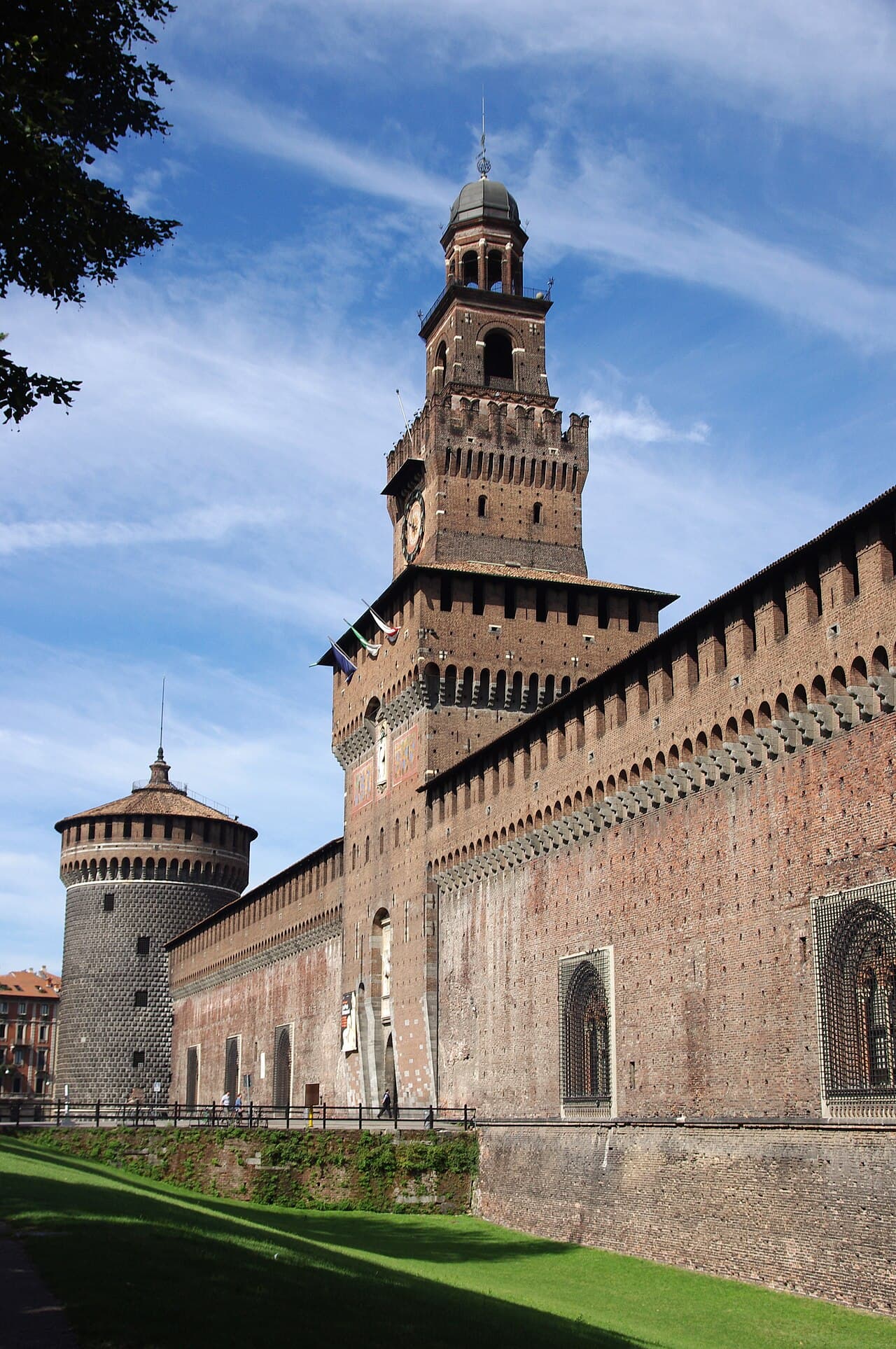
Sforza Castle
Sforza Castle stands as one of the most iconic landmarks of Milan, embodying centuries of history and architectural evolution. Originally constructed in the 14th century by the Visconti family, the fortress was transformed in the 15th century into a grand ducal residence by Francesco Sforza, Duke of Milan. The castle’s strategic location near the city’s defensive walls and its imposing square layout with four corner towers symbolized the power and prestige of Milan’s ruling families.
The castle’s history is deeply intertwined with the cultural flourishing of the Italian Renaissance. Under the patronage of Ludovico Sforza, known as Ludovico il Moro, the castle became a vibrant center for the arts, attracting master artists such as Leonardo da Vinci and Donato Bramante. Their contributions, including frescoes and architectural enhancements, elevated the castle from a military fortress to a magnificent ducal palace.
Historical development and architectural evolution
Visconti origins and medieval fortress
The site that would become Sforza Castle originally hosted a Roman fortification known as Castrum Portae Jovis, guarding the northern gate of ancient Mediolanum. In the mid-14th century, the Visconti family constructed a medieval fortress between 1368 and 1370 under Duke Galeazzo II Visconti. This early castle featured a square plan approximately 200 meters per side, with seven-meter-thick walls and four corner towers—two cylindrical facing the city and two square facing outward—designed for defense and control.
Sforza transformation and renaissance grandeur
Following the fall of the Ambrosian Republic in 1447, Francesco Sforza began rebuilding the castle in 1450, hiring the sculptor and architect Filarete to design the central tower, now known as the Torre del Filarete. This tower, rebuilt in the early 20th century by Luca Beltrami, is a defining feature of the castle’s entrance, adorned with defensive machicolations, Ghibelline merlons, and a clock bearing the Visconti sun emblem.
Successors Galeazzo Maria Sforza and Ludovico il Moro continued the castle’s expansion and decoration. Ludovico’s court was one of the richest in Europe, commissioning artists like Leonardo da Vinci to fresco rooms such as the Sala delle Asse, whose vaulted ceiling features intricate designs inspired by nature. Bramante contributed architectural elements including the Ponticella di Ludovico il Moro, a covered bridge linking the ducal apartments to the outer walls.
Military significance and fortifications
Throughout the 16th and 17th centuries, the castle’s role shifted from a ducal residence to a formidable military citadel. Under Spanish rule, it was adapted into a hexagonal star fort with twelve bastions and extensive moats, covering approximately 25.9 hectares. The castle housed a garrison of up to 3,000 soldiers and served as a key defensive stronghold during numerous conflicts, including the French invasion and the Battle of Marignano in 1515.
In 1521, an explosion destroyed the Torre del Filarete, which was later rebuilt during the 19th and 20th centuries. The castle’s fortifications were gradually reduced during the Napoleonic era, with many outer defenses demolished to make way for urban development. The surrounding area evolved into Piazza Castello and a radial street layout, integrating the castle into Milan’s expanding cityscape.
Restoration and cultural revival
19th-century restoration by luca beltrami
By the late 19th century, the castle had fallen into disuse as a military facility. In 1890, architect Luca Beltrami undertook a major restoration project to revive the castle’s Renaissance appearance. He reconstructed the Torre del Filarete as a monument to King Umberto I and restored the castle’s courtyards and façades, transforming it into the seat of Milan’s Civic Museums.
20th-century damage and post-war reconstruction
The castle suffered severe damage during the Allied bombardments of World War II in 1943. The post-war restoration, led by the architectural partnership BBPR, focused on repairing structural damage and adapting the castle for museum use. Further restorations in the 21st century have preserved the castle’s historical integrity while enhancing public access and exhibition spaces.
Architectural features and notable structures
Towers and gates
The castle’s perimeter is defined by its four corner towers: two cylindrical towers facing the city and two square towers facing the park. The main entrance, the Torre del Filarete, features a massive square base with machicolations and a distinctive upper section with Ghibelline merlons. Above the entrance arch is a marble relief of King Umberto I on horseback and a statue of Saint Ambrose, Milan’s patron saint, flanked by the coats of arms of six Sforza dukes.
Courtyards and residential quarters
The castle’s interior includes three main courtyard complexes: the Piazza d’Armi (parade ground), the Rocchetta fortress, and the Ducal Court. The Rocchetta is a square courtyard surrounded by five-story buildings with a ground-floor portico supported by stone columns and upper floors with terracotta-framed windows. It is defended by the Bona di Savoia tower, built in 1477, and the Castellana or Treasure Tower, which housed the duchy’s treasury and contains Renaissance frescoes.
The Ducal Court, built mainly in the late 15th century, features light plaster walls with sgraffito decorations, rows of pointed-arch windows framed in terracotta, and the “Elephant Portico” with faded frescoes of exotic animals. A Renaissance fountain adorned with Sforza and Visconti emblems divides the Ducal Court from the Rocchetta.
Museums and cultural collections
Today, Sforza Castle is a vibrant cultural hub housing several important museums. The Pinacoteca del Castello Sforzesco displays masterpieces by artists such as Andrea Mantegna, Canaletto, Tiepolo, Vincenzo Foppa, Titian, and Tintoretto. The Museo d'Arte Antica holds a vast collection of sculptures from late antiquity through the Renaissance, including the famous Rondanini Pietà by Michelangelo.
The castle also houses the Egyptian Museum, featuring mummies and sarcophagi from the Greco-Roman period, and the Museum of Musical Instruments, which exhibits over 700 instruments spanning five centuries, highlighting Lombard craftsmanship.
Recent archaeological discoveries
In 2024, archaeological excavations uncovered a network of underground galleries beneath the castle. These tunnels, depicted in sketches by Leonardo da Vinci, were used for military purposes and connected the fortress to the nearby Church of Santa Maria delle Grazie. This discovery adds a new dimension to the understanding of the castle’s defensive and logistical systems during the Renaissance.
Public access and cultural significance
Sforza Castle today is a beloved cultural and recreational destination for both locals and tourists. Its location adjacent to Sempione Park makes it a popular weekend retreat. Visitors can explore the castle’s museums, admire its architectural grandeur, and enjoy the surrounding green spaces. The castle’s rich history, artistic heritage, and architectural splendor continue to make it a symbol of Milan’s past and present.
Frequently asked questions (FAQ)
- What is Sforza Castle known for?
- Sforza Castle, or Castello Sforzesco, is renowned for its impressive architecture and rich history. Originally built in the 15th century, it served as a fortress and later became a residence for the Duke of Milan, Francesco Sforza. Today, it houses several museums and art collections, showcasing the cultural heritage of Milan.
- When was Sforza Castle built?
- Construction of Sforza Castle began in 1450 under Francesco Sforza, the Duke of Milan. The castle underwent many renovations and expansions over the centuries, with significant modifications made in the 19th century. Its historical significance reflects the power struggles of the Renaissance period in Italy.
- Can I visit Sforza Castle?
- Yes, Sforza Castle is open to visitors year-round, allowing you to explore its extensive grounds and museums. A ticket is required for access to certain areas, including exhibitions and collections. Be sure to check the official website for any special events or temporary exhibitions during your visit.
- What are the opening hours of Sforza Castle?
- Sforza Castle typically opens from 7 AM to 7:30 PM, with extended hours for museums within the castle. It is advisable to check the specific opening times for each museum, as they may vary. The castle is closed on certain holidays, so it's best to plan your visit accordingly.
- Is Sforza Castle accessible for visitors with disabilities?
- Yes, Sforza Castle is committed to accessibility for all visitors. There are ramps and elevators available to help navigate the castle's grounds and museum areas. It is recommended to inquire at the ticket office for any specific assistance you may need during your visit.
- What is the best time to visit Sforza Castle?
- The best time to visit Sforza Castle is during the spring and fall when the weather is mild and the tourist crowds are smaller. Early mornings or late afternoons are ideal for a quieter experience. Be sure to check for any special events that may enhance your visit.
- What are the ticket prices for Sforza Castle?
- Ticket prices for Sforza Castle vary depending on the areas you wish to access. Generally, a combined ticket for the castle and its museums ranges from €5 to €10. Discounts are often available for students, seniors, and groups, so it's worth checking for specific pricing details before your visit.
- Are there any nearby attractions to Sforza Castle?
- Yes, Sforza Castle is located near several other attractions in Milan, including the beautiful Sempione Park and the iconic Milan Cathedral. The Galleria Vittorio Emanuele II and La Scala Theatre are also within walking distance. Exploring these sites can enhance your overall experience in Milan.
Photo gallery

Information
Website
Visit websiteSources & official resources
Verify the information above using these authoritative references.
Loading map...
Visitor reviews
No reviews yet. Been here? Write the first review and help other travelers!
Write the first reviewVisited this castle? Share your experience
Your review helps other travelers and adds first-hand knowledge to our encyclopedia.



