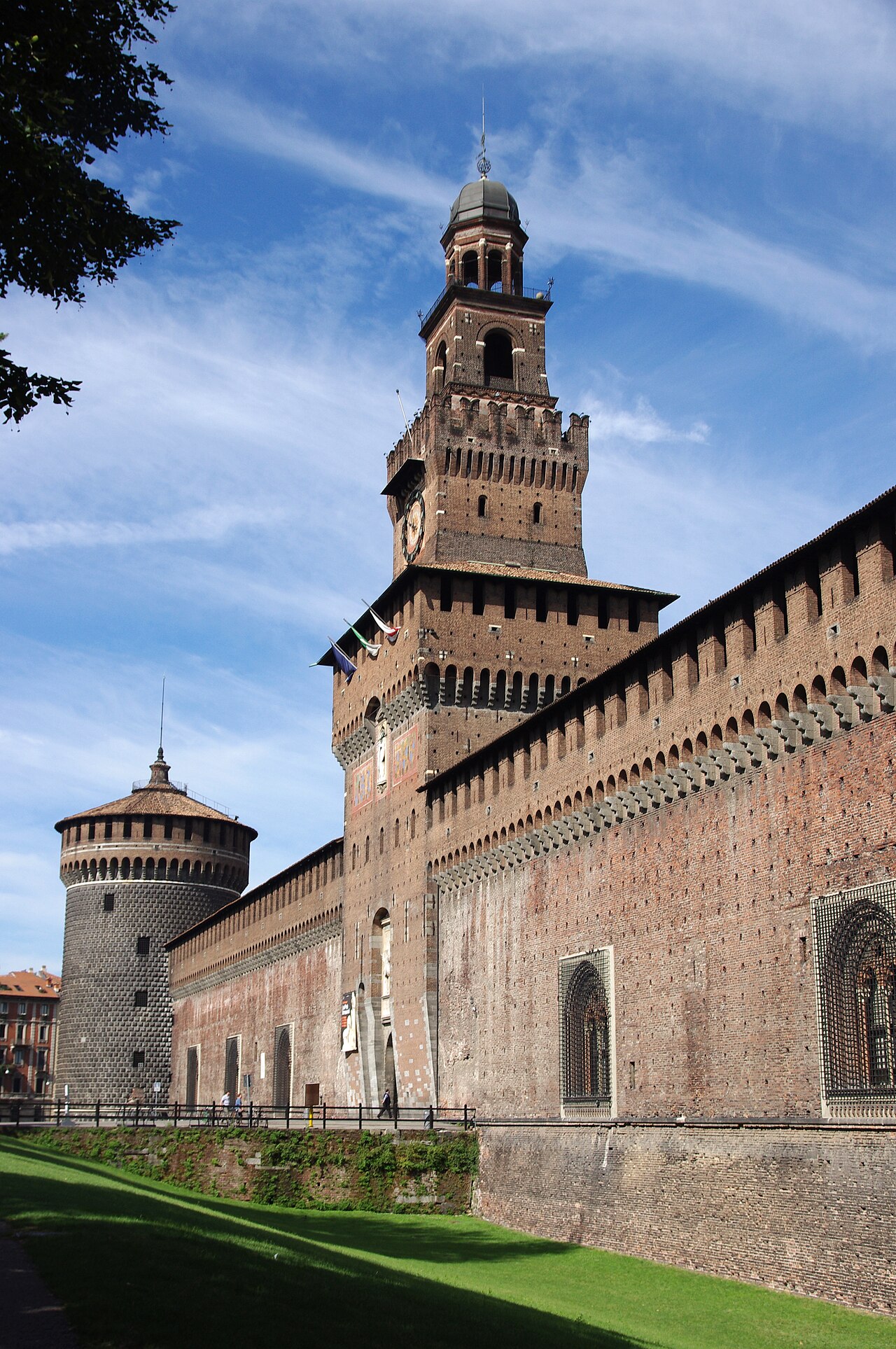
Cusago Castle
Cusago Castle, also known as Castello Visconteo di Cusago, stands as a remarkable example of a medieval hunting lodge transformed into a Renaissance villa, located in the town of Cusago within the province of Milan, Lombardy, Italy. Constructed between 1360 and 1369 by the powerful Milanese ruler Bernabò Visconti, the castle was strategically positioned within an extensive Visconti hunting reserve south of Milan, bridging the countryside between the city and Vigevano. This location allowed it to function both as a secluded retreat and a convenient country residence close to the ducal court.
The castle was likely built atop the remains of an earlier Lombard fortification, reflecting the site's longstanding strategic importance. Its initial purpose was to serve as a hunting lodge within the Visconti family's vast game reserve, a role it fulfilled with distinction under Bernabò Visconti, who often resided there until his overthrow in 1385. The castle's proximity to Milan made it a favored rural residence for the Visconti dynasty, with its use extending beyond hunting to include refuge during crises, such as when Caterina Visconti, Duchess of Milan, sought shelter there during the 1398 plague outbreak.
Architectural features and layout
The castle exhibits a rectangular plan with two floors, constructed predominantly from brick, a common building material in Lombardy during the medieval period. The main eastern façade is distinguished by a prominent crenellated tower topped with a smaller turret, a feature that was modified in the 16th century under the ownership of Count Massimiliano Stampa. The entrance tower was raised and a bell tower was added, which notably influenced the design of the Torre del Filarete in Milan’s Castello Sforzesco.
The castle's walls are substantial, with external walls approximately 2.1 meters thick and side walls around 76 centimeters thick, providing a robust structure though the tower was more symbolic than defensive. Windows vary in design, with pointed arches on the upper floor and flattened arches below, arranged irregularly due to later modifications. The south and north façades each contain seven windows, some of which have been bricked up or resized over the centuries.
The external loggia
A distinctive Renaissance feature is the external loggia located at the castle’s northeastern corner. Originally, it consisted of thirteen slender columns with grooved shafts, crowned by capitals adorned with ducal shields. The loggia's windows were decorated with floral motifs and diamond-patterned graffiti, typical of the period’s ornamental style. Beneath the loggia runs a vividly painted frieze with alternating white and black stripes framing elongated arches, dating to the time of Ludovico il Moro. Although the loggia was opened in the 19th century, it was later walled up, altering its original open-air character.
Historical evolution and significance
Visconti era and ducal enhancements
Following its construction under Bernabò Visconti, the castle remained an important ducal residence. After Bernabò's removal, his nephew Gian Galeazzo Visconti continued to maintain the estate, enforcing hunting bans in 1386 to protect the game. The castle gained further prominence under Filippo Maria Visconti (r. 1425-1440), who invested in significant improvements including the excavation of the Naviglietto canal in 1438, linking the castle to the main Naviglio Grande waterway. This canal facilitated direct water transport and enhanced access to the estate.
Filippo Maria also ordered the construction of a private ducal road and a hunting enclosure known as a "steccata." His mistress, Agnese del Maino, occasionally resided in the castle, underscoring its role as both a political and personal retreat. During the turbulent period of the Golden Ambrosian Republic (1447-1450), the castle was repurposed as a hospital and quarantine station, reflecting the era's concerns with public health. Parts of the castle were demolished during this time, and it was temporarily closed.
Renaissance restoration and sforza ownership
The castle was restored to its former splendor by Ludovico Sforza, also known as Ludovico il Moro, who transformed it into a refined country villa suited for hunting and courtly festivities. In 1496, the castle hosted Emperor Maximilian I, highlighting its stature as a noble residence. Ludovico added architectural refinements such as the external loggia and enhanced the castle’s tower, whose design influenced the later reconstruction of Milan’s Castello Sforzesco tower.
In 1525, the castle changed hands when Duke Francesco II Sforza sold it to Massimiliano Stampa, 1st Marquess of Soncino. The Stampa family used the castle primarily as a country residence before adapting it for agricultural purposes, including silk farming in the 18th century, reflecting broader economic shifts in the region.
Later history and current status
By the 20th century, Cusago Castle had declined significantly, functioning as a large farmhouse inhabited by approximately thirty families. Ownership passed through various hands, including prominent figures such as Silvio Berlusconi and several real estate developers. In 2016, the castle was acquired by a real estate company that initiated restoration efforts, which are ongoing.
Currently, Cusago Castle is undergoing restoration and is not open to the public. Despite this, it remains an important cultural and historical landmark, representing the evolution of Lombard noble residences from medieval hunting lodges to Renaissance villas.
Legend of the underground tunnels
Local tradition speaks of a network of underground tunnels beginning beneath the castle’s right side. This vaulted brick passage, reportedly large enough for horse-drawn carriages, is said to extend beneath Cusago, connecting to the church of Santa Maria Rossa and reaching towards Baggio in Milan and the Certosa monastery in Pavia. The tunnels were likely intended as escape routes for the dukes during times of danger. The entrance was sealed in the mid-1960s but remains a captivating element of the castle’s lore.
Architectural details of the courtyard and interiors
The castle’s interior courtyard is rectangular, with sides measuring approximately 38 to 40 meters and 53 meters, respectively. The eastern side features a portico with eight bays, including the main gate, supported by capitals carved with horse-head motifs and medallions depicting Roman emperors. These decorative elements originally bore ducal heraldry, which has since been removed.
Windows facing the courtyard reflect the exterior’s architectural style, with pointed arches on the upper floor and flattened arches below. Many retain traces of their original bichrome red and white decoration. The number of windows increases progressively on each side clockwise, adding a rhythmic visual pattern to the courtyard façade. Extensive diamond-patterned graffiti decorations adorn the walls inside the courtyard and on large external surfaces, echoing Renaissance ornamental trends.
No archaeological remains survive of the oratory that once existed above the upper floors. The nearby small chapel of Sant’Antonio, once adjacent to the parish church, was demolished in the 18th century.
Frequently asked questions (FAQ)
- What are the opening hours of Cusago Castle?
- Cusago Castle is open to visitors from Wednesday to Sunday, with visiting hours typically from 10 AM to 6 PM. It is advisable to check the castle's official website for any seasonal variations or special holiday hours before planning your visit.
- Is it possible to take guided tours of Cusago Castle?
- Yes, guided tours are available at Cusago Castle, providing an in-depth look at its rich history and architecture. These tours are conducted by knowledgeable guides who can share fascinating stories about the castle's past and its significance in the region.
- When was Cusago Castle built?
- Cusago Castle was originally constructed in the 14th century, making it a significant historical landmark in Italy. Over the centuries, it has undergone various renovations and restorations that reflect different architectural styles.
- Can I buy tickets online for Cusago Castle?
- Yes, tickets for Cusago Castle can be purchased online through the official website. This is recommended to avoid long queues at the entrance, especially during peak tourist seasons.
- What is the best time to visit Cusago Castle?
- The best time to visit Cusago Castle is during the spring and early fall when the weather is mild and pleasant. These seasons also offer beautiful scenery in the surrounding gardens and parks.
- How accessible is Cusago Castle for visitors with disabilities?
- Cusago Castle strives to be accessible to all visitors, with ramps and designated pathways for those with mobility challenges. However, it is advisable to contact the castle in advance to confirm specific accessibility arrangements.
- Why is Cusago Castle historically significant?
- Cusago Castle holds historical significance as a key defensive structure in the region and a residence for noble families. Its architecture and preservation reflect the medieval heritage of Italy, making it a valuable site for both history enthusiasts and casual visitors.
- What nearby attractions can I visit while at Cusago Castle?
- While visiting Cusago Castle, you can explore nearby attractions such as the charming village of Cusago, the beautiful Parco Agricolo Sud Milano, and local restaurants offering traditional Italian cuisine. Each of these spots enhances the overall experience of your trip.
- What architectural styles can be seen in Cusago Castle?
- Cusago Castle features a blend of medieval and Renaissance architectural styles, showcasing its historical evolution over the centuries. Visitors can admire its imposing towers, fortified walls, and elegant courtyards that highlight the craftsmanship of the era.
Information
Loading map...
Visitor reviews
No reviews yet. Been here? Write the first review and help other travelers!
Write the first reviewVisited this castle? Share your experience
Your review helps other travelers and adds first-hand knowledge to our encyclopedia.