Serravalle Castle
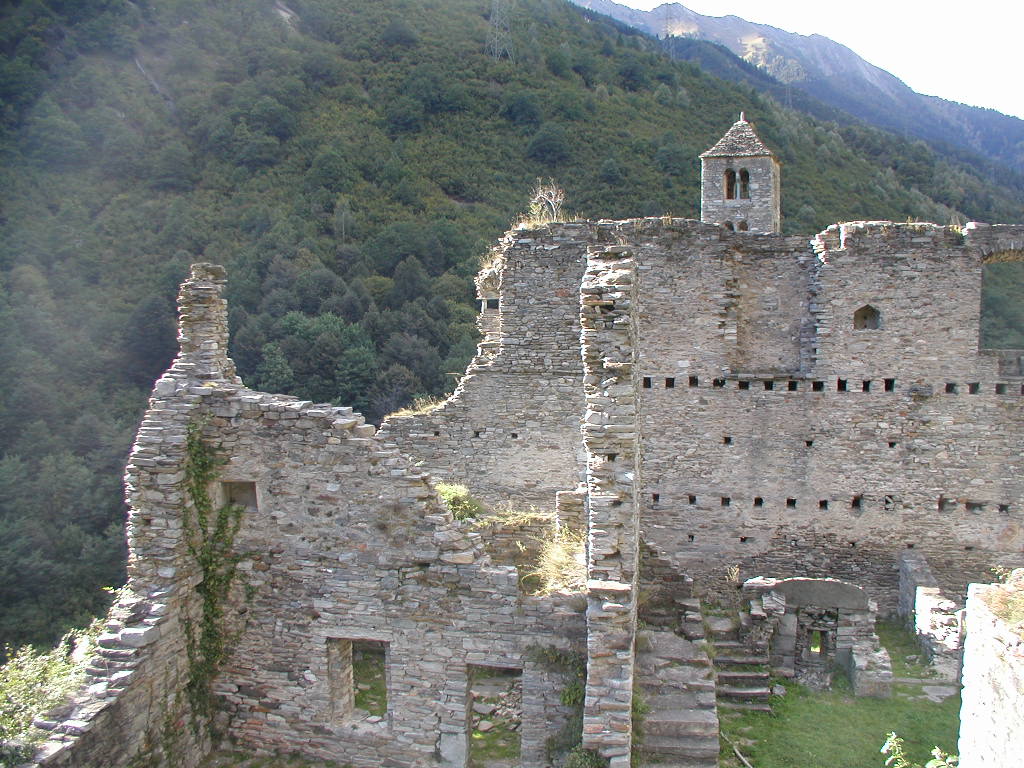
Serravalle Castle stands as a significant medieval fortress located near the village of Semione in the Blenio Valley, Switzerland. The castle's strategic position atop a rocky ridge at approximately 391 meters above sea level allowed it to control the vital Lukmanier Pass, a key alpine route. This hill castle played a crucial role in regional defense and administration from its earliest origins through the late Middle Ages.
The castle's history likely begins in the Carolingian era around 900 AD, as suggested by radiocarbon dating of foundational remains and early historical accounts. However, the first documentary evidence dates to 1162, when Alcherius da Torre is recorded as the lord of Serravalle. Alcherius was a supporter of the Holy Roman Emperor Frederick I Barbarossa, who appointed him as avogadro, a type of bailiff, of the Blenio Valley. The castle served as a military and administrative center under imperial authority, with Emperor Frederick Barbarossa reputedly staying there during his 1176 Italian campaign.
Medieval conflicts and destruction
In 1182, tensions between the castle's lord and local inhabitants culminated in the formation of the "Patto di Torre," an alliance aimed at ousting the lord's control. Following a siege, Artusio da Torre surrendered, and the castle was intentionally destroyed as a symbol of resistance. The ruins remained abandoned for about fifty years, reflecting the local population's determination to resist external domination.
Rebirth and expansion under the orelli family
Between 1220 and 1230, the castle was rebuilt and expanded under the direction of the Orelli family, who became vassals to the powerful rulers of Milan. This reconstruction marked Serravalle's resurgence as the political heart of the Blenio Valley. The castle's fortifications were significantly enhanced, including the construction of a massive donjon tower around 1250 and a semicircular defensive tower added in the 14th century.
Throughout the 13th and 14th centuries, Serravalle Castle underwent continual enlargement and strengthening. Control shifted from the Orelli family to the Counts of Oleggio and eventually to the Visconti family, who ruled the valley until 1380. The Visconti later sold their rights to the Pepoli family from Bologna. However, following the death of Duke Gian Galeazzo Visconti in 1402, local unrest led to a violent revolt against the Pepoli lord, Taddeo Pepoli. The castle was attacked and destroyed again during this uprising, and unlike before, it was never rebuilt.
Architectural features and layout
The castle complex consists of two main construction phases. The earliest phase, dating roughly from 900 to 1180, left only foundation fragments, while most surviving structures belong to the second phase from approximately 1224 until 1402. The fortress includes a main castle and a southern outer bailey, a fortified courtyard area extending about 90 by 30 meters. Although medieval walls of the outer bailey are largely overgrown, the layout reveals careful defensive planning.
Access to Serravalle Castle was tightly controlled. Visitors approached from the north through an outer gate on the east side, then made a sharp right turn to cross a drawbridge leading into the main courtyard. Defensive features included multiple gates, narrow zwinger passages designed to trap attackers, and intermediate ditches, creating layered protection before reaching the core castle.
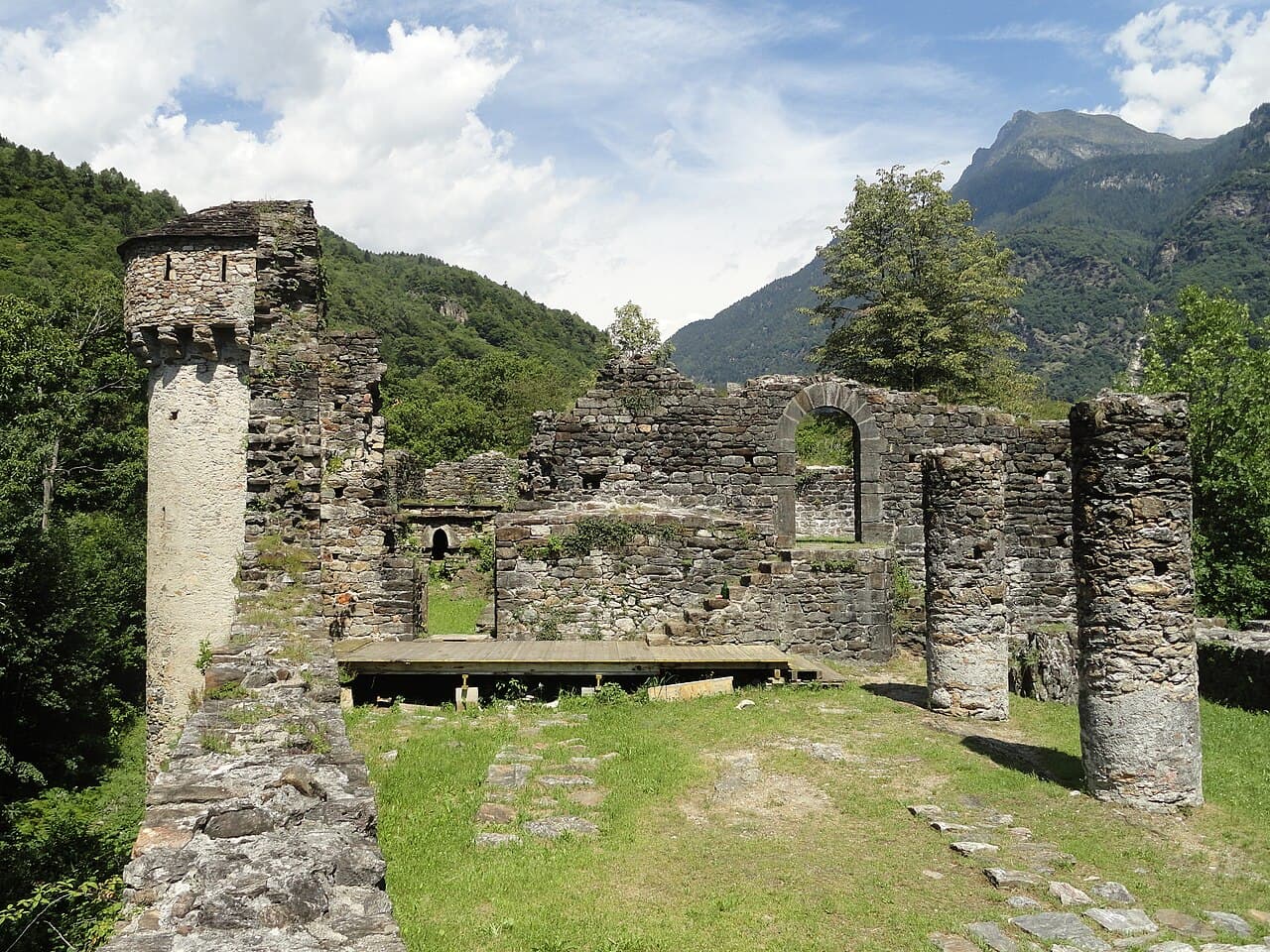
The main fortress is divided into distinct sections. The southern wing contains rooms of uncertain original purpose. Central to the castle was a large courtyard with remains of three thick columns that supported a covered hall with a staircase leading to a prominent two-story building. The northern section housed the primary living and defensive structures, including a large round donjon tower with walls approximately two meters thick. Notably, the donjon was not physically attached to the main castle building, with access to its upper floors provided by a wooden bridge connecting from the northern wing.
West of the courtyard lay a long kitchen wing identified by a large oven and a cellar-like storage room. A later-added flanking tower on the west side of the kitchen enhanced the castle's defenses in that direction. The entire complex was constructed primarily of stone masonry, with visible variations in wall joints reflecting centuries of modifications and repairs. Today, preservation ranges from foundation remains to collapsed rubble.
The chapel of santa maria del castello
At the southwestern edge of the outer bailey stands the chapel of Santa Maria del Castello, originally dedicated to Saint Martin and documented as early as 1339. Incorporated into the castle's ring wall, the chapel was renovated in the 16th and 18th centuries. Its interior features late 16th-century frescoes by Giovanni Battista Tarilli, including a late Gothic depiction of Saint Christopher on the north wall and an image of Justice on the west facade. The chapel historically was associated with executions, adding to its cultural significance.
Archaeological discoveries and medieval life
Excavations in the 20th and early 21st centuries have uncovered a wealth of artifacts that illuminate the castle's rich history. Finds include luxury items such as Venetian glassware, colorful majolica ceramics, coins, jewelry, and fragments of painted wall decorations dating to the 13th century. These artifacts demonstrate the high standard of medieval life at Serravalle and its cultural connections to Northern Italy.
Military artifacts recovered from the site include arrowheads, crossbow bolts, heavy siege stones weighing up to 104 kilograms, and remains of a large trebuchet, a Byzantine-origin heavy siege engine used during the 1402 siege. These findings confirm Serravalle Castle's active role in medieval warfare and its importance as a military bastion in the region.
Serravalle castle's legacy
Today, the ruins of Serravalle Castle remain a testament to medieval military architecture and the turbulent history of the Blenio Valley. Its layered construction phases, well-planned defenses, and archaeological treasures provide valuable insights into the political, cultural, and military dynamics of the region from the Carolingian era through the late medieval period. As a hill castle with a commanding position, Serravalle played a pivotal role in controlling alpine routes and regional power struggles.
Visitors to the site can explore the remains of the donjon tower, the outer bailey, the chapel, and the complex defensive features that once made Serravalle a formidable fortress. The castle's story of destruction, rebuilding, and final ruin reflects broader shifts in medieval military strategy and regional governance. Its archaeological richness continues to attract researchers and history enthusiasts interested in medieval fortifications and alpine heritage.
Frequently asked questions (FAQ)
- How do I get to Serravalle Castle?
- Serravalle Castle is located near the village of Semione in the Blenio Valley, Ticino, Switzerland. Visitors can reach the site by car or local transport, followed by a hike up the rocky ridge where the ruins stand.
- What is the historical significance of Serravalle Castle?
- Serravalle Castle was a key medieval fortress controlling the Lukmanier Pass and served as a military and administrative center from the 12th to 15th centuries, reflecting regional power struggles.
- Can I explore the ruins of Serravalle Castle?
- Yes, visitors can explore the ruins, including the remains of the donjon tower, outer bailey, chapel, and defensive structures, though some areas may be overgrown or unstable.
- When was Serravalle Castle destroyed?
- The castle was destroyed twice: first in 1182 after a local revolt, then again in 1402 during a violent uprising following the death of Duke Gian Galeazzo Visconti.
- Is there an entrance fee to visit Serravalle Castle?
- There is no widely publicized entrance fee; visiting the ruins is generally free, but it's best to check locally for any updates on access or guided tours.
Photo gallery

Information
Sources & official resources
Verify the information above using these authoritative references.
Loading map...
Visitor reviews
No reviews yet. Been here? Write the first review and help other travelers!
Write the first reviewVisited this castle? Share your experience
Your review helps other travelers and adds first-hand knowledge to our encyclopedia.