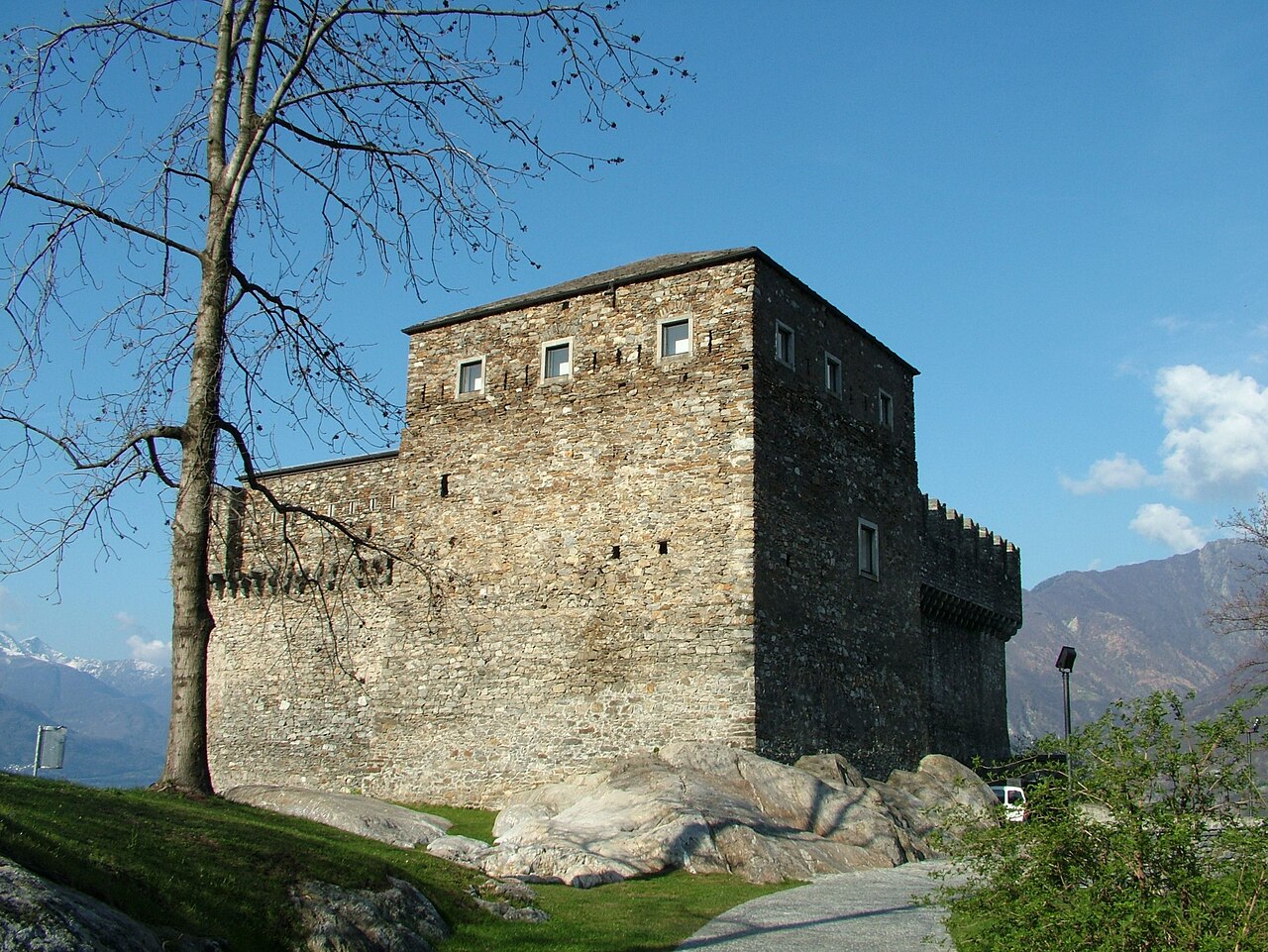
Santa Maria in Calanca Castle
Santa Maria in Calanca castle stands as a remarkable example of High Medieval fortifications nestled on a hilltop at the entrance to the Calanca valley in Switzerland. The site has a long history of occupation, with evidence of prehistoric habitation and a late Roman era church dedicated to Santa Maria, marking it as a place of both strategic and spiritual importance. By the 12th century, the location had become the political center of the valley, prompting the construction of the first castle below the church.
Early history and initial construction
The earliest castle at Santa Maria in Calanca was likely built for the de Calanca family, with Anricus de Calanca first documented in 1203. This initial fortification consisted primarily of a ring wall encircling the hilltop and a residential building positioned in the north corner. The castle's design reflected the defensive needs of the era, utilizing the natural elevation for protection and control over the valley entrance.
Architectural evolution and unique design
By the end of the 13th century, the original castle was replaced by a striking new structure: a large five-sided donjon. This massive tower, which dominates the ruins today, featured a distinctive layout uncommon in the Alpine region and northern Italy but reminiscent of certain castles in northern and central France. The interior of the donjon was rectangular, while the exterior presented a pentagonal shape, with walls ranging from 2 to 4 meters thick.
The donjon was designed with two of its three levels serving as living quarters, incorporating stairways, chimneys, and toilets within the walls themselves. The lower level contained a cistern and storage for supplies, essential for withstanding sieges. Access was through a high entrance on the west side, a typical defensive feature to hinder attackers.
This architectural style suggests that the builder was likely trained in France, explaining the unusual design for the region. The castle's robust construction has allowed it to endure centuries of neglect, preserving its imposing form.
Ownership and historical significance
Ownership of the castle passed to the influential Counts of Sax-Misox by the late 13th century, with Martin von Sax recorded at Santa Maria in 1291. The castle remained under the Sax family, specifically the Sax-Grono branch, until 1480. That year, they sold their holdings, including the Mesocco Castle and the Santa Maria area, to General Giacomo Trivulzio, a Milanese commander sent to secure the Misox and Calanca valleys.
Interestingly, the castle itself was not mentioned in the 1480 sale, suggesting it may have already been abandoned by that time. Trivulzio later allied with the Three Leagues, marking a shift in regional power dynamics.
Castle site and surrounding features
The castle ruins overlook the village of Santa Maria in Calanca, with the main street passing by the parish church on its way to the hilltop. The church, dedicated to the Assumption of St. Mary, was first documented in 1219 and served as the religious center for the entire valley.
The church itself showcases architectural developments spanning centuries: the choir was constructed in either 1385 or 1416, and the nave was extended in 1606. The Gothic bell tower north of the choir is topped with a Baroque octagonal pyramid spire. The west portico, built in the Tuscan style, leads to a portal adorned with statues dating from 1626. Inside, the nave features a richly painted Renaissance ceiling from 1606, decorated with cherubs holding the coats of arms of Calanca, the Gray League, Grono, and San Vittore.
Near the castle ruins, fragments of the old residence tract and a portion of the original ring wall remain visible, providing insight into the castle's original layout and defensive structures.
Restoration efforts and current condition
Despite centuries of abandonment, the castle's thick walls have preserved its structure remarkably well. The first major restoration occurred in 1932-34, during which the donjon was repurposed as an observation tower. Further repairs were carried out in 1979 to maintain the ruins and ensure visitor safety.
Today, the Santa Maria in Calanca castle ruins offer a unique glimpse into medieval Alpine fortifications influenced by French architectural traditions. Its unusual design and historical ties to prominent regional families make it a significant cultural landmark within the Swiss canton of Graubünden.
Frequently asked questions (FAQ)
- What is the historical significance of Santa Maria in Calanca Castle?
- Santa Maria in Calanca Castle is a notable example of medieval architecture in Switzerland, reflecting the strategic importance of the region in the past. Built in the 13th century, it served as a fortress and residence for local nobility, playing a key role in the defense against invaders and rival factions.
- When was Santa Maria in Calanca Castle built?
- The construction of Santa Maria in Calanca Castle began in the early 13th century, with significant modifications made over the years. Its enduring structure showcases the evolution of military architecture and provides insight into the historical context of the region.
- How do I get to Santa Maria in Calanca Castle?
- To reach Santa Maria in Calanca Castle, visitors can use public transportation or drive, as the castle is accessible via local roads. There are also nearby parking facilities for those who prefer to drive, making it convenient for day trips.
- What are the opening hours for Santa Maria in Calanca Castle?
- Santa Maria in Calanca Castle is typically open to visitors from April to October, with hours varying by season. It is advisable to check the official website or local tourism information for the most current opening hours before planning your visit.
- Can I take guided tours of Santa Maria in Calanca Castle?
- Yes, guided tours are available at Santa Maria in Calanca Castle, providing a rich narrative of its history and architecture. These tours are often led by knowledgeable guides who can offer insights into the castle's significance and the surrounding area.
- Is it possible to host events at Santa Maria in Calanca Castle?
- Yes, Santa Maria in Calanca Castle is available for private events, including weddings and corporate gatherings. The unique setting and historical ambiance make it an ideal venue for memorable occasions.
- What is the best time to visit Santa Maria in Calanca Castle?
- The best time to visit Santa Maria in Calanca Castle is during the late spring and early fall when the weather is pleasant and the surrounding landscape is at its most beautiful. This period also tends to be less crowded, allowing for a more enjoyable experience.
- Are there any nearby attractions to visit along with Santa Maria in Calanca Castle?
- Yes, there are several nearby attractions, including picturesque hiking trails and quaint villages that showcase the charm of the Calanca Valley. Visitors can also explore local museums and enjoy the stunning natural scenery that Switzerland is known for.
- What are the ticket prices for Santa Maria in Calanca Castle?
- Ticket prices for Santa Maria in Calanca Castle are generally affordable, with discounts available for students and seniors. It's best to check the official website for the most accurate and up-to-date pricing information before your visit.
- Is Santa Maria in Calanca Castle accessible for people with disabilities?
- Santa Maria in Calanca Castle has made efforts to improve accessibility, though some areas may still present challenges due to its historical structure. It is recommended to contact the castle administration beforehand to inquire about specific accessibility options available for visitors with disabilities.
Information
Loading map...
Visitor reviews
No reviews yet. Been here? Write the first review and help other travelers!
Write the first reviewVisited this castle? Share your experience
Your review helps other travelers and adds first-hand knowledge to our encyclopedia.