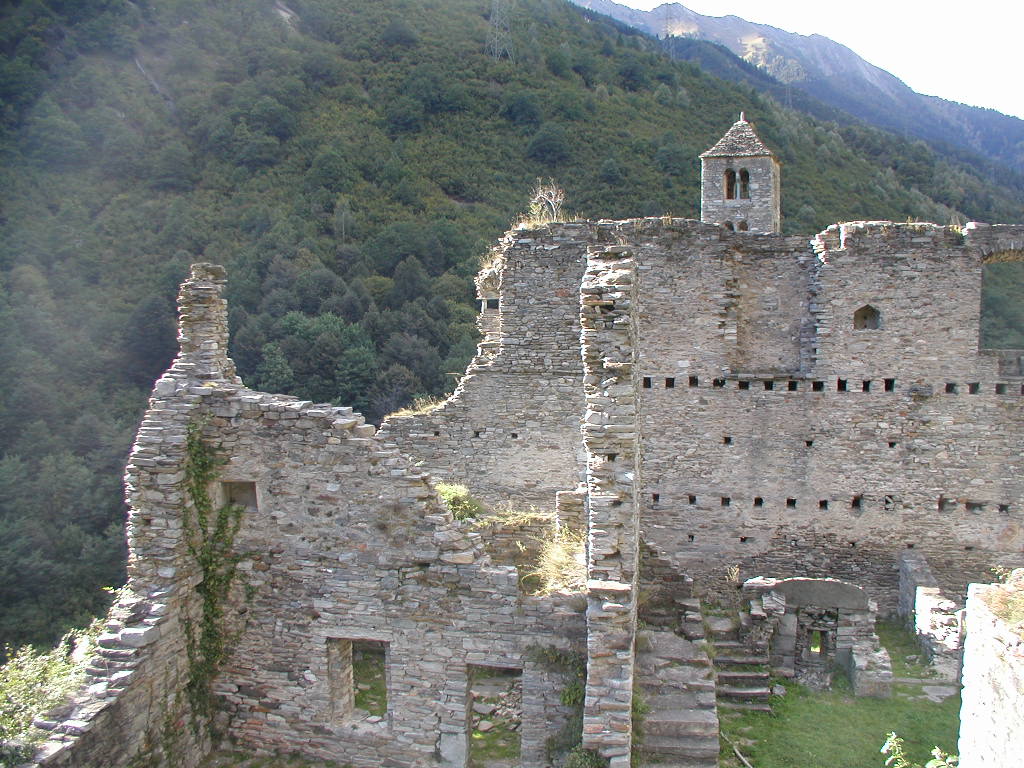
Norantola Castle
Norantola Castle, located in Cama, Switzerland, is a significant medieval ruin with origins dating back to the 12th century. Initially constructed for a local noble family, the castle's earliest mentions appear in historical records with Locarnus de Norantola in 1248 and Petrus de Norantola in 1295. By the turn of the 14th century, the castle passed into the hands of the powerful Counts of Sax/Misox, marking a pivotal shift in ownership and regional influence. The original Norantola family disappears from records around this time, indicating a decline or absorption into the Sax/Misox lineage.
Architectural evolution and 14th-century reconstruction
In the early 14th century, Norantola Castle underwent a comprehensive rebuilding that transformed its defensive and residential structures. The castle's ring wall was enhanced with swallowtail crenellations, a distinctive battlement style providing both protection and an imposing silhouette. A new tower was constructed atop the curtain wall, reinforcing the castle's fortifications and serving as a lookout point.
The castle's layout expanded with the addition of a north wing housing apartments and a throne room, reflecting its role as a seat of local power and governance. Opposite, the south wing was designated for stables, essential for the cavalry and transport needs of the castle's occupants. The original palas was modified by adding a gallery, becoming the east wing, which likely served as the main residential and ceremonial area.
This reconstruction was commissioned by the cadet branch of the Sax/Misox family known as Sax-Norantola, who became the castle's rulers. Their tenure is marked by both architectural advancements and political engagements within the region.
Historical context and political significance
Throughout the 15th century, Norantola Castle played a role in regional disputes and power struggles. In 1439, a local court confirmed the rights of the Sax-Norantola family during an internal family conflict, underscoring the castle's importance as a noble seat. However, this stability was challenged in 1452 when Count Henri von Sax-Misox negotiated an agreement with valley residents that nullified previous accords and traditional rights held by Sax-Norantola, indicating shifting political alliances and tensions.
A significant conflict arose in 1480 involving Count Peter von Sax and Gian Giacomo Trivulzio over control of Mesocco. The Sax-Norantola family aligned themselves with Trivulzio and the Duke of Milan, suggesting the castle's strategic importance in broader regional power dynamics. It is believed that either Trivulzio or the Duke of Milan provided reinforcements to Norantola Castle during this period.
Destruction and legacy
Despite these reinforcements, Norantola Castle's defenses failed during the hostilities between the Duke of Milan and the Counts of Sax-Misox. In 1483, Sax-Misox troops burned the castle, effectively ending its role as a military and noble stronghold. The castle was never rebuilt, and by the 16th century, the Sax-Norantola family had relocated to Bellinzona, marking the end of Norantola Castle's direct association with regional nobility.
Today, the castle remains a ruined site, offering valuable insights into medieval fortification styles and noble residences in the High Medieval period. Its remnants, including the distinctive swallowtail crenellations and the layout of its wings, provide a tangible connection to the complex feudal and military history of the Jura region of Switzerland.
Architectural features and defensive elements
The castle's design reflects typical High Medieval fortification principles, combining residential comfort with military functionality. The ring wall served as the primary defensive barrier, augmented by the swallowtail crenellations, which allowed defenders to shield themselves while observing or attacking enemies. The addition of a tower on the wall enhanced surveillance capabilities and provided a strongpoint in the castle's defenses.
The internal arrangement, with specialized wings for apartments, a throne room, stables, and a gallery, illustrates the multifunctional nature of Norantola Castle as both a fortress and a noble residence. The presence of a throne room indicates the castle's role as a local administrative center where justice and governance were exercised.
Cultural and historical importance
Norantola Castle embodies the feudal complexities of medieval Switzerland and the shifting allegiances among noble families. Its history reflects broader themes of territorial disputes, family rivalries, and the influence of external powers such as the Duke of Milan. The castle's destruction in 1483 marks a significant moment in the region's military history, illustrating the volatility of power during the late Middle Ages.
As a heritage site, Norantola Castle offers scholars and visitors a glimpse into medieval architecture and the socio-political landscape of the Jura region. The ruins serve as a cultural landmark, preserving the legacy of the Sax-Norantola family and their role in Swiss history.
Visiting norantola castle today
Visitors to Norantola Castle can explore the remains of this High Medieval fortress, appreciating the surviving walls, tower foundations, and traces of the castle's wings. The site provides an evocative setting for understanding medieval defensive architecture and noble life. While the castle is in a ruined state, it remains accessible for those interested in history, architecture, and Swiss cultural heritage.
Frequently asked questions (FAQ)
- How do I get to Norantola Castle?
- Norantola Castle is located in Cama, Switzerland, and can be accessed by public transport or car. If you're driving, follow the signs to Cama, and there is parking available nearby. For public transport, check the local bus schedules that connect to Cama from major cities.
- What is the historical significance of Norantola Castle?
- Norantola Castle dates back to the 11th century and is an important example of medieval architecture in Switzerland. It has served various roles throughout its history, including as a stronghold and residence for local nobility. The castle's rich history is reflected in its preserved structures and artifacts.
- When was Norantola Castle built?
- Norantola Castle was constructed in the early 11th century, making it over a thousand years old. It has undergone several renovations and restorations, which have helped preserve its historical features for future generations. The castle's age adds to its charm and allure for visitors.
- Can I take a guided tour of Norantola Castle?
- Yes, guided tours of Norantola Castle are available and are highly recommended for a deeper understanding of its history and architecture. Tours typically last around an hour and provide insights from knowledgeable guides. Be sure to check the schedule and book in advance, especially during peak tourist seasons.
- Why is Norantola Castle a popular tourist destination?
- Norantola Castle attracts visitors due to its stunning architecture, rich history, and picturesque location in the Swiss countryside. The castle offers breathtaking views and a unique glimpse into medieval life. Additionally, its proximity to other attractions in the region makes it a convenient stop for tourists.
- Is it possible to host events at Norantola Castle?
- Yes, Norantola Castle offers facilities for hosting various events, including weddings, corporate meetings, and cultural gatherings. The unique setting provides a memorable backdrop for any occasion. It is advisable to contact the castle administration for details on availability and services provided.
- What are the opening hours for Norantola Castle?
- Norantola Castle is open to visitors from 10 AM to 5 PM, Tuesday through Sunday. During the peak tourist season, extended hours may be available, so it’s best to check the official website for the most current information. Closed on Mondays, the castle encourages visitors to plan their trips accordingly.
- What are the ticket prices for visiting Norantola Castle?
- Ticket prices for Norantola Castle are generally affordable, with discounts available for children and seniors. Adult tickets typically cost around CHF 10, while children under 12 may enter for free. Special rates may apply for guided tours, so it's worthwhile to inquire when purchasing your tickets.
- When is the best time to visit Norantola Castle?
- The best time to visit Norantola Castle is during the spring and early autumn months when the weather is mild and the surrounding landscapes are beautiful. These seasons also tend to have fewer crowds compared to the peak summer months. Visiting during these times allows for a more enjoyable experience exploring the castle grounds.
- Are there nearby attractions to Norantola Castle?
- Yes, there are several nearby attractions to Norantola Castle, including picturesque hiking trails and other historic sites in the region. The town of Cama itself offers charming shops and local cuisine. Visitors can also explore the beautiful natural landscapes of the surrounding area, making it a great destination for outdoor enthusiasts.
Information
Loading map...
Visitor reviews
No reviews yet. Been here? Write the first review and help other travelers!
Write the first reviewVisited this castle? Share your experience
Your review helps other travelers and adds first-hand knowledge to our encyclopedia.