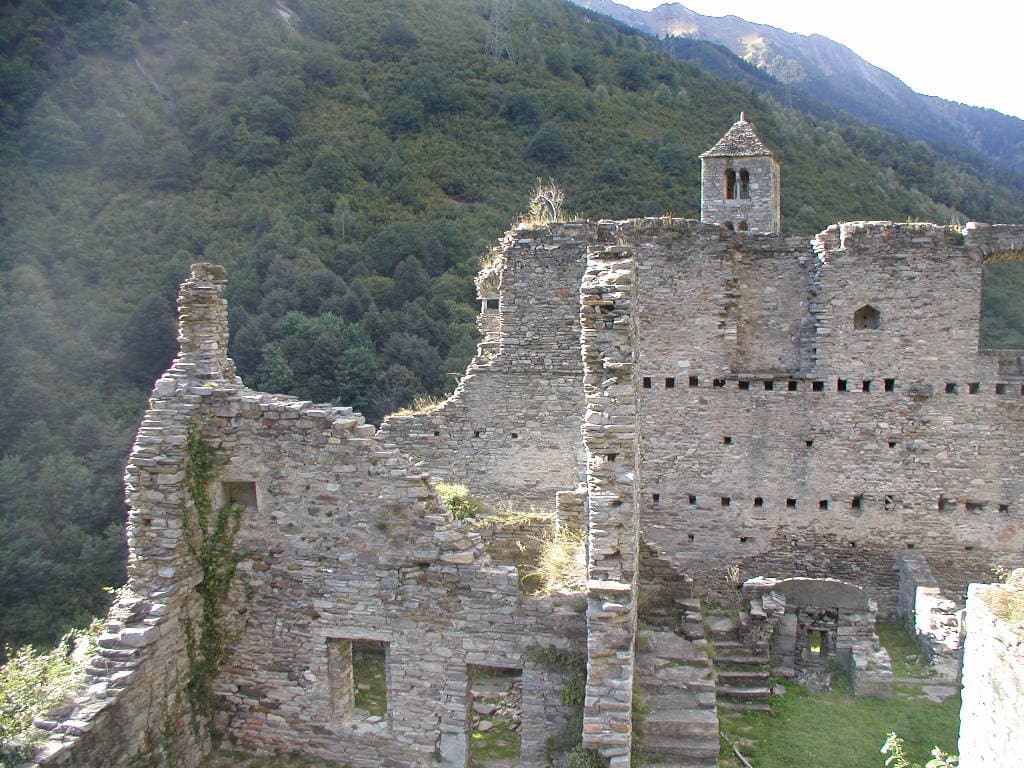
Mesocco Castle
Mesocco Castle stands as one of the most significant medieval hill castles in the canton of Graubünden, Switzerland. Its extensive ruins cover the entire summit of a rocky hill overlooking the village of Mesocco, offering a commanding view of the surrounding Mesolcina valley. The castle's strategic location and formidable fortifications reflect its historical role as a political, military, and administrative center from the 12th century through the 16th century.
The castle complex is an impressive example of high medieval military architecture, evolving over centuries from a small fortified church into a sprawling fortress. The site’s origins trace back to the early medieval period, with a refuge church dedicated to Saint Carpoforo constructed around the 7th century. This early religious and defensive structure was gradually expanded, culminating in the castle’s first mention in historical records in 1219. Over the following centuries, the castle was continuously enlarged and fortified to meet changing military and residential needs.
Architectural evolution and layout
Early foundations and medieval expansions
The initial fortification was a small church with a round apse, serving as a refuge for local villagers. By the 11th century, this was replaced by a Romanesque church featuring a horseshoe-shaped apse and a freestanding seven-story bell tower with paired round-arched windows. Around the same period, the site began its transformation into a castle with the addition of defensive walls and a bergfried (a tall, freestanding tower) constructed between 1150 and 1200.
The castle complex
The castle walls form an irregular pentagon enclosing the summit, reinforced by five towers including the massive Torre Grossa on the east side, notable for walls up to five meters thick. The northwest tower, with its polygonal base, has been partially rebuilt and contains remains of a residential chamber. All towers feature narrow arrow slits designed for archers and later adapted for early firearms.
The interior of the castle was a self-sufficient complex, housing the noble family von Sax and their soldiers. Facilities included armories, a foundry, a bakery, a dairy, a cistern for water storage, and a charnel house. The castle's layout reflects the dual military and domestic functions typical of high medieval castles.
Historical significance and ownership
The von sax family and the grey league
From the 12th century until 1480, Mesocco Castle was the seat of the noble family von Sax, who ruled the Mesolcina valley and controlled several castles in the region. Their influence extended beyond the valley, crossing the San Bernardino Pass. Baron Albert von Sax-Misox, a prominent figure in the early 15th century, was a founding member of the Grey League, an alliance that played a key role in the political landscape of Graubünden.
Albert's assassination in 1406 marked the beginning of the family's decline. By the late 15th century, the castle became a focal point in the struggle for control between local powers, the Duchy of Milan, and the Swiss Confederates.
Trivulzio family and military upgrades
In 1480, the castle was sold to General Gian Giacomo Trivulzio, representing Milanese interests. Trivulzio fortified the castle further, installing cannons and adapting the walls for firearms, reflecting the military innovations of the late medieval period. In 1496, he allied with the Grey League, supplying weapons and support during conflicts such as the Swabian War and the Musso War.
Decline and abandonment
Despite its formidable defenses, the castle was ordered to be abandoned in 1526 by the Three Leagues, who feared it could be used by hostile forces. The administrative center was relocated to Palast Trivulzio in Roveredo, and Mesocco Castle gradually fell into ruin. A lightning strike destroyed the main tower in 1835.
Modern restoration and preservation
In the 20th century, efforts to preserve Mesocco Castle began with excavations and reinforcement led by architect Eugen Probst in 1925-1926. Although early restoration lacked systematic planning, it prevented further deterioration. More comprehensive restoration occurred between 1986 and 1993, including rebuilding the polygonal northwest tower and sections of the northern and northwestern walls, stabilizing the ruins for public access and study.
The church of santa maria al castello and san carpoforo
At the base of the hill lies the Church of Santa Maria al Castello, first mentioned in 1219. It contains valuable frescoes from the mid-15th century, attributed to the workshop of Seregnesi, adding cultural and artistic significance to the site. Within the castle walls, the church of San Carpoforo stands on the foundations of the early medieval refuge church, featuring Romanesque architectural elements and a distinctive bell tower.
Castle remains and visitor experience
Today, visitors to Mesocco Castle can explore the extensive ruins that illustrate the complexity of medieval fortifications and noble residence life. The irregular pentagonal walls and five towers, including the restored polygonal tower, provide insight into defensive strategies. The remains of domestic buildings such as the bakery, dairy, and foundry emphasize the castle’s role as a self-contained community.
The castle’s elevated position offers panoramic views of the Mesolcina valley and the surrounding Alpine landscape, enhancing its appeal as a historic and scenic destination. Interpretation panels and preserved frescoes enrich the visitor experience, connecting the architectural heritage with the region's turbulent history.
Frequently asked questions (FAQ)
- How do I get to Mesocco Castle?
- Mesocco Castle is located on a hill above the village of Mesocco in Graubünden, Switzerland. Visitors can reach the castle by a hiking trail starting from the village center, which takes about 20-30 minutes on foot.
- What is the best time to visit Mesocco Castle?
- The best time to visit Mesocco Castle is during the late spring to early autumn months (May to September) when the weather is favorable for hiking and exploring the ruins.
- Is Mesocco Castle accessible for people with limited mobility?
- Due to its hilltop location and uneven terrain, Mesocco Castle is not fully accessible for visitors with limited mobility. The hike to the castle involves steep and rocky paths.
- Are there guided tours available at Mesocco Castle?
- Guided tours are occasionally offered by the local municipality or heritage organizations. It is recommended to check in advance for availability during the visiting season.
- What historical periods does Mesocco Castle represent?
- Mesocco Castle primarily represents the high medieval period, with architectural elements and expansions spanning from the 12th to the 15th centuries.
- Can I see frescoes at Mesocco Castle?
- Yes, the nearby Church of Santa Maria al Castello houses several mid-15th century frescoes from the workshop of Seregnesi, which visitors can view during their visit.

Information
Sources & official resources
Verify the information above using these authoritative references.
Loading map...
Visitor reviews
No reviews yet. Been here? Write the first review and help other travelers!
Write the first reviewVisited this castle? Share your experience
Your review helps other travelers and adds first-hand knowledge to our encyclopedia.



