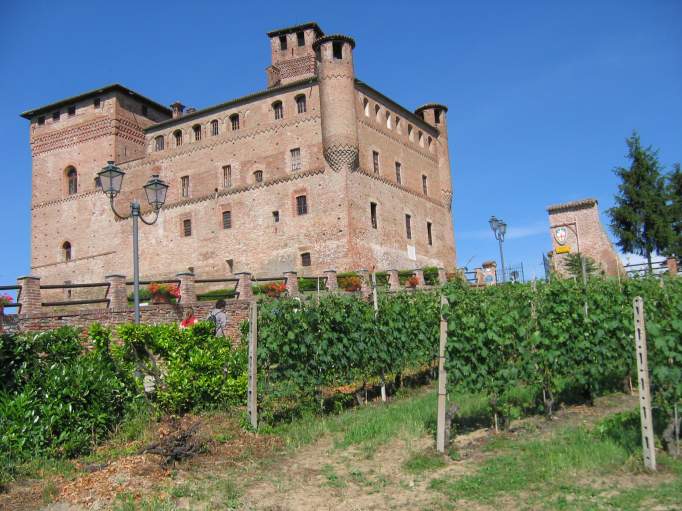
Serralunga d'Alba Castle
Serralunga d'Alba Castle stands as a slender and majestic symbol dominating one of the most beautiful and intact villages of the Langhe region, surrounded by rolling hills renowned for their prestigious vineyards and great wines. This castle is widely regarded as one of the best preserved examples of a fourteenth-century noble castle in Piedmont, Italy, and is unique in the country for its architectural structure, which is typical of a French donjon. Its imposing vertical silhouette is a defining feature of the local landscape, reflecting both the defensive and symbolic functions it served throughout history.
Early history and construction
The origins of the castle can be traced back to the 12th century when a tower stood overlooking and defending the village of Serralunga d'Alba. This early fortification played a crucial role in the local defense system. In 1340, following his military service, Pietrino Falletti was granted the feudal rights over the area. He demolished the original tower and began constructing the current castle, a project that was completed by 1357. Documentation from that year includes a sale contract dated February, signed within one of the castle's rooms, attesting to its completion and use.
Architectural significance and design
The castle is remarkable for having remained largely unchanged since its completion in the 14th century. Unlike many other castles, it was not subjected to significant military conflicts or extensive residential modifications, preserving its original medieval stronghold character. Its design emphasizes verticality, a feature that not only served defensive purposes but also symbolized the prestige and dominance of the Falletti family over the surrounding productive lands.
Structural components
The castle's layout by the late 14th century included several key elements: the palacium, a compact and elongated main building comprising large, stacked rooms; a cylindrical tower and a hanging tower used for surveillance and as status symbols; a square-based tower; and a courtyard protected by a drawbridge. The palacium contained a large public hall for administering justice, alongside a small chapel with a barrel vault adorned with mid-fifteenth-century frescoes depicting the Martyrdom of Saint Catherine of Alexandria.
Interior features
Inside, remnants of the castle’s original furnishings survive, including large fireplaces and wooden ceilings. The top floor features a walkway that was initially open and protected by battlements but later covered by a roof. From the windows on the third floor, visitors can enjoy spectacular panoramic views spanning 360 degrees over the Langhe hills and extending to the Alpine arc.
Historical role and ownership
Throughout its history, the castle’s primary role was less military and more focused on controlling and overseeing the agricultural productivity of the surrounding territory. This is reflected in its imposing and vertical architecture, which served as a symbol of the Falletti family's prestige and authority.
In 1949, the castle was acquired by the Italian State from the Opera Pia Barolo, an institution founded by the testamentary will of Marchesa Giulia di Barolo, the last heir of the Falletti family. Prior to this, during the late 19th and early 20th centuries, the castle was used in connection with the productive activities of local farms, housing cellars, dye works, and agricultural product storage.
Restoration and current management
Following its acquisition by the state, significant restoration efforts were undertaken to preserve the castle's medieval structure and heritage. Since 2015, the castle has been managed by the Piedmont Museums and entrusted to the Barolo & Castles Foundation, which oversees its conservation and public access. The castle remains a vital cultural landmark, attracting visitors interested in medieval architecture, noble heritage, and stunning panoramic views.
Architectural style and classification
Serralunga d'Alba Castle is classified as a hill castle, situated prominently on elevated terrain to maximize defensive capabilities and visibility. Its architectural style is predominantly Gothic, reflecting the design trends of the High to Late Medieval period in northern Italy and influenced by French military architecture, particularly the donjon or keep style. The castle’s well-preserved condition offers a rare and authentic glimpse into 14th-century noble fortifications in the region.
Frequently asked questions (FAQ)
- What is the historical significance of Serralunga d'Alba Castle?
- Serralunga d'Alba Castle, built in the 13th century, is a prime example of medieval military architecture in Italy. It served as a defensive stronghold for the local nobility and played a vital role in the region's history, particularly during the conflicts between the House of Savoy and the House of Montferrat.
- When was Serralunga d'Alba Castle constructed?
- The construction of Serralunga d'Alba Castle began in the 13th century, specifically around 1210. Over the years, it underwent various modifications and restorations, reflecting the architectural styles and needs of different periods.
- Can I visit Serralunga d'Alba Castle?
- Yes, Serralunga d'Alba Castle is open to visitors. You can explore its impressive towers, walls, and panoramic views of the surrounding vineyards and hills.
- What are the opening hours for Serralunga d'Alba Castle?
- The castle is typically open from March to November, with varying hours depending on the season. It is advisable to check the official website or contact local tourism for the most current information before planning your visit.
- Is it possible to access Serralunga d'Alba Castle by public transport?
- Yes, you can reach Serralunga d'Alba Castle by public transport, although services may be limited. Local buses connect the castle with nearby towns, but it is recommended to check the schedule in advance for the best options.
- What are the ticket prices for visiting Serralunga d'Alba Castle?
- Ticket prices for Serralunga d'Alba Castle are generally affordable, with discounts available for students, seniors, and groups. It's best to check the official website for the latest pricing and any special offers.
- When is the best time to visit Serralunga d'Alba Castle?
- The best time to visit Serralunga d'Alba Castle is during the spring and early autumn months when the weather is pleasant and the scenery is particularly beautiful. This timing allows visitors to enjoy the stunning views of the surrounding vineyards at their peak.
- What nearby attractions can I explore while visiting Serralunga d'Alba Castle?
- While visiting Serralunga d'Alba Castle, you can also explore the charming town of Serralunga d'Alba, known for its wine production. Additionally, the nearby Langhe region offers various wine tours, picturesque villages, and culinary experiences.
Information
Loading map...
Visitor reviews
No reviews yet. Been here? Write the first review and help other travelers!
Write the first reviewVisited this castle? Share your experience
Your review helps other travelers and adds first-hand knowledge to our encyclopedia.