Castle of Roddi
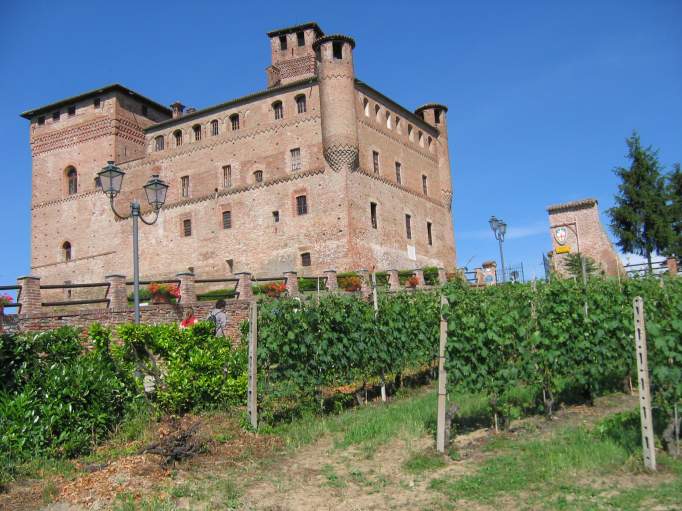
The Castle of Roddi is a prominent hill castle located in the municipality of Roddi in the Piedmont region of Italy. Its origins trace back to the 11th century, situating it firmly within the medieval period. This fortress exemplifies the strategic and architectural characteristics typical of its era, built to oversee and control the surrounding territory from its commanding elevated position.
Historical background and ownership transitions
Throughout the Middle Ages, the castle was a significant fiefdom under the control of the Marquises of Monferrato, a powerful noble family influential in the region's politics and military affairs. The castle's initial construction served both defensive and residential purposes, reflecting the dual needs of protection and noble habitation during turbulent medieval times.
In the late 14th and early 15th centuries, the castle underwent substantial remodeling under the direction of the Faletti family. Their renovations shaped much of the current structure, including the distinctive cylindrical towers and fortified walls that remain visible today. These modifications enhanced both the defensive capabilities and the residential comfort of the castle.
A pivotal moment in the castle's history occurred in the early 16th century. On December 5, 1525, Giovanna Carafa, wife of Giovanni Francesco II Pico della Mirandola, purchased the castle along with its lands and legal rights from Anna d’Alençon, widow of Guglielmo IX Paleologo, Marquis of Monferrato. The transaction, valued at 6,000 gold scudi, was ratified by Emperor Charles V through a diploma signed in Granada on June 20, 1525.
Following the assassination of Giovanni Francesco II Pico and his son Alberto in 1533 at the family’s ancestral castle, Giovanna Carafa relocated with her surviving children to the Castle of Roddi. This move was necessitated by their loss of legitimate rule over Mirandola to Galeotto II Pico. The castle thus served as a refuge and new family seat for the Carafa lineage.
In subsequent centuries, ownership of the castle changed hands several times. By 1690, it was under the control of the Della Chiesa family from Saluzzo. Later, the castle became part of the possessions of the House of Savoy. Following the decisions of the Congress of Vienna in the early 19th century, the castle was transferred to the Italian state. In 2001, stewardship was assumed by the municipality of Roddi, ensuring local preservation and management.
Since 2007, the Castle of Roddi has been included in the "Castelli D.O.C." circuit, linking it to the UNESCO World Heritage site recognized for the Langhe-Roero and Monferrato wine landscape. It is grouped with seven other castles in this cultural and historic network. Additionally, the castle participates in the regional "Castelli Aperti" initiative, which promotes public access to historic fortresses throughout Lower Piedmont.
Architectural features and defensive design
Perched atop a prominent hill overlooking the village of Roddi, the castle's layout is typical of a medieval fortress. The main building rises to three stories and is flanked by two robust cylindrical towers positioned at opposite corners. These towers were integral to the castle's defense, providing vantage points for surveillance and protection against attackers.
One of the castle's most notable defensive elements is the presence of machicolations—openings on the upper floors that allowed defenders to drop objects or pour harmful substances on enemies attempting to breach the walls. The main tower is tall and slender, functioning as both an observation post and a final refuge during sieges. The second tower, somewhat shorter, features a cantilevered design that projects outward, increasing the defensive coverage of the castle's perimeter.
The original entrance was secured by a drawbridge, a movable bridge mechanism that could be raised to prevent enemy access. Though the drawbridge no longer exists, visitors enter through an external courtyard that likely replaced or incorporated the original approach, maintaining the defensive layout's integrity.
Interior elements and residential features
Inside the castle, several richly decorated features survive, illustrating the site's role beyond mere military defense. The wooden coffered ceilings are particularly noteworthy, featuring recessed panels that combine structural strength with artistic detail, enhancing the aesthetic appeal of the interiors.
The castle also preserves ancient 16th-century kitchens, offering valuable insights into the domestic life of its noble inhabitants. These kitchens demonstrate the adaptation of functional spaces within a fortress setting, balancing practicality with the needs of a noble household.
Cultural significance and modern stewardship
The Castle of Roddi stands as a significant cultural monument within the Piedmont region. Its inclusion in the Castelli D.O.C. circuit and the "Castelli Aperti" network highlights its importance as part of Italy's rich heritage of medieval fortifications and noble residences.
These initiatives promote public engagement with the castle, encouraging tourism and educational activities that underscore the historical and architectural value of the site. The castle's preservation under municipal management ensures ongoing conservation efforts and accessibility for visitors interested in exploring medieval architecture and history.
Frequently asked questions (FAQ)
- How do I visit the Castle of Roddi?
- The Castle of Roddi is open to visitors through the Castelli Aperti network, which offers guided tours and special events. It is advisable to check the municipality's official website or local tourist information for current opening hours and tour availability.
- What is the historical significance of the Castle of Roddi?
- The Castle of Roddi played a key role as a medieval fortress and noble residence in Piedmont. It was associated with prominent families such as the Marquises of Monferrato, the Faletti family, and the Carafa lineage, reflecting the region's feudal and political history.
- What architectural features make the Castle of Roddi unique?
- The castle features distinctive cylindrical towers with machicolations, a tall main tower used for observation and refuge, and richly decorated wooden coffered ceilings. Its combination of defensive and residential elements illustrates medieval castle design.
- Is the Castle of Roddi accessible for visitors with limited mobility?
- Due to its medieval hilltop location and historic structure, accessibility may be limited for visitors with mobility challenges. It is recommended to inquire in advance about specific accommodations or assistance.
- When is the best time to visit the Castle of Roddi?
- The castle is best visited during the warmer months when the Castelli Aperti network operates its tours and events. Spring through early autumn offers pleasant weather for exploring the castle and its surroundings.
Information
Sources & official resources
Verify the information above using these authoritative references.
Loading map...
Visitor reviews
No reviews yet. Been here? Write the first review and help other travelers!
Write the first reviewVisited this castle? Share your experience
Your review helps other travelers and adds first-hand knowledge to our encyclopedia.