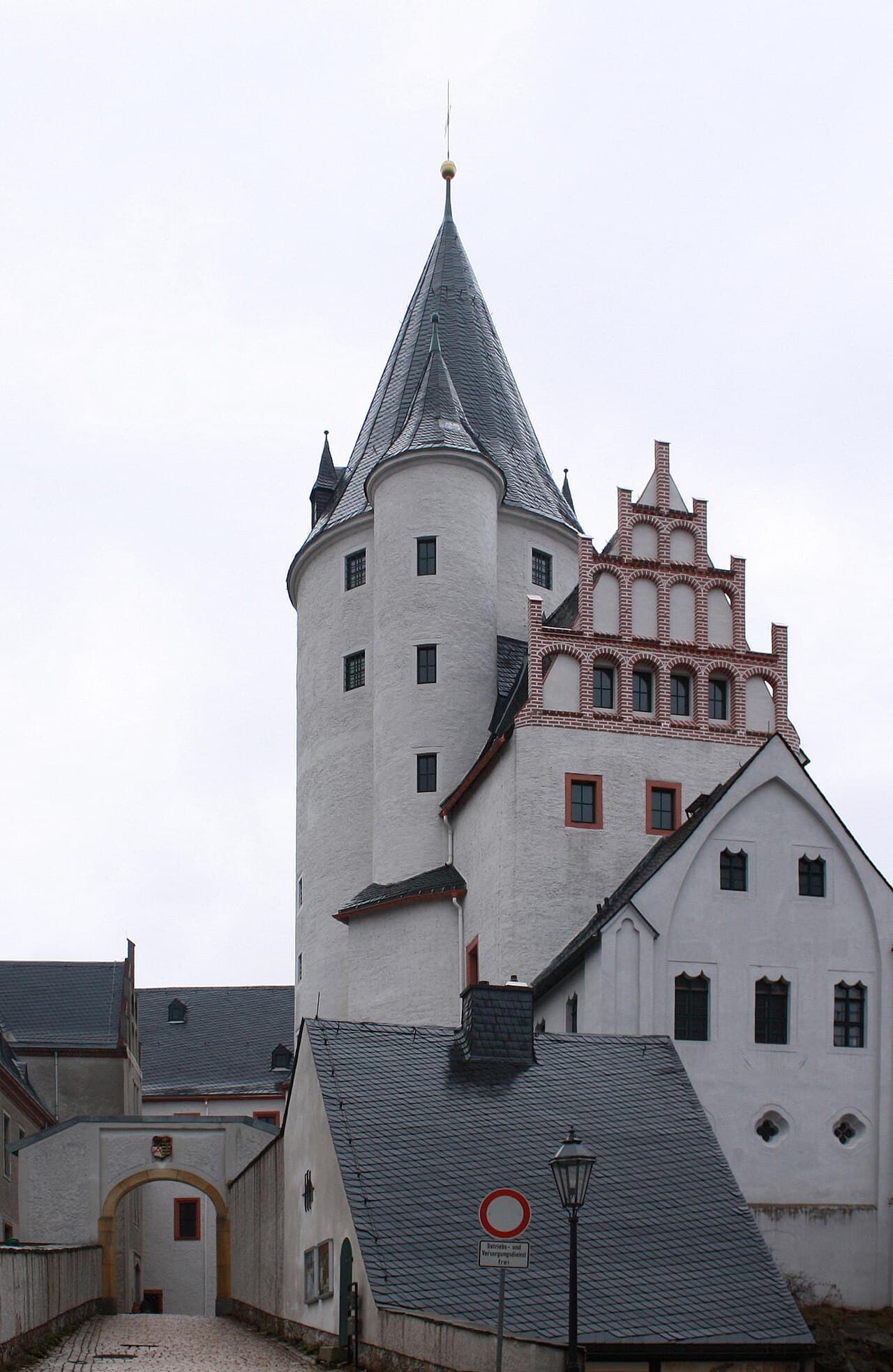
Schwarzenberg Castle — Germany castle

Schwarzenberg Castle

Schwarzenberg Castle in Saxony, Germany
Schwarzenberg, Germany
High Medieval (11th–13th c.)
Restored

Schwarzenberg Castle stands as a prominent historical landmark in the town of Schwarzenberg, Saxony, Germany. Dominating the town's skyline alongside St. George's Church, the castle's origins date back to the 12th century, when it was initially established as a medieval fortification. This early foundation served as the original base for the settlement of Schwarzenberg and its surrounding areas, marking the castle as a key defensive and administrative site in the region.

Medieval origins and early development

The castle's foundation in the high medieval period reflects the strategic importance of hilltop fortifications during this era. Originally constructed as a fort, Schwarzenberg Castle was designed to oversee and protect the surrounding territory. Its initial structure included fortified walls and a keep, which were typical defensive features of medieval hill castles. Over time, the castle became the nucleus around which the town of Schwarzenberg developed.

Transformation into a hunting lodge and renaissance renovations

Between 1555 and 1558, Schwarzenberg Castle underwent a significant transformation when it was converted into a hunting lodge for the Electorate of Saxony. This conversion introduced a more residential and representational character to the castle, blending its medieval defensive features with Renaissance architectural influences. The castle's keep and south wing were notably raised during renovations in 1851-1852, enhancing its stature and appearance. Later in the 19th century, an office building extension was added in 1875-1876, reflecting the castle's evolving administrative functions.

Architectural features and style

Schwarzenberg Castle exemplifies the architectural evolution from a medieval fortification to a Renaissance hunting lodge. Its hill castle classification denotes its elevated position, which was advantageous for defense and surveillance. The castle retains elements such as fortified walls, a prominent keep, and watchtowers, which highlight its original military purpose. The Renaissance modifications introduced more ornate and comfortable living spaces, aligning with the tastes and needs of the Saxon electors.

Historical significance and ownership

The castle has played a vital role in the region's history, serving variously as a military stronghold, administrative center, and noble residence. Its association with the Electorate of Saxony underscores its importance in Saxon political and social life. The castle's ownership and function evolved through the centuries, reflecting broader historical changes in governance and aristocratic culture.

Modern preservation and current status

Today, Schwarzenberg Castle is restored and maintained as a significant cultural heritage site. Its preservation allows visitors to appreciate the blend of medieval fortification and Renaissance elegance. The castle continues to be a focal point for the town of Schwarzenberg, attracting tourists interested in its rich history and architectural beauty.

Visitor information and cultural impact

Visitors to Schwarzenberg Castle can explore its historic structures and enjoy panoramic views of the surrounding Saxon landscape. The castle's proximity to St. George's Church enhances the cultural experience, offering insights into the region's medieval and Renaissance heritage. As a restored monument, it serves educational and tourism purposes, contributing to the local economy and cultural identity.

Frequently asked questions (FAQ)

How do I get to Schwarzenberg Castle?
Schwarzenberg Castle is located in the town of Schwarzenberg, Saxony, Germany. It is accessible by car and public transportation, with local bus services connecting the castle area to the town center.
What are the opening hours for Schwarzenberg Castle?
Opening hours for Schwarzenberg Castle vary seasonally. Visitors should check the official website or local tourist information for current times, as the castle is typically open during daylight hours.
Is there an admission fee to visit Schwarzenberg Castle?
Admission fees may apply for guided tours or special exhibitions. General entry to the castle grounds is often free, but visitors should verify ticket prices in advance.
What architectural styles are visible at Schwarzenberg Castle?
The castle features a blend of <strong>high medieval</strong> fortification elements and <strong>Renaissance</strong> style renovations, including fortified walls, a keep, and residential wings added during the 16th century.
Can I explore the interior of Schwarzenberg Castle?
Certain areas of Schwarzenberg Castle are open to the public, including historic rooms and exhibition spaces. Access may be limited to guided tours depending on preservation and event schedules.

Photo gallery

Schwarzenberg Castle
Click to view

Photo by Devilsanddust•CC BY-SA 3.0

1 photo • Click any image to view in full screen

Information

Hill Castle

Current owner

Municipality

Sources & official resources

Verify the information above using these authoritative references.

Loading map...

Visitor reviews

No reviews yet. Been here? Write the first review and help other travelers!

Write the first review

Visited this castle? Share your experience

Your review helps other travelers and adds first-hand knowledge to our encyclopedia.

Write a review

(5/5)

0/2000 characters

Your review will be visible after admin approval

Nearby castles

6.1 km

Syrgenstein Castle

Heimenkirch, Germany

Syrgenstein Castle is a notable example of a late medieval fortress located in Heimenkirch, Germany. Although the castle was first documented in 1265, the structure that stands today was constructed between 1480 and 1490. This period places the castle firmly within the late medieval era, a time characterized by the evolution of castle architecture to adapt to advances in siege technology and changing military tactics. Historical background and significance The earliest records mentioning Syrgenstein Castle date back to the mid-13th century, indicating its longstanding presence in the region. The castle was likely built initially as a fortified residence for local nobility or knights, serving both defensive and administrative functions. The current structure, erected in the late 15th century, reflects the architectural and strategic needs of the time, including thicker walls and improved fortifications designed to withstand artillery and other emerging threats. Throughout its history, Syrgenstein Castle played a role in the local power dynamics of the Allgäu region. Its strategic position would have allowed control over nearby trade routes and local settlements. The castle's ownership has changed hands multiple times, and today it remains privately owned, preserving its historical character. Architectural features and construction The castle, built between 1480 and 1490, exhibits typical late medieval defensive features. It likely includes a keep or donjon as the central stronghold, surrounded by thick curtain walls and possibly a moat or defensive ditch, common in castles of that period. The design would have balanced residential comfort with military functionality. While detailed architectural surveys are limited, the castle's construction period suggests the use of local stone materials and late medieval masonry techniques. The walls probably feature battlements and arrow slits, allowing defenders to repel attackers effectively. The castle's layout may include a courtyard, residential quarters, storage rooms, and defensive towers. Late medieval defensive adaptations During the late 15th century, castles like Syrgenstein were often modified to withstand the growing threat of gunpowder artillery. This would have influenced the thickness of the walls and the shape of towers, favoring rounded or angled bastions to deflect cannonballs. Although Syrgenstein is not classified as a bastioned fortress, it likely incorporated some of these defensive innovations. Current status and preservation Today, Syrgenstein Castle is privately owned and not generally open to the public. Its preservation status is consistent with many such castles that remain in private hands, where maintenance depends on the owners' resources and interest in heritage conservation. The castle remains an important cultural landmark within the Allgäu region, reflecting the architectural and historical development of the late medieval period in southern Germany. Visiting and accessibility As a privately owned property, Syrgenstein Castle is not typically accessible for public tours or visits. Visitors interested in viewing the castle are advised to respect private property rights and enjoy the castle's exterior views from public roads or nearby vantage points. The surrounding region offers rich opportunities for exploring other historical sites and the natural beauty of the Allgäu landscape.

Late Medieval (14th–15th c.)
Details
6.1 km

Ratzenried Castle

Ratzenried, Germany

Ratzenried Castle is a significant high medieval hill castle located in Ratzenried, Germany, with origins tracing back to the early 12th century. The castle was likely constructed to protect the extensive estates of the St. Gallen Monastery in the region and to facilitate the collection of agricultural tributes. Its strategic position on a prominent mountain spur provided natural defensive advantages, a site that may have been utilized as a fortification even before the medieval period. Early history and strategic importance The first documentary mention of the Lords of Ratzenried dates to 1145, indicating the castle's establishment around the same period. The castle's foundation is believed to be contemporaneous with other regional fortifications, such as Burg Praßberg near Wangen im Allgäu, initiated in 1123 for similar protective and administrative purposes. The Lords of Ratzenried served as vassals to the monastery, overseeing the castle and the surrounding lands. By the late 13th century, the original Ratzenried lineage had vanished, but the castle remained a significant seat of power. Subsequent owners took on the Ratzenried name, preserving the castle’s identity and its role in local governance and defense. Ownership transitions and architectural developments In the mid-14th century, the castle changed hands, reflecting the turbulent political landscape of the region. Around 1350, the original owners lost control and relocated to East Allgäu. From 1353, the Lords of Molpertshausen occupied the castle, with official ownership granted by the Abbot of St. Gallen to Hans von Molpertshausen in 1369. Approximately a decade later, the castle was sold to the Humpis von Ravensburg family, who in the 16th century adopted the name Humpis von Ratzenried. This family undertook significant restoration efforts, notably in 1502 when Jos Humpis von Ratzenried invested 11,000 guilders to repair the castle, which had fallen into disrepair. Architectural features and medieval fortifications The exact appearance of the original 12th-century castle remains uncertain, but it is assumed that remnants of the old keep and outer defensive walls survive. These walls likely featured arrow slits for archers, typical of medieval military architecture designed to repel attackers while providing protection for defenders. There are suggestions of a possible reconstruction around 1220, potentially initiated by a Staufer Duke, though details remain unclear. The castle’s design would have incorporated typical high medieval defensive elements such as a fortified keep, curtain walls, and possibly a moat or natural barriers enhanced by man-made defenses. Destruction and later history During the Thirty Years' War in 1632, Ratzenried Castle suffered significant damage when it was burned down by Swedish forces. Financial constraints prevented its reconstruction, leading to its decline into ruin. In the 19th century, the castle passed through various political hands, reflecting the shifting borders and governance of the region. It became part of the Kingdom of Bavaria in 1806, then transferred to Württemberg in 1810. Ownership later passed to the Beroldingen Counts in 1813 and eventually to the Waldburg-Zeil Counts in 1908. Cultural significance and preservation Today, Ratzenried Castle stands as a partially preserved medieval ruin, offering valuable insights into the high medieval fortification techniques and feudal history of the Allgäu region. Its location on a mountain spur highlights the medieval preference for naturally defensible sites. While much of the castle remains in ruins, surviving elements such as the keep foundations and sections of the outer walls with arrow slits provide important archaeological and architectural evidence of its original structure and function. The castle’s enduring legacy is intertwined with the history of the St. Gallen Monastery’s territorial control, the noble families who held it, and the military conflicts that shaped its fate. It remains a point of interest for historians and visitors interested in medieval architecture and the feudal history of southern Germany.

High Medieval (11th–13th c.)
Details
7.7 km

Neuravensburg Castle

Wangen im Allgäu, Germany

Neuravensburg Castle is a historic medieval fortress located in Wangen im Allgäu, Germany. Constructed at the end of the 12th century, it was originally built by the Counts of Argengau, a noble family influential in the region during the High Medieval period. The castle's strategic position provided control over important trade routes and local territories, reflecting the feudal power structures of the time. Early history and original construction The castle is first mentioned in historical records in 1271, indicating its established importance by the late 13th century. As a typical hill castle of the High Medieval period, Neuravensburg was designed primarily for defense and residence. Its original layout included a keep (donjon), which served as the fortified residence and last line of defense, surrounded by curtain walls and possibly a moat, typical of the era's military architecture. Destruction and rebuilding in the early modern period Neuravensburg Castle suffered significant damage during the Peasants' War of 1525, a widespread uprising that affected many castles and noble estates across southern Germany. The castle was destroyed in this conflict, reflecting the social upheaval and decline of feudal authority during the early 16th century. Between 1614 and 1617, the castle underwent major reconstruction and expansion under the direction of Abbot Bernhard Müller of the St. Gallen Abbey. This transformation converted the medieval fortress into a more comfortable and representative residence, blending defensive features with the architectural styles of the Renaissance period. The rebuilding included enlarging the living quarters and adding new structural elements, although much of the medieval character was retained. 19th-century decline and partial dismantling By the 19th century, Neuravensburg Castle had lost much of its strategic and residential importance. In 1836, it was sold with the intention of demolition. Over the following decade, from 1837 to 1845, significant portions of the castle were dismantled, reducing it to ruins. This was a common fate for many castles during this period, as changing political and economic conditions made their upkeep impractical. Modern preservation and restoration efforts In 1987, the Neuravensburg Castle and Homeland Association was established to promote the preservation and research of the castle complex. The city of Wangen acquired the castle ruins in 1992, initiating further restoration work between 1995 and 1996. These efforts focused on stabilizing the remaining structures and making the site accessible to the public. Today, visitors can explore the ruined keep, which includes a viewing platform accessible from the interior, offering panoramic views of the surrounding landscape. The foundation walls of the former palace are also preserved, providing insight into the castle's original scale and design. The entrance to the castle ruins is located at Hagmühleweg, making it easily reachable for visitors interested in medieval architecture and regional history. Architectural features and significance Neuravensburg Castle exemplifies the evolution of castle architecture from the High Medieval defensive stronghold to a more residential and representational Renaissance castle. The surviving keep ruins highlight the medieval military design, while the later expansions reflect changing tastes and functions in castle construction. The castle's location on a hill provided natural defensive advantages, with thick stone walls and elevated towers designed to withstand sieges. The remains of the palace foundations reveal the scale of the residential quarters added during the early 17th century reconstruction. Cultural importance and visitor experience Neuravensburg Castle remains an important cultural landmark in the region, symbolizing the historical shifts from feudal power to ecclesiastical influence and later secular decline. The site offers educational opportunities about medieval and early modern architecture, feudal history, and the social conflicts such as the Peasants' War. Visitors can enjoy walking tours of the ruins, interpretive signage, and panoramic views from the keep's platform. The castle's preservation by the local association and the city ensures ongoing research and public engagement with this significant heritage site.

High Medieval (11th–13th c.)
Details

