Schwanenburg Castle
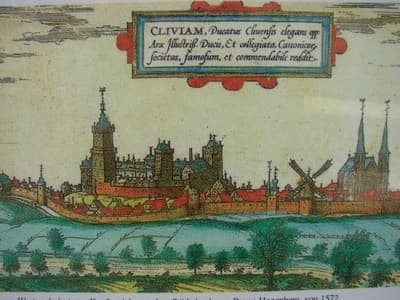
Schwanenburg Castle, perched on a steep hill in Kleve, North Rhine-Westphalia, is a landmark steeped in medieval history and architectural evolution. Founded in the 11th century, this hill castle served as the residence of the Counts and later the Dukes of Cleves, playing a central role in the region's political and cultural development. The castle's most iconic feature, the Schwanenturm (Swan Tower), rises approximately 55 meters and is famously linked to the legend of the Knight of the Swan, immortalized in Richard Wagner's opera Lohengrin. The castle complex blends medieval fortifications with Renaissance and Baroque architectural influences, reflecting centuries of adaptation and restoration.
Medieval origins and early development
The origins of Schwanenburg Castle trace back to the late 11th century, with the earliest documented mention dating to 1092, associated with Count Dietrich I of Kleve. Contrary to earlier theories suggesting Roman foundations, archaeological studies confirm the castle's medieval genesis. By the late 12th century, the castle had evolved into a formidable fortified residence featuring substantial stone walls, a polygonal ring wall, and an artificially created ditch protecting its southern approach. These defensive structures underscore the castle's strategic importance on the Hartenberg ridge, a raised plateau with steep drops on three sides, providing natural protection.
Symbolism and heraldry
In the early 13th century, the Counts of Kleve adopted the carbuncle heraldic figure, linked to the legendary Swan Knight Helias, as part of their coat of arms. This emblem inspired the name of the Schwanenturm and ultimately the castle itself during the 19th century. The castle's association with the Swan Knight legend enhances its cultural significance and connects it to broader European medieval mythology.
Urban development and political significance
In 1242, Count Dietrich IV founded the settlement of Kleve just west of the castle, granting it city rights and establishing Schwanenburg as the administrative center of the county. The castle remained the seat of the Counts and later Dukes of Kleve, who expanded their territory and influence throughout the 16th century. The elevation of Adolf II of Kleve-Mark to Duke of Kleve in 1417 marked a period of increased prestige, although the ducal court often resided elsewhere, such as Düsseldorf or Jülich, limiting Schwanenburg's role as a primary residence.
Renaissance and baroque transformations
Following the extinction of the Kleve counts' male line in 1368, the castle passed to the Counts of Mark and later became part of the United Duchies of Jülich-Cleves-Berg. After Duke Johann Wilhelm died without an heir in the early 17th century, control transferred to the Margraviate of Brandenburg. Under Brandenburg's governor Johann Moritz of Nassau-Siegen, starting in 1649, the castle underwent significant renovations.
Dutch baroque remodeling by pieter post
Between 1663 and 1666, the renowned Dutch architect Pieter Post led an extensive Baroque renovation of Schwanenburg. This project introduced a large gate passage wing adorned with the Brandenburg coat of arms, which remains the castle's main entrance today. The addition of Renaissance arcades to both courtyards reflected contemporary architectural tastes, blending Renaissance elegance with the castle's medieval fabric. Post also designed extensive gardens, including the Forstgarten, which significantly influenced European landscape design in the 17th century.
Architectural features and layout
The castle occupies approximately 6,300 square meters on the plateau, with a crescent-shaped western section and a straight eastern side aligned with the plateau's edge. A transverse wing divides the complex into northern and southern courtyards, both roughly triangular. The southern courtyard is dominated by the Spiegelturm (Mirror Tower), a 28-meter-high square tower with a slate roof and weather vanes. Its ground floor features a barrel vault ceiling, while the first floor has a groin vault supported by a central pillar. The tower's south face is fortified with basalt blocks up to five meters high.
Attached to the Spiegelturm is the Alte Kanzlei, a four-story building dating from 1463, historically serving as a prison. The northern courtyard features Renaissance arcades supported by brick pillars and incorporates architectural spolia from the demolished medieval palas, including richly decorated black stone columns and arches. The former residential building's outer walls partly consist of the medieval ring wall, which reaches up to three meters thick.
The Schwanenturm stands as the tallest structure at 54 meters. Built of tuff stone with trachyte corner accents, it has a square base covering 180 square meters and walls 3.25 meters thick at the ground floor. The lower seven floors end with a projecting pointed arch frieze and a battlement walkway with turreted corners. Above are two smaller floors with another battlement and corner watchtowers, topped by a pointed roof crowned by a lantern. An inscription plaque at the entrance commemorates its construction.
Modern history and restoration
In the 18th century, the castle's political importance declined as Prussia centralized administration in Berlin and Potsdam. Schwanenburg transitioned to administrative and judicial functions, serving as a courthouse and prison during the 19th and early 20th centuries. Parts of the castle, including the chancery buildings and the knights' hall, were demolished due to neglect.
Damage and reconstruction after world war ii
On October 7, 1944, during World War II, Kleve suffered a devastating bombardment. An Allied plane crashed into the Swan Tower, causing a catastrophic explosion that severely damaged the castle and destroyed much of Kleve's historic center. Reconstruction of Schwanenburg took place between 1948 and 1953, with restoration efforts continuing into the late 20th century. Today, the castle houses the district and district court of Kleve, maintaining its administrative legacy.
Current use and cultural significance
Schwanenburg remains a vital cultural and historical symbol for Kleve and the surrounding region. The Swan Tower hosts a small geological museum operated by the local history museum, while the Spiegelturm is accessible via guided tours, offering visitors insight into the castle's layered history. The castle's blend of medieval fortifications, Renaissance arcades, and Baroque renovations exemplifies the architectural evolution typical of European castles adapting to changing political and cultural contexts.
The surrounding gardens, inspired by Pieter Post's 17th-century designs, continue to influence landscape architecture and attract visitors interested in historical garden art. Schwanenburg Castle's enduring presence on the Kleve skyline, its legendary associations, and its architectural richness make it a significant heritage site in Germany.
Frequently asked questions (FAQ)
- What is the historical significance of Schwanenburg Castle?
- Schwanenburg Castle served as the residence of the Counts and Dukes of Kleve from the 11th century, playing a central role in regional politics and culture.
- Can I visit the Swan Tower and other parts of Schwanenburg Castle?
- Yes, the Swan Tower houses a geological museum and is accessible via guided tours, which also include other parts of the castle and its courtyards.
- When was Schwanenburg Castle built?
- The castle was founded in the 11th century, with the earliest documented mention in 1092 linked to Count Dietrich I of Kleve.
- What architectural styles are present at Schwanenburg Castle?
- The castle features a mix of medieval fortifications, Renaissance arcades, and Baroque renovations, reflecting its long history and adaptations.
- How was Schwanenburg Castle affected by World War II?
- In 1944, the castle was severely damaged when an Allied plane crashed into the Swan Tower during a bombardment, leading to extensive post-war reconstruction.
- Are there gardens associated with Schwanenburg Castle?
- Yes, the castle's gardens were designed in the 17th century by Pieter Post and have influenced European landscape design, with the Forstgarten being a notable example.
Photo gallery

Photo by Arch•Public domain
Information
Opening hours
Guided tours available; check local listings
Ticket prices
Varies; small fee for tours
Current owner
District and district court of Kleve
Website
Visit websiteSources & official resources
Verify the information above using these authoritative references.
Loading map...
Visitor reviews
No reviews yet. Been here? Write the first review and help other travelers!
Write the first reviewVisited this castle? Share your experience
Your review helps other travelers and adds first-hand knowledge to our encyclopedia.