Moyland Castle
Moyland Castle stands as a striking example of neo-Gothic architecture in North Rhine-Westphalia, Germany. This moated castle, located in the town of Bedburg-Hau, is renowned not only for its architectural grandeur but also as a prominent cultural institution housing the world's largest collection of works by the influential artist Joseph Beuys. The castle's name originates from the Dutch word Mooiland, meaning "beautiful country," reflecting its picturesque setting and historic charm.
The origins of Moyland Castle trace back to the early 14th century, with the first documented mention in 1307 as a fortified farmstead leased by Jacob van den Eger from Count Otto of Kleve. Between 1345 and 1355, the estate was transformed by Roland von Hagedorn into a classic Gothic castle featuring a square layout with four towers, including a prominent dungeon tower. This medieval structure was characterized by defensive walls, battlements, and a great hall on the western side, with a bailey and gate providing access from the south.
Medieval origins and gothic transformation
During the 14th century, the castle's design embodied typical high medieval military architecture with its moat, ramparts, and fortified towers. The fourth round tower, serving as a dungeon, was equipped with essential amenities such as a well, latrine, light niches, and a fireplace, demonstrating the castle's dual role as a fortress and residence. In the 15th century, the castle expanded with additional wings built within the courtyard and the addition of a decorated chapel in the east tower, enhancing its residential and religious functions.
Baroque renovations and prussian royal connections
The castle experienced significant changes during the Baroque period, especially after its acquisition by Brandenburg Field Marshal Alexander von Spaen in 1662. Von Spaen initiated renovations inspired by the nearby town of Kleve, introducing symmetrical window arrangements, vaulted cellar rooms, and axial approach roads that emphasized grandeur and order. Around 1695, the castle was sold to Elector Friedrich I of Brandenburg, later King of Prussia, who used Moyland primarily as a hunting lodge and private retreat. Notably, King Frederick II, known as Frederick the Great, met the philosopher Voltaire at Moyland Castle in 1740. Their meeting led to the conception of a philosopher academy called the "Truth Factory," underscoring the castle's cultural significance during the Enlightenment.
19th-century neo-gothic remodeling
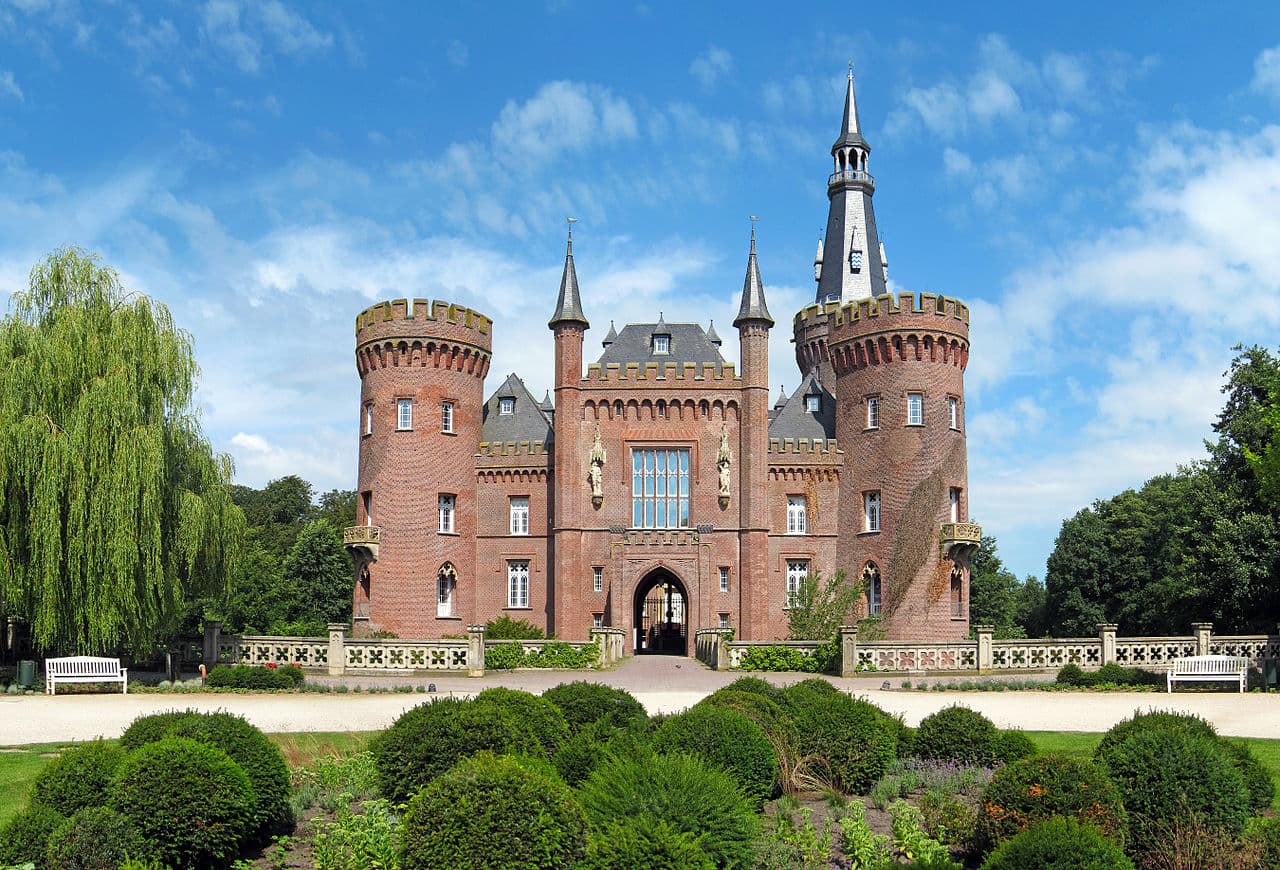
Between 1854 and 1862, the castle underwent a major transformation under the direction of Ernst Friedrich Zwirner, the master builder of Cologne Cathedral. This renovation embraced the neo-Gothic style, a historicist architectural movement that revived medieval Gothic elements with romanticized features. Zwirner preserved much of the Baroque interior while encasing the castle walls in red brick, adding battlements supported by corbels, and installing pointed arch windows on the towers. The three horseshoe-shaped corner towers were enhanced with battlements, and the southeast keep was topped with a historicist pointed roof. The gatehouse was redesigned and connected to the main building by a newly constructed stone bridge, while the fore-castle was rebuilt on the foundations of its medieval predecessor.
Architectural features and layout
The castle's layout consists of four wings arranged in a square plan surrounding a central courtyard. The southeast wing features the gatehouse flanked by two polygonal towers with pointed roofs externally and two slender round towers internally. The upper floor houses the Zwirner Hall, a venue for concerts and cultural events. The main entrance stairway is adorned with metal railings decorated with animal figures, including lions, a wolf, and a pug. These sculptures commemorate historical visits by Voltaire and Winston Churchill, linking the castle's architecture to its rich human history.
20th-century history and wartime impact
Owned by the von Steengracht family from 1766 until 1990, Moyland Castle served as a family residence for over two centuries. During World War II, the castle remained relatively intact until February 1945, when it was occupied by Allied forces. Field Marshal Bernard Montgomery established his headquarters here, and British Prime Minister Winston Churchill visited the site. Unfortunately, after the military occupation, the castle suffered extensive looting and vandalism by Canadian soldiers, resulting in the loss of much of its sumptuous interior furnishings.
Postwar restoration was delayed due to a fire in 1956, leaving the castle in a state of ruin for decades. Restoration efforts began in 1987 after the establishment of the Museum Schloss Moyland Foundation in 1990, dedicated to the castle's reconstruction and the restoration of its gardens according to historical documentation. The restored castle reopened as a museum in 1997, marking a new chapter in its history.
Museum and cultural significance today
Today, Moyland Castle functions as a museum housing an extensive art collection amassed by the brothers Hans and Franz Joseph van der Grinten. The collection spans the 19th and 20th centuries, featuring works by artists such as Erwin Heerich, Willem den Ouden, Rudolf Schoofs, and Hermann Teuber. The centerpiece is the nearly 5,000-piece collection of Joseph Beuys, making it the largest repository of his work worldwide.
The castle park and sculpture garden
The surrounding park, originally designed in the early 19th century and restored in the 1990s, combines elements of English landscape gardens with Baroque garden architecture. It features avenues, ditches, and a blend of landscaped and herb gardens. Since 2004, the park has been part of the "Road of Garden Art" tourist route and hosts sculptures by renowned contemporary artists including James Lee Byars, Eduardo Chillida, Hans Karl Burgeff, and Antoni Tàpies.
Library and archives
The castle also houses a museum library containing over 60,000 volumes and the Joseph Beuys Archive, which preserves approximately 200,000 documents related to the artist's life and work, underscoring Moyland's role as a center for artistic research and cultural heritage.
Frequently asked questions (FAQ)
- What is the historical significance of Moyland Castle?
- Moyland Castle, built in the 14th century, is a remarkable example of Gothic architecture in the Lower Rhine region. Its rich history includes serving as a residence for various noble families and later becoming a museum that houses a significant collection of modern art.
- When was Moyland Castle constructed?
- Moyland Castle was originally constructed in the 14th century, with notable renovations occurring in the 19th century. These renovations expanded the castle's architectural features, enhancing its beauty and historical value.
- What are the opening hours of Moyland Castle?
- Moyland Castle is typically open to visitors from Tuesday to Sunday, with varying hours depending on the time of year. It is advisable to check the official website for the most current opening hours before your visit.
- Can I visit Moyland Castle with children?
- Yes, Moyland Castle is family-friendly and welcomes visitors of all ages. There are often special programs and activities for children, making it an enjoyable experience for families.
- Is it possible to explore the grounds of the castle?
- Absolutely! Visitors are encouraged to explore the beautiful grounds surrounding Moyland Castle. The gardens and parkland provide a perfect setting for leisurely walks and picnics.
- What are the ticket prices for visiting Moyland Castle?
- Ticket prices for Moyland Castle are generally affordable, with discounts available for students, seniors, and families. It's best to purchase tickets in advance online or check at the entrance for current pricing.
- When is the best time to visit Moyland Castle?
- The best time to visit Moyland Castle is during the spring and summer months when the gardens are in full bloom and outdoor activities are plentiful. However, the castle also offers unique events and exhibitions throughout the year, making it worthwhile to visit any season.
- How do I get to Moyland Castle from nearby cities?
- Moyland Castle is easily accessible by car and public transportation from nearby cities like Kleve and Duisburg. Detailed directions can be found on the castle's official website, ensuring a smooth journey for visitors.
- What nearby attractions can I visit while at Moyland Castle?
- While visiting Moyland Castle, you can also explore the nearby town of Bedburg-Hau, known for its charming atmosphere and local cafes. Additionally, several nature reserves and historical sites are within a short drive, providing a full day of exploration.
Photo gallery

Information
Sources & official resources
Verify the information above using these authoritative references.
Loading map...
Visitor reviews
No reviews yet. Been here? Write the first review and help other travelers!
Write the first reviewVisited this castle? Share your experience
Your review helps other travelers and adds first-hand knowledge to our encyclopedia.