Schönfels Castle
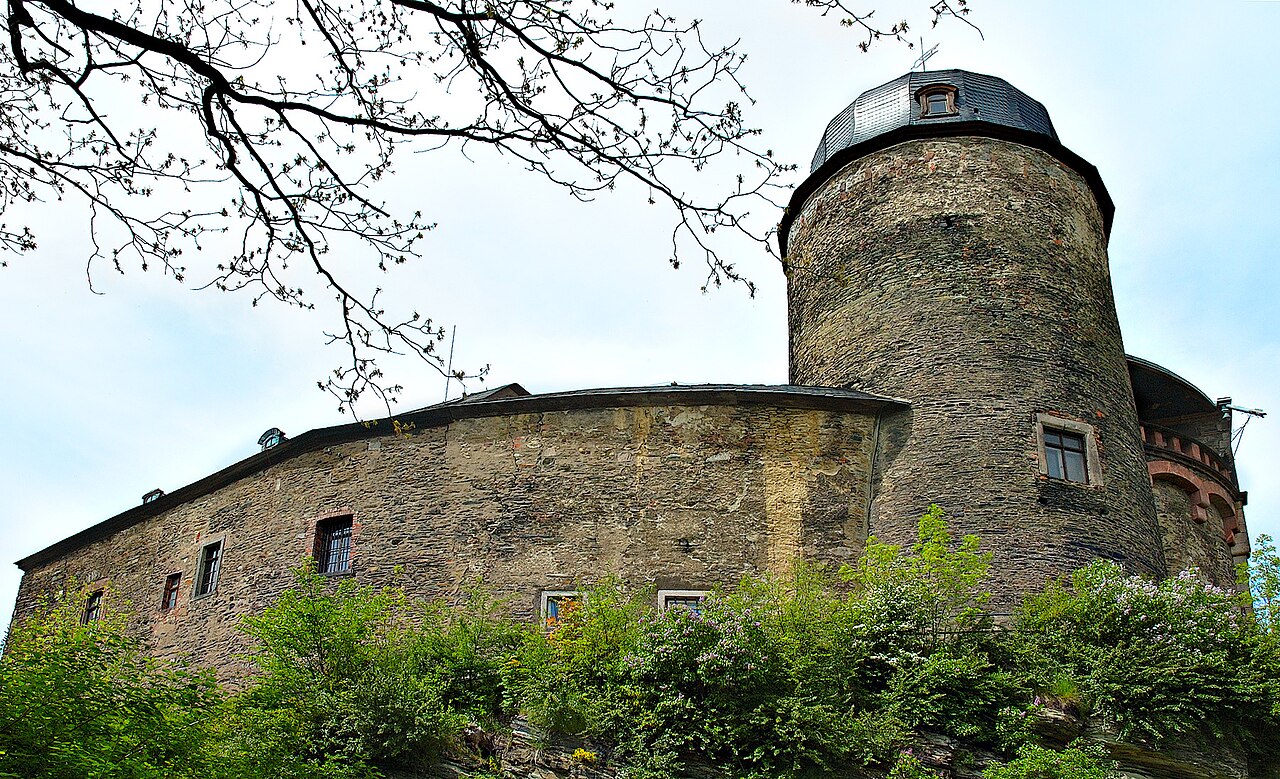
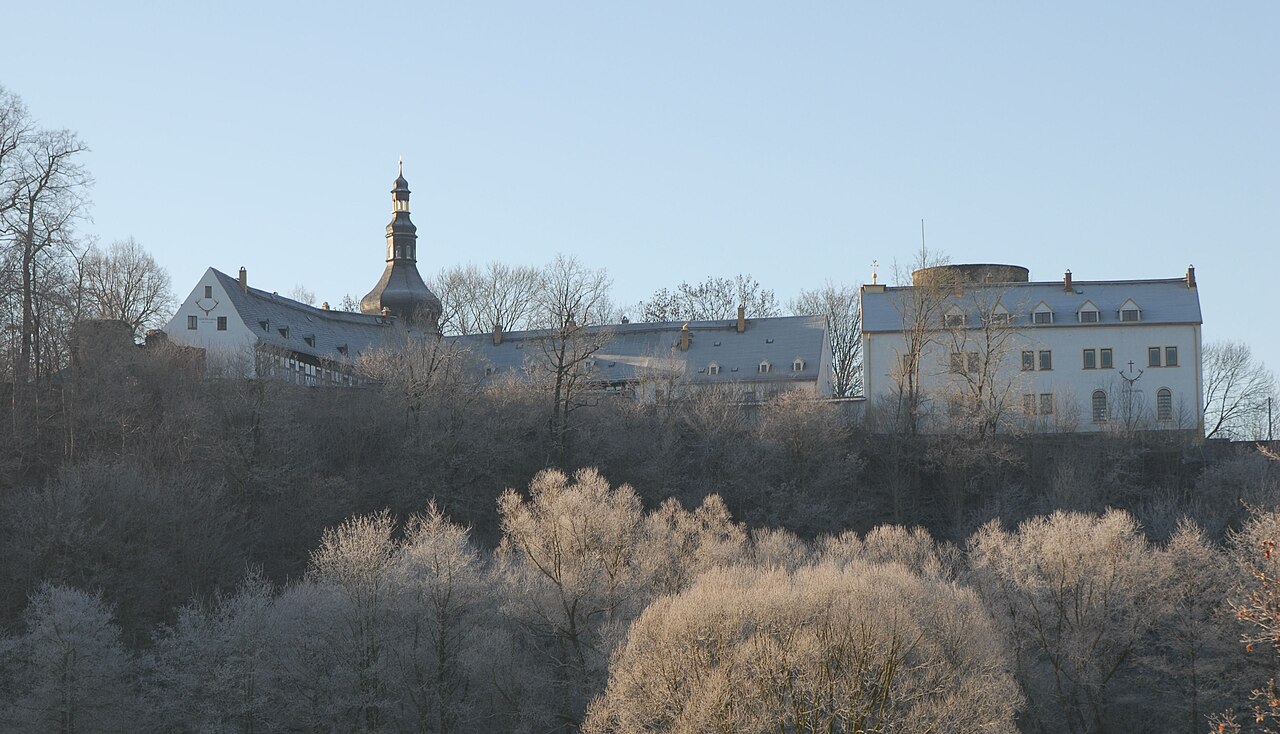
Schönfels Castle stands as a remarkable example of a high medieval hill castle in the municipality of Lichtentanne, Germany. Constructed around 1200 on a basalt cone rising 393 meters above sea level, it overlooks the Schönfelser Bach stream, commanding a strategic position typical of medieval fortifications. The castle's enduring presence offers a vivid window into the architectural, political, and social history of the region, blending defensive military features with residential and ceremonial spaces.
The origins and early history of Schönfels Castle
Built during the late 12th to early 13th century, Schönfels Castle was established by settlers from the Saxon regions as part of efforts to secure and administer the frontier lands near the Pleisse border marches. The first documented mention of the castle dates to 1225, associating it with the von Schönfels family who acted as castellans under the authority of the Bishop of Naumburg. This early phase highlights the castle's role as a seat of local administration and military oversight in a contested border area.
Throughout the subsequent centuries, ownership transitioned among various noble families, including the Vögte of Gera and Plauen and later the Reuß family, with notable figures such as Heinrich II and Heinrich IV Reuß von Plauen. The castle's strategic importance was recognized by the Wettin margraves of Meissen, who acquired it in 1398, integrating it into their expanding territorial holdings.
Political shifts and noble ownership from the 15th to 18th centuries
Following the Leipzig Partition of 1485, Schönfels Castle came under the Ernestine Electorate of Saxony, before transferring to the Albertine line after the political reorganization in 1547. Between 1586 and 1770, the castle passed through the hands of several noble families, including the von Milckau, von Carlowitz, von Groß zu Altenhain, and von Dieskau families. Each contributed to the castle's evolution, particularly in adapting its residential quarters and fortifications to the changing demands of the period.
From 1770 until 1945, the castle was owned by the von Römer-Rauenstein family foundation, linked to a prosperous merchant lineage from Zwickau involved in Saxony’s mining industry. During this era, the castle was largely unoccupied except for a forester’s apartment, a circumstance that inadvertently preserved much of its medieval character by preventing modern alterations.
Architectural features and preservation
Layout and defensive structures
Schönfels Castle's layout centers on an oval main fortress area comprising two distinct courtyards. As a hill castle, it incorporates classic defensive elements such as a bergfried (main tower), which served as both a lookout and last refuge during sieges. Surrounding the core castle is a wehrgang or defensive wall walk, allowing guards to patrol and defend the perimeter effectively.
The castle's entrance is marked by a robust gatehouse featuring a schallloch (sound hole), an architectural detail designed to facilitate communication or alert defenders through sound signals. An arcaded gallery, known as a laubengang, provides covered passageways within the complex, enhancing both defense and daily movement.
Residential and ceremonial spaces
Inside, the castle boasts a late Gothic wooden-paneled Bohlenstube with a characteristic pointed arch door, reflecting the stylistic preferences of the period. The castle chapel, dating from the 17th century, is a highlight of the complex. It houses a richly painted winged altar crafted around 1600 by Mathias Crodel the Younger, an artwork of significant historical and artistic value.
The chapel also contains a rare wooden cabinet organ from circa 1730, notable for its survival as an uncommon example of this musical instrument type in Europe. The richly decorated baroque pulpit further enhances the chapel's interior, illustrating the blend of Gothic and Baroque influences within the castle.
Modern history and cultural significance
After World War II, Schönfels Castle was expropriated and became public property. It was registered as a protected archaeological monument in 1971, recognizing its cultural and historical importance. Restoration efforts were undertaken to safeguard its heritage, and the castle opened as a museum in 1975, allowing public access to its well-preserved medieval and early modern interiors.
Since 1995, the municipality of Lichtentanne has managed the castle, supported by regional cultural organizations and a dedicated association committed to its upkeep and educational outreach. The castle has also served as a filming location in the late 20th century, appearing in productions in 1988 and 1994, which has helped raise its profile and attract visitors.
The castle's exceptional preservation is largely due to minimal habitation and the absence of extensive modern renovations, allowing it to retain original structural and decorative elements. This makes Schönfels Castle a valuable resource for understanding medieval fortification architecture and the lifestyle of its former noble residents.
Visiting Schönfels Castle today
Visitors to Schönfels Castle can explore its ramparts, moat, bergfried, gatehouse, and arcaded galleries, gaining insight into medieval defensive strategies. The interior spaces, including the Bohlenstube and castle chapel, offer a glimpse into the artistic and religious life of the castle's inhabitants.
The castle's location on a basalt cone provides scenic views of the surrounding landscape, enhancing the visitor experience. Guided tours and exhibitions help contextualize the castle's history, architecture, and the noble families who shaped its development over centuries.
Frequently asked questions (FAQ)
- What is the best time to visit Schönfels Castle?
- The best time to visit Schönfels Castle is during the warmer months from late spring to early autumn when the weather is pleasant and the castle grounds are fully accessible.
- Is Schönfels Castle accessible for visitors with limited mobility?
- While the castle is situated on a hill, some areas may be challenging for visitors with limited mobility. It is advisable to check with the local visitor center for specific accessibility information and assistance.
- Are guided tours available at Schönfels Castle?
- Yes, guided tours are offered to provide detailed historical and architectural insights, enhancing the visitor experience. Check the castle's official website or local tourist information for tour schedules.
- What are the opening hours of Schönfels Castle?
- Schönfels Castle is typically open to visitors during daytime hours, with specific opening times varying by season. It is recommended to consult the official site or local tourist office for current hours.
- Are there any special events held at Schönfels Castle?
- The castle occasionally hosts cultural events, exhibitions, and historical reenactments that celebrate its heritage and engage the community. Visitors should check the event calendar for upcoming activities.
Information
Sources & official resources
Verify the information above using these authoritative references.
Loading map...
Visitor reviews
No reviews yet. Been here? Write the first review and help other travelers!
Write the first reviewVisited this castle? Share your experience
Your review helps other travelers and adds first-hand knowledge to our encyclopedia.