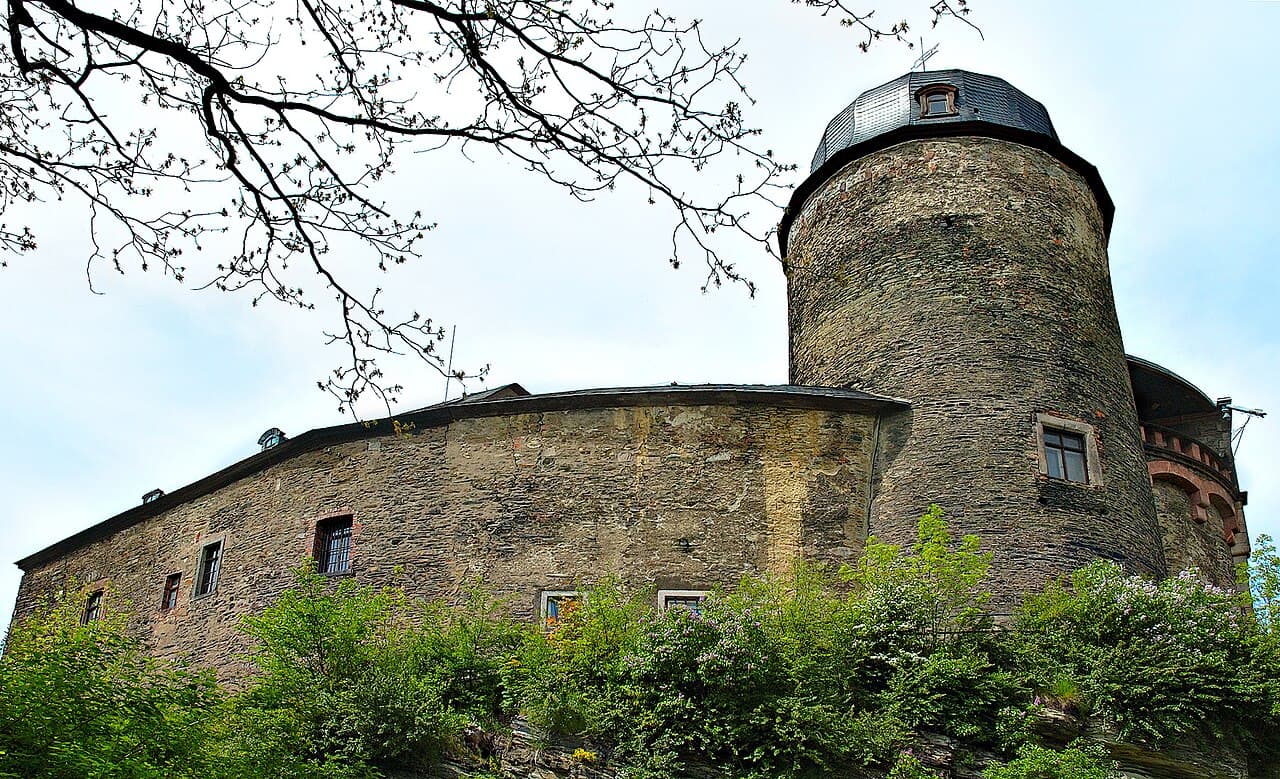
Mylau Castle
Mylau Castle stands as one of the most well-preserved medieval castles in Saxony, Germany. Located in the town of Mylau, this high medieval hill castle was likely constructed in the 12th century during the German eastward expansion under Emperor Frederick Barbarossa. Its strategic position on a rocky ridge overlooking the confluence of the Göltzsch river and its tributary, the Seifenbach, provided an ideal defensive site and control point for the surrounding region.
The castle’s origins are closely tied to the settlement of predominantly Frankish colonists in an area previously sparsely inhabited by Slavic peoples. The earliest recorded inhabitants were the Lords of Milin, documented in 1214. Over the centuries, Mylau Castle evolved through numerous phases of construction, destruction, and renovation, reflecting the complex political and military history of the Vogtland region.
Architectural features and construction
Originally, Mylau Castle was designed as a hill castle with a single courtyard, situated on a ridge approximately 80 meters long and 35 meters wide. The castle was surrounded by a dry moat roughly 10 meters deep, enhancing its defensive capabilities. Four defensive towers framed the castle, including a prominent 27-meter-high bergfried constructed in the Romanesque style around the time of initial construction. This bergfried served as a stronghold and lookout point, typical of high medieval fortifications.
Following damage sustained during a feud in 1400, the castle underwent significant reconstruction, including the addition of two large outer baileys. These baileys expanded the castle’s defensive and administrative areas, accommodating the evolving needs of its rulers. The castle’s layout, with its elongated ridge and multiple defensive layers, exemplifies the strategic military architecture of the high medieval period.
In the late 19th century, Mylau Castle experienced a historicist renovation that introduced new architectural elements. A city hall building was constructed in the upper courtyard using rubble stone and decorated with local Rochlitz porphyry. The gable of this building features the emblem of the German imperial crown from the era of the German Empire, symbolizing the castle’s continued civic importance.
Notable interior spaces
The castle’s council chamber is its most representative room, inspired by the Wartburg Castle in Thuringia. It features a wood-paneled ceiling and Neo-Renaissance ornamental wall paintings. The gable field houses a marble bust of King Albert, while stained glass windows crafted by the Cologne workshop Schneiders & Schmolz in 1890 add to the room’s historic ambiance. Above the main entrance gate, a porphyry relief of Emperor Charles IV highlights the castle’s historic ties to the Bohemian crown.
Historical significance and ownership
Mylau Castle played a crucial role in the regional power dynamics of the Vogtland. After the Vogtland War (1354–1357), Emperor Charles IV ordered the sale of the castle to the Bohemian crown in 1367. That same year, he granted town privileges to the adjacent town of Mylau and established a royal Bohemian administrative office within the castle. This marked the castle’s emergence as a center of governance and royal authority.
Under Charles IV and his sons, Wenceslaus IV and Sigismund, the castle was expanded and fortified. However, a feud in 1400 between Wenceslaus IV and the Vogtland vogts resulted in partial destruction. The subsequent reconstruction included the addition of the outer baileys and further strengthening of the castle’s defenses.
In 1422, Emperor Sigismund pledged the castle to the Electorate of Saxony as a reward for support during the Hussite Wars. Except for a brief period between 1547 and 1569 when a burgrave governed the Vogtland from the castle, it remained under Saxon control. The castle passed through several noble families, including the Metzsch, Schönberg, Bose, and Planitz families. Notably, Joseph Levin von Metzsch, a friend of Martin Luther and an early supporter of the Reformation, served as burgrave in the 16th century.
By the late 16th century, under the aristocratic Von Schönberg family, the castle transitioned from a military fortress to a residential estate. Its defensive role diminished, and it became a noble residence. In 1772, the castle lost its aristocratic estate status and entered private ownership.
Industrial use and cultural transformation
Between 1808 and 1828, the castle housed the first factory in northern Vogtland, established by the local spinning magnate Christian Gotthelf Brückner. Later, from 1868 to 1894, it was home to the Baust calico and wool printing works, reflecting the region’s industrial development. These industrial uses led to several renovations and adaptations of the castle’s structures.
In 1892, the castle became municipal property. A local foundation undertook a historicist remodeling, transforming the castle into a multifunctional civic building housing the city hall, tavern, and museum. The castle’s museum, opened in 1883, contains the largest natural history collection in the Vogtland region. It also features exhibits on regional geology, mining, and the construction of the nearby Göltzsch Viaduct, one of the largest brick bridges in the world.
Museum collections and exhibitions
The museum within Mylau Castle is renowned for its extensive natural history collection, the largest in Vogtland. It offers visitors insights into the regional geology and mining history, providing context for the area's economic and cultural development. Additionally, the museum highlights engineering achievements such as the construction of the Göltzsch Viaduct, an iconic 19th-century railway bridge renowned for its size and architectural significance.
Since 2010, the museum has been managed by the Evangelical School Association Vogtland e.V., which installed a new permanent exhibition in 2014 and 2015. This exhibition continues to emphasize the castle’s role as a cultural and educational hub in the region.
Castle grounds and visitor experience
The castle complex includes a market gate leading to the imperial court, along which informational panels explain the castle’s architectural features and historical context. Visitors can explore the castle grounds via hiking trails that offer scenic views of the town of Mylau and the surrounding landscape.
The castle’s archaeological layers span from the 13th century to modern times, reflecting its continuous adaptation and reuse. Its protected status as an archaeological monument, established in 1956, ensures the preservation of its historic structures and artifacts.
Today, Mylau Castle stands as a testament to the region’s rich history, architectural evolution, and cultural heritage. Its combination of Romanesque defensive architecture, historicist renovations, and extensive museum collections make it a significant destination for visitors interested in medieval history, architecture, and regional culture.
Frequently asked questions (FAQ)
- How do I get to Mylau Castle?
- Mylau Castle is located in the town of Mylau, Saxony, Germany. It is accessible by car and public transport, with parking available nearby. The castle is situated on a hill overlooking the town and can be reached via marked hiking trails.
- What are the opening hours of Mylau Castle museum?
- The Mylau Castle museum is generally open daily from 10:00 to 16:00, but it is advisable to check the official website or local tourist information for seasonal variations and special closures.
- What can I see in the museum at Mylau Castle?
- The museum houses the largest natural history collection in the Vogtland region, featuring exhibits on regional geology, mining history, and the construction of the Göltzsch Viaduct. It also includes displays on the castle's history and noble families.
- Is Mylau Castle suitable for families and children?
- Yes, Mylau Castle offers an engaging experience for families, with educational exhibits and walking trails. The museum's natural history displays and historical information provide learning opportunities for children and adults alike.
- Can I explore the castle grounds and hiking trails?
- Visitors can explore the castle grounds and enjoy hiking trails that offer panoramic views of Mylau and the surrounding landscape. Informational panels along the trails provide historical and architectural insights.
Photo gallery

Information
Sources & official resources
Verify the information above using these authoritative references.
Loading map...
Visitor reviews
No reviews yet. Been here? Write the first review and help other travelers!
Write the first reviewVisited this castle? Share your experience
Your review helps other travelers and adds first-hand knowledge to our encyclopedia.



