Wiesenburg Castle
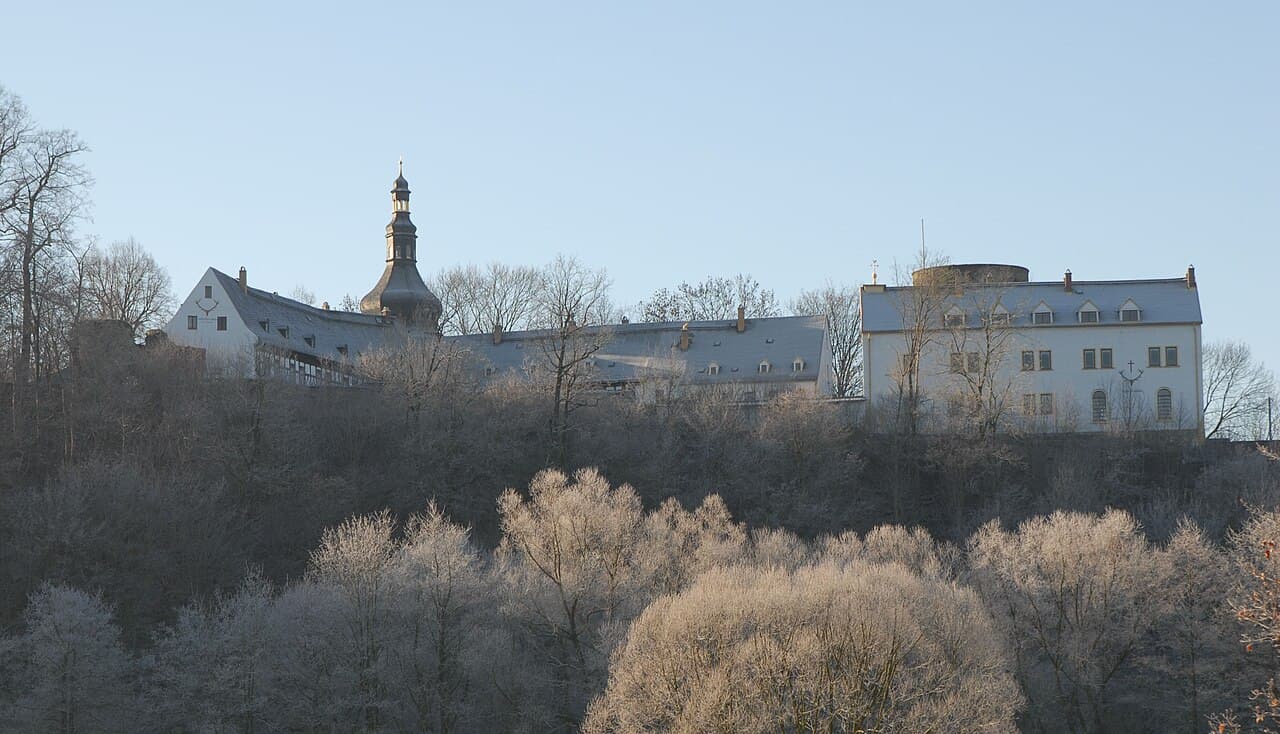
Wiesenburg Castle is a notable high medieval hill castle located in the Wiesenburg district of Wildenfels, Germany. Positioned strategically on a hill overlooking the eastern shore of the Mulde river, it historically guarded the vital bridge connecting Schönau and Wildenfels. This castle's origins date back to around the year 1200, marking it as a significant medieval fortification in the region.
Early history and medieval origins
The initial construction of Wiesenburg Castle likely began around 1200, during the high medieval period. The castle was first documented in 1251, establishing its presence as a defensive and administrative center. The earliest known owners were the Vogts of Weida, a noble family responsible for overseeing the settlement of the Kirchberg, the Saxony basin, and the Mulde area southeast of Zwickau. Their authority extended over more than twenty villages, including those in the Rödel valley, whose inhabitants paid socage—labor or services—to the castle.
Architectural features of the original castle
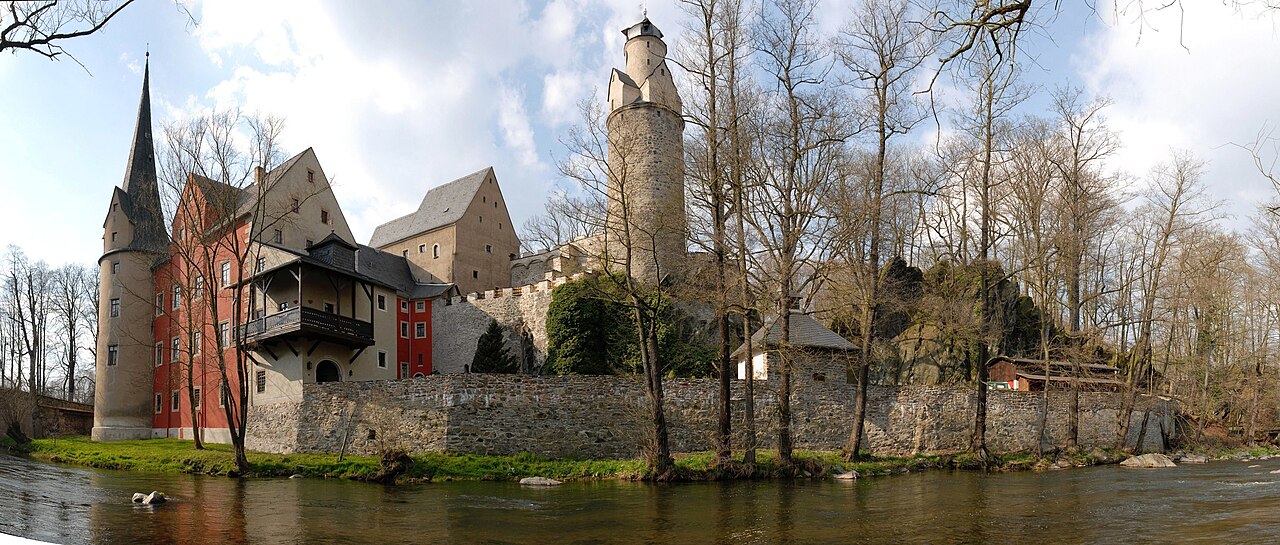
The original medieval castle was built with typical defensive features of the period. Today, only fragments remain from this early phase, including parts of the round keep, remnants of the castle walls, and the moat that once encircled the fortress. The round keep would have served as a last line of defense and a lookout point, while the moat provided an additional barrier against attackers.
Expansion and ownership changes in the late medieval period
During the 14th century, Wiesenburg Castle underwent significant expansion to enhance its fortifications and living quarters. Ownership passed through several hands, reflecting the shifting political landscape of the region. From 1412 to 1591, the castle was held by the von der Planitz family, a prominent noble lineage in Saxony. The castle's strategic importance was underscored during the German Peasants' War (1524–1525), when it was attacked and sacked by rebellious serfs, highlighting its role as a symbol of feudal authority.
Early modern period and reconstruction
In 1591, the city of Zwickau purchased Wiesenburg Castle and its associated dominion, marking a shift from noble to municipal control. Subsequently, in 1618, the Elector of Saxony acquired the castle and lordship, further integrating it into the territorial holdings of Saxony. The castle suffered damage during the Thirty Years' War (1618–1648), a devastating conflict that affected much of central Europe.
Reconstruction in 1664
Following the war, Wiesenburg Castle was reconstructed in 1664. The rebuilding introduced a timber-framed courtyard and an octagonal gate tower, which remain defining features of the castle complex today. This reconstruction reflected the architectural styles and defensive needs of the post-war period, blending medieval fortifications with early modern elements.
Later ownership and current status
In 1663, the castle and lordship were sold to Philip Louis of Holstein-Sonderburg, a member of the Danish-German ducal family. Later, in 1724, the lordship was acquired by Augustus II the Strong, Elector of Saxony and King of Poland, who was known for his extensive architectural patronage and political influence.
After the political changes of the 20th century and German reunification in 1990, Wiesenburg Castle passed into private ownership. It is currently not open to the public, preserving its historical fabric away from mass tourism.
Architectural significance and heritage
Wiesenburg Castle exemplifies the evolution of a hill castle through multiple historical phases, from its high medieval origins to its early modern reconstruction. The remaining round keep and moat offer insight into medieval defensive architecture, while the timber-framed courtyard and octagonal gate tower illustrate post-war adaptations. Its location overlooking the Mulde river underscores its strategic role in controlling regional transportation and trade routes.
Role in regional history
The castle's history reflects broader social and political changes in Saxony, including feudal governance, noble family dynamics, urban acquisition, and territorial consolidation under the Electorate of Saxony. Its experience during the German Peasants' War and the Thirty Years' War highlights its involvement in significant historical conflicts.
Visiting information
Although Wiesenburg Castle is privately owned and not accessible to the public, its historical and architectural legacy remains of interest to historians and castle enthusiasts. The castle's hilltop position provides a commanding view of the Mulde river valley and nearby settlements, illustrating the strategic considerations behind its original placement.
Frequently asked questions (FAQ)
- When was Wiesenburg Castle originally built?
- Wiesenburg Castle was likely constructed around the year 1200 during the high medieval period, with the first documented mention in 1251.
- What architectural features remain from the original castle?
- Remnants of the original castle include parts of the round keep, sections of the castle wall, and the moat, which illustrate its medieval defensive design.
- Who were the first owners of Wiesenburg Castle?
- The first known owners were the Vogts of Weida, who governed the surrounding region and collected socage from local villages.
- Is Wiesenburg Castle open to the public?
- No, Wiesenburg Castle is privately owned and currently not accessible to visitors.
- What significant events affected the castle?
- The castle was sacked during the German Peasants' War and damaged in the Thirty Years' War, leading to a reconstruction in 1664.
Photo gallery

Information
Loading map...
Visitor reviews
No reviews yet. Been here? Write the first review and help other travelers!
Write the first reviewVisited this castle? Share your experience
Your review helps other travelers and adds first-hand knowledge to our encyclopedia.