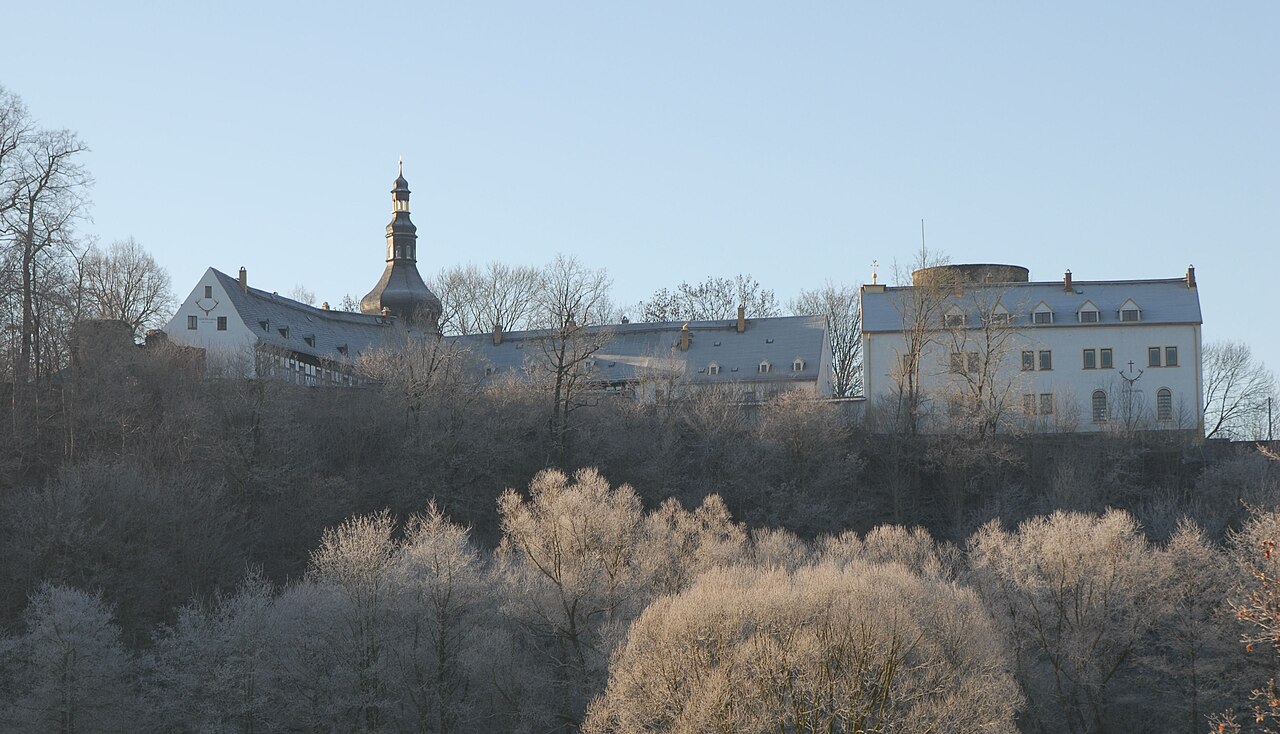
Osterstein Castle
Osterstein Castle stands as a significant historical monument in the town of Zwickau, Saxony, Germany. Originally mentioned in 1292 as "Castrum Czwickaw," this castle has witnessed centuries of transformation, destruction, and rebirth. Its location on a prominent hill above the town provided strategic advantages typical of hill castles, combining defensive strength with commanding views of the surrounding landscape.
The medieval origins and early history
The earliest records of Osterstein Castle date back to the late 13th century, marking it as an important fortification in the region. The castle suffered severe damage during a fire in 1403, a common hazard for medieval structures largely built with timber elements. Subsequently, between 1404 and 1407, it was demolished under the orders of William I, Margrave of Meissen. This demolition was part of broader political and military strategies of the time, reflecting the turbulent nature of the region's feudal conflicts.
Renaissance rebuilding under Christian I
The castle's most notable architectural phase began in the late 16th century when it was reconstructed between 1587 and 1590 during the reign of Christian I, Elector of Saxony. This rebuilding transformed Osterstein into a magnificent Renaissance castle, reflecting the era's architectural trends emphasizing symmetry, proportion, and classical elements. The reconstruction likely included the addition of elegant facades, fortified walls, and residential quarters suitable for noble residence rather than solely military defense.
Architectural features of the Renaissance castle
The Renaissance design incorporated characteristic elements such as ornate gables, arched windows, and decorative stonework. The castle's layout was adapted to balance defensive needs with comfort and status display. Though originally a fortress, the Renaissance rebuild shifted Osterstein's role toward a stately residence, demonstrating the period's changing social and political dynamics.
Use as a prison and wartime roles
In the 18th century, Osterstein Castle underwent a functional transformation when it became the site of the Zwickau Prison (Zuchthaus Zwickau). This prison operated with some interruptions until after the Second World War, marking a significant shift from noble residence to penal institution. Throughout its operation as a prison, it housed several prominent prisoners, including the famous writer Karl May, socialist politician August Bebel, revolutionary Rosa Luxemburg, and communist activist Martin Hoop.
World War II and concentration camp use
During the Second World War, Osterstein Castle's role darkened as it was used as a concentration camp. This period marks one of the most tragic chapters in the castle's history, reflecting the broader horrors of Nazi Germany's regime. After the war, the castle continued to function as a prison until 1962, when its penal use officially ended after 187 years.
Post-prison era and decline
Following the closure of the prison, parts of the castle were repurposed for civilian use. An intermediate wing housed a public bathhouse, while other sections served as storage for local businesses and archives related to the coal mining industry, a key economic sector in the region. However, parts of the castle were demolished, and from the 1980s onward, the structure suffered significant deterioration, becoming a source of urban blight.
Restoration and modern use
Efforts to preserve and restore Osterstein Castle began in earnest in the early 21st century. After years of proposals and delays, reconstruction work started in 2006, led by GP Schuppertbau GmbH. This extensive restoration aimed to stabilize the structure and adapt it for new uses while respecting its historical significance.
Conversion to a nursing home
By 2008, the castle was successfully converted into a modern nursing home, operated by the Betreibergesellschaft Senioren- und Seniorenpflegeheim GmbH Zwickau. This adaptive reuse preserved the castle's architectural heritage while providing vital community services. Plans also include parts of the complex being used for a restaurant and museum, allowing visitors to engage with the castle's rich history.
Architectural and cultural significance
Osterstein Castle exemplifies the evolution of castle architecture from medieval fortress to Renaissance residence and later institutional use. Its layered history reflects broader historical themes, including feudal power struggles, Renaissance cultural shifts, penal history, and the impacts of war. The castle's restoration and adaptive reuse demonstrate contemporary approaches to heritage conservation, balancing preservation with functional modernization.
Today, Osterstein Castle remains an important cultural landmark in Zwickau, embodying centuries of architectural innovation and historical events. Its transformation from a defensive stronghold to a Renaissance palace, then to a prison, and now a nursing home, illustrates the dynamic life cycle of historic buildings in Europe.
Frequently asked questions (FAQ)
- When was Osterstein Castle originally built and what is its architectural style?
- Osterstein Castle was originally built in the late 16th century, specifically between 1587 and 1590, in the Renaissance architectural style, reflecting the era's emphasis on symmetry and classical elements.
- What notable historical figures were imprisoned at Osterstein Castle?
- Prominent prisoners at Osterstein Castle included writer Karl May, socialist politician August Bebel, revolutionary Rosa Luxemburg, and communist activist Martin Hoop, highlighting its role as a significant prison.
- How was Osterstein Castle used during World War II?
- During World War II, Osterstein Castle was used as a concentration camp, marking a tragic period in its history before it ceased functioning as a prison in 1962.
- What is the current use of Osterstein Castle?
- Today, Osterstein Castle has been restored and converted into a nursing home, providing care services while preserving its historical architecture.
- Are there plans for public access or cultural activities at Osterstein Castle?
- There are plans to utilize parts of Osterstein Castle for a restaurant and museum, allowing visitors to experience its rich history alongside its current function as a nursing home.
Information
Current owner
Betreibergesellschaft Senioren- und Seniorenpflegeheim GmbH Zwickau
Loading map...
Visitor reviews
No reviews yet. Been here? Write the first review and help other travelers!
Write the first reviewVisited this castle? Share your experience
Your review helps other travelers and adds first-hand knowledge to our encyclopedia.