Schoenfels Castle
Schoenfels Castle stands as a prominent medieval fortress located in the picturesque village of Schoenfels, nestled within the Mamer valley south of Mersch in Luxembourg. This historic hill castle is part of the renowned Valley of the Seven Castles, a cluster of medieval fortifications including Koerich, Septfontaines, Ansembourg, New Ansembourg, Hollenfels, and Mersch castles. Schoenfels Castle's origins date back to the late 13th century, marking it as a significant monument reflecting Luxembourg's feudal and architectural heritage.
Early history and medieval origins
The castle was originally constructed in 1292 by Ferri, also known as Friedrich von Schoenfels, as a fortified keep or donjon. This initial structure served primarily as a defensive stronghold and residence, typical of late medieval fortifications prior to the widespread use of artillery. The castle was strategically positioned in the valley of the Mamer stream, providing both natural protection and control over the surrounding lands.
Ownership of Schoenfels Castle transitioned through noble families by marriage, a common practice in medieval Europe. The Von Ansembourg family acquired it through such an alliance, followed later by the Von Sassenheim family. These transfers reflect the castle's role within the feudal system as a symbol of power and territorial control.
Renaissance period and architectural evolution
In the early 16th century, the castle came under the lordship of Henri Schloeder von Lachen. His tenure is marked by the addition of heraldic elements, including the display of the Schloeder von Lachen coat of arms above the entrance to the main tower, emphasizing noble identity and ownership.
Despite its imposing appearance, Schoenfels Castle held limited strategic military importance. This was made evident when the French army dismantled its fortifications in 1683 during the reign of King Louis XIV, part of broader efforts to neutralize potential threats in the region. The castle's defenses were deliberately destroyed, signaling a shift in military tactics and political control in Luxembourg.
Destruction and decline in the late 17th century
On June 22, 1690, the castle and the adjacent village were set ablaze amid a conflict between Théodore de Neunheuser and the lord of Brandenburg. This violent confrontation resulted in significant damage, marking a period of decline for the castle and its surrounding community.
Following these events, the property underwent division and changes in ownership throughout the 18th century. In 1759, through marriage, Pierre-François de Gaillot de Genouillac became the lord of Schoenfels, continuing the tradition of noble stewardship.
19th century ownership and architectural modifications
In 1813, Jean-Baptiste Thorn-Suttor, who later served as governor of Luxembourg during the Belgian period (1831-1839), purchased the castle. Thorn's acquisition occurred during a politically turbulent era marked by tensions between Luxembourg and Belgium.
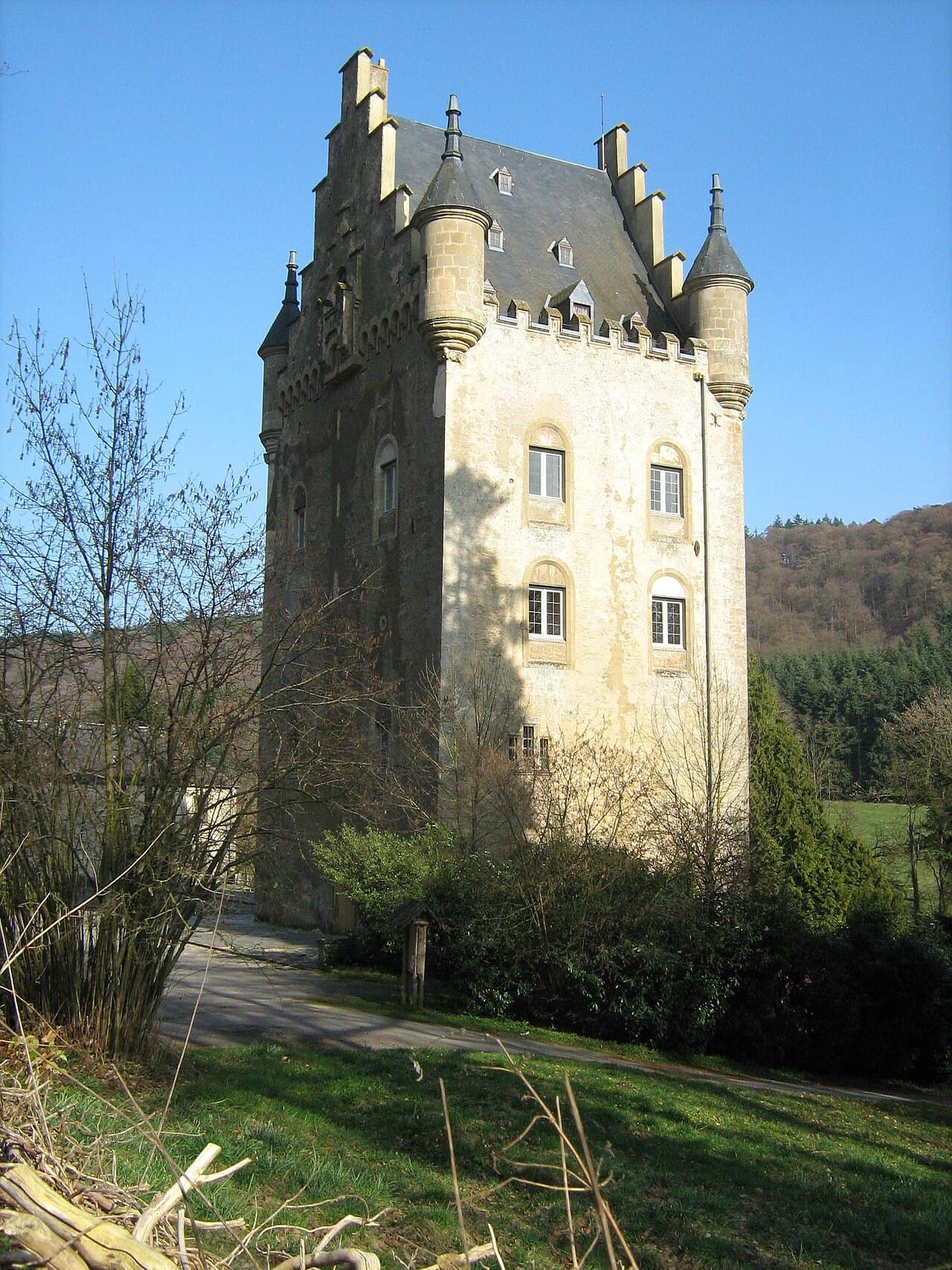
By 1840, the castle was sold to Jacques Engler, a Belgian senator, who subsequently passed it to his son-in-law, Baron Auguste Goethals. In 1870, Goethals constructed a manor house adjacent to the medieval keep, adding a residential dimension to the site. He is also credited with remodeling the donjon's roof in the neo-Gothic style, a popular 19th-century architectural revival movement that sought to evoke medieval Gothic aesthetics.
This neo-Gothic roof alteration gave the tower a distinctive silhouette, blending historical medieval elements with romanticized 19th-century design.
20th century to present: restoration and public use
The castle changed hands several times in the 20th century, eventually being sold in 1948 to timber merchant Camille Weiss. The Luxembourg state acquired the property in 1971, marking a new phase focused on preservation and public benefit.
In 1976, the state demolished the 19th-century manor house, leaving the medieval donjon as the sole surviving structure of the castle complex. The donjon measures approximately 17 by 13 meters at its base and rises to a height of 21 meters, featuring four corner turrets that enhance its vertical profile.
Currently, the donjon is undergoing renovation to stabilize and restore its medieval fabric. The state plans to repurpose the castle as a visitor center for the nearby Mamer Valley Nature Reserve and as offices for the Forestry Administration. While the tower remains closed to the public during restoration, visitors are welcome to explore the castle gardens and courtyard, which offer scenic views and a glimpse into the site's historical ambiance.
Architectural features and significance
Schoenfels Castle's most prominent surviving feature is its medieval donjon, a large stone tower that served as the castle's primary defensive and residential structure. The donjon's robust stone masonry reflects typical construction techniques of the late 13th century, designed to withstand sieges and provide a last refuge for inhabitants.
The four turrets at each corner not only enhanced defense but also contributed to the tower's imposing aesthetic. The entrance is adorned with heraldic decorations, notably the Schloeder von Lachen coat of arms, linking the architectural fabric to the castle's historical owners.
Although the original defensive walls and other fortifications have been lost, the donjon remains a powerful symbol of medieval Luxembourg's feudal past. The neo-Gothic roof added in the 19th century represents an important layer of architectural evolution, reflecting changing tastes and the romantic revival of medieval forms.
Cultural and historical context
Schoenfels Castle embodies the complex history of Luxembourg's nobility, military conflicts, and architectural heritage. Its location in the Valley of the Seven Castles situates it within a unique cultural landscape renowned for its concentration of medieval fortresses. This valley attracts historians, architects, and tourists interested in the region's feudal past and castle architecture.
The castle's history of ownership through marriage, conflict, and political change mirrors broader European patterns of noble estate management and territorial disputes. The destruction by French forces and subsequent burning during local conflicts illustrate the turbulent history Luxembourg experienced during the 17th century.
Today, the castle serves as a testament to the resilience of medieval architecture and the ongoing efforts to preserve Luxembourg's cultural heritage. Its planned transformation into a visitor center will enhance public engagement with the region's natural and historical assets.
Visitor information and accessibility
Currently, Schoenfels Castle is undergoing restoration work, and the medieval donjon is not open to the public. However, the castle grounds, including the gardens and courtyard, are freely accessible to visitors who wish to experience the historic atmosphere and scenic surroundings.
The future visitor center will provide educational resources about the Mamer Valley Nature Reserve and the castle's history, offering a comprehensive experience for tourists and locals alike. Visitors are encouraged to check for updates on opening hours and access as restoration progresses.
Frequently asked questions (FAQ)
- When was Schoenfels Castle originally built?
- Schoenfels Castle was originally constructed in 1292 by Friedrich von Schoenfels as a fortified keep in the Mamer valley.
- What is the architectural style of Schoenfels Castle?
- The castle features a medieval donjon with 19th-century neo-Gothic roof modifications, representing a mix of late medieval and romantic revival styles.
- Is Schoenfels Castle open to visitors?
- Currently, the castle's medieval donjon is closed due to restoration work, but the gardens and courtyard are accessible to the public.
- What historical events affected Schoenfels Castle?
- The castle's fortifications were dismantled by the French army in 1683, and it was burned down in 1690 during a local conflict between Théodore de Neunheuser and the lord of Brandenburg.
- What are the future plans for Schoenfels Castle?
- The Luxembourg state plans to convert the castle into a visitor center for the Mamer Valley Nature Reserve and offices for the Forestry Administration.

Information
Sources & official resources
Verify the information above using these authoritative references.
Loading map...
Visitor reviews
No reviews yet. Been here? Write the first review and help other travelers!
Write the first reviewVisited this castle? Share your experience
Your review helps other travelers and adds first-hand knowledge to our encyclopedia.