Mersch Castle
Mersch Castle stands as a prominent hill castle in the heart of Mersch, Luxembourg, renowned for its rich history and architectural evolution spanning over seven centuries. Situated within the famed Valley of the Seven Castles along the Eisch River, this castle exemplifies the transition from medieval fortress to Renaissance residence, reflecting the turbulent history and noble lineage of the region.
Originally constructed in the 13th century by Theodoric I, a knight serving Countess Ermesinde of Luxembourg, the castle's earliest component was a fortified tower or donjon documented as early as 1232. This tower likely formed the nucleus of a larger defensive complex that included a protective moat and curtain walls. Some historical accounts suggest the site may have origins dating back to the Carolingian era, possibly linked to a figure named Nithardus, indicating the strategic importance of this location for centuries.
Medieval origins and early fortifications
The initial castle was primarily a military stronghold designed to assert control over the surrounding territory. The original square donjon measured approximately 12 meters per side and was surrounded by a broad moat about 11 meters wide, enhancing its defensive capabilities. The perimeter was further secured by a curtain wall, reinforced with seven round towers spaced evenly to provide overlapping fields of fire and observation.
During the 15th century, the castle endured significant hardship when it was captured and burnt by Burgundian forces amid regional conflicts such as the Burgundian-Swiss wars. This destruction necessitated extensive rebuilding and marked a period of decline in the castle's military prominence.
Renaissance transformation and architectural enhancements
In 1574, the castle underwent a significant transformation under the ownership of Paul von der Veltz, who remodeled the fortress into a more comfortable and stylish residence embracing Renaissance architectural elements. The renovation included the installation of large windows in the keep, replacing the narrow arrow slits typical of medieval fortifications, and the addition of finely vaulted ceilings on the ground and first floors, showcasing the late Gothic net vaulting technique.
The castle's knights' hall on the second floor became a centerpiece of the interior, featuring a grand chimney and walls adorned with the coats of arms of sixteen noble families, symbolizing the castle's aristocratic connections. The defensive curtain wall was maintained, with a thickness of approximately 1.35 meters, and the seven towers continued to provide formidable protection.
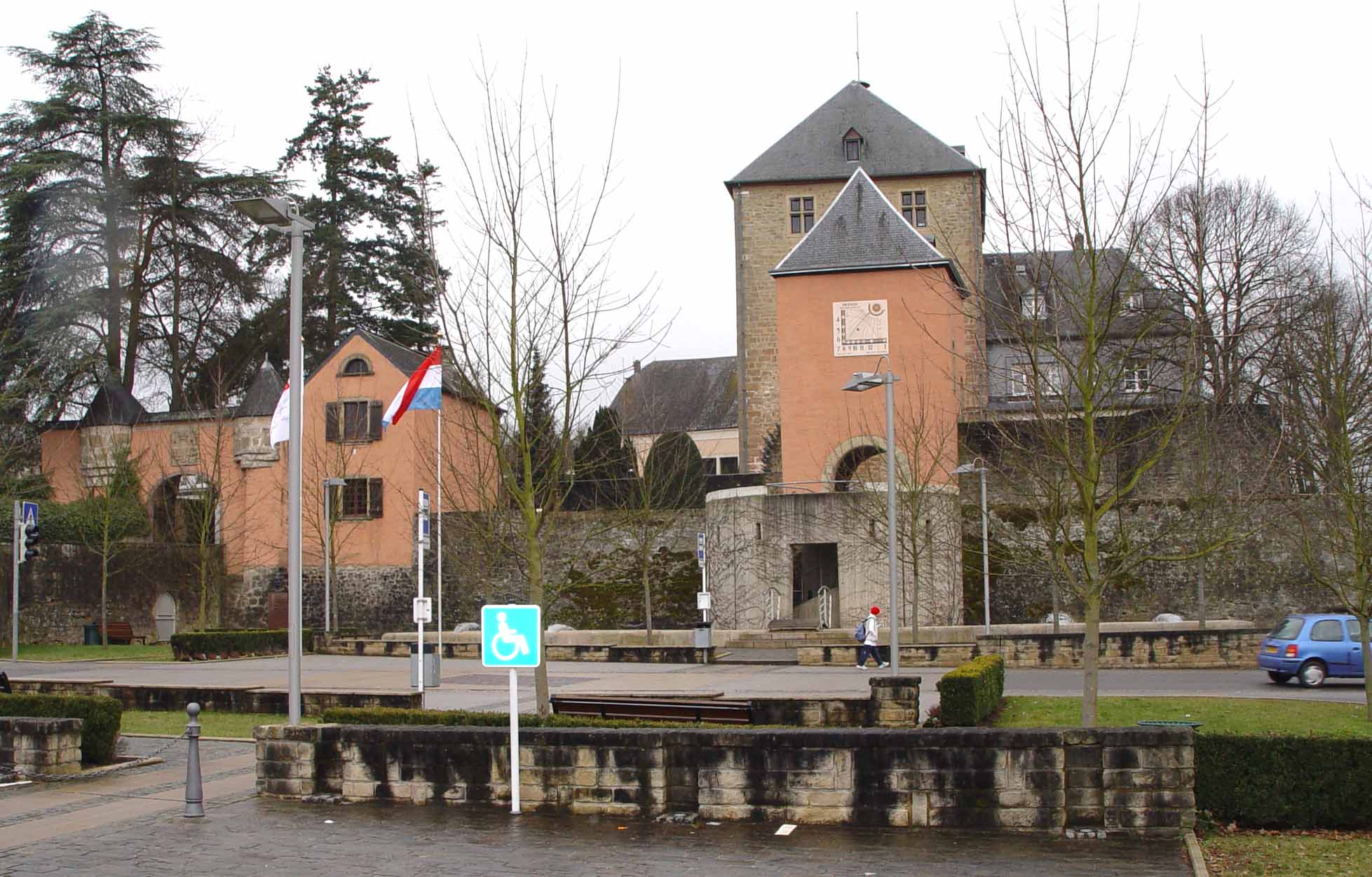
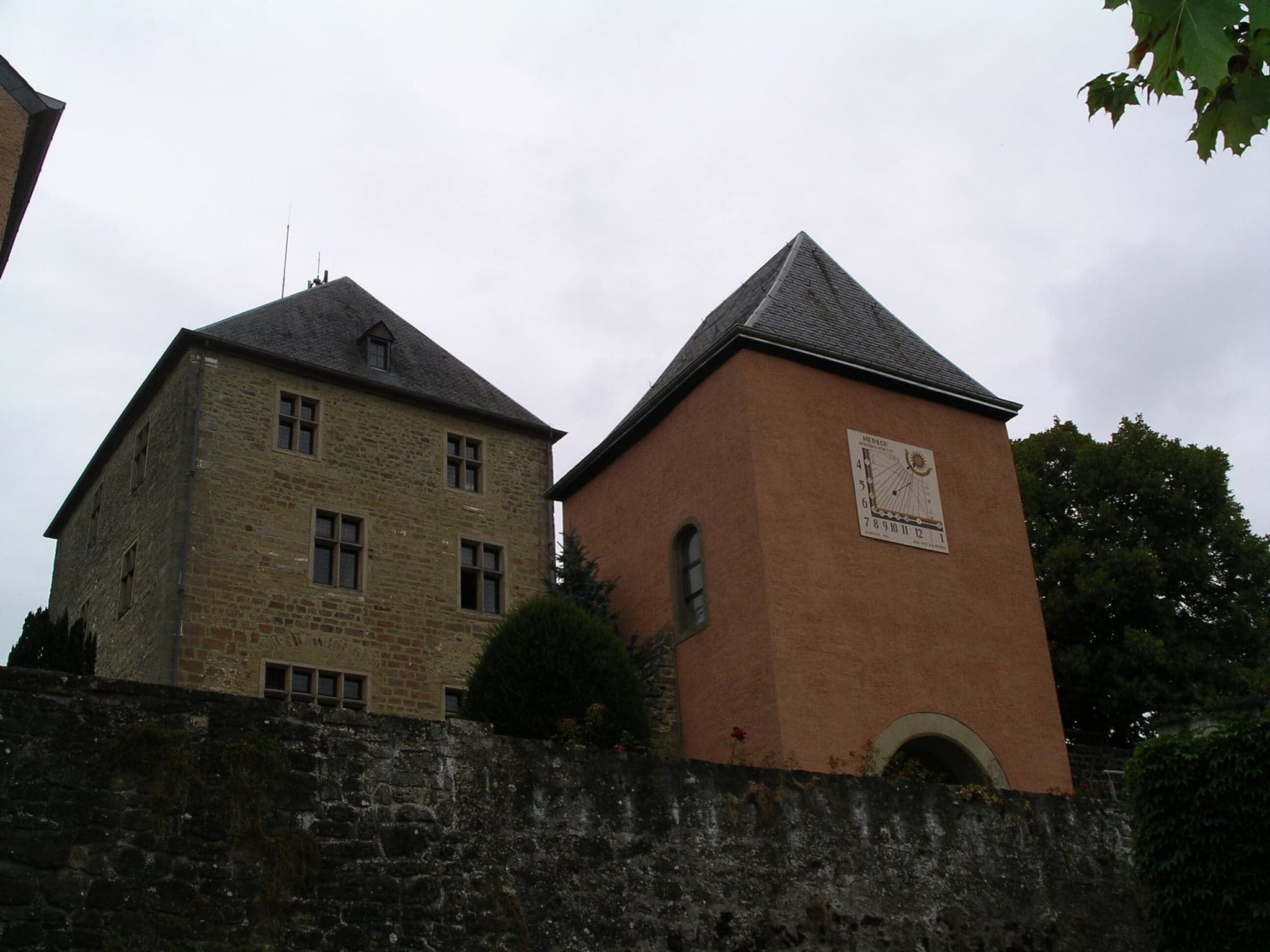
Photo by Cornischong at lb.wikipedia • CC BY-SA 3.0
Conflicts and restorations in the early modern period
Despite its Renaissance refinement, Mersch Castle faced further adversity in the early 17th century. It suffered fire damage in 1603 and was severely impacted during the Thirty Years' War (1618-1648), which left both the castle and the village in a state of ruin by 1635.
Restoration efforts resumed around 1700 under Count Johann-Friedrich von Elter, who rebuilt the castle's gate and prominently displayed his family's coat of arms. The castle chapel was also restored and reconsecrated in 1717, with the altar bearing the heraldic emblem of Charlotte von Elter, the castle's heiress, underscoring the continued noble heritage of the estate.
Modern history and adaptive reuse
Ownership of the castle passed through various hands over the centuries, including the Sonnenberg-Reinach family, who sold it in 1898 to a businessman named Schwartz-Hallinger. In 1930, the owner M. Uhres undertook restoration work to preserve the structure. A youth hostel was established in a new building adjacent to the castle in 1938, marking a shift towards adaptive reuse of the site.
In the mid-20th century, the castle's stewardship changed hands between the municipality of Mersch and the State of Luxembourg, with the commune regaining ownership in 1988. Following extensive renovations completed in 1993, the castle now serves as the administrative offices for the local commune, blending its historical significance with contemporary civic use.
Architectural features and preservation status
Mersch Castle is constructed on a roughly rectangular plan measuring about 34 by 30 meters. The complex integrates medieval defensive elements with Renaissance residential features. The original square donjon remains a dominant feature, enlarged northwestward over time to accommodate evolving needs.
The castle's curtain wall, once fortified with seven round towers approximately six meters in diameter, provided robust protection, complemented by the wide moat. Inside, the vaulted ceilings, especially the late Gothic net vaulting, add architectural elegance. The knights' hall with its large fireplace and heraldic decorations remains a highlight of the interior.
The gate rebuilt by Count Johann-Friedrich von Elter stands as a testament to the castle's layered history, bearing his coat of arms. The chapel's altar, adorned with the arms of Charlotte von Elter, continues to signify the religious and familial importance within the castle's narrative.
Today, Mersch Castle is well preserved, reflecting centuries of care and restoration. It holds national monument status, recognized officially twice, most recently in 2023. The castle's inclusion on a 5 euro coin in 2011 highlights its cultural and historical significance within Luxembourg.
Visiting mersch castle and its surroundings
Visitors to Mersch Castle can appreciate its blend of medieval fortifications and Renaissance elegance, alongside its role as a functioning administrative center. The castle is part of the Valley of the Seven Castles, a popular route featuring several historic fortresses along the Eisch River, offering rich opportunities for cultural tourism and exploration.
Nearby, the youth hostel established in 1938 provides accommodation options for travelers interested in experiencing the region's heritage. The castle's location in central Mersch makes it accessible and a focal point for understanding Luxembourg's feudal and architectural history.
Frequently asked questions (FAQ)
- How do I get to Mersch Castle?
- Mersch Castle is easily accessible by public transportation, with regular trains and buses connecting it to Luxembourg City and other nearby towns. If you're driving, there is parking available near the castle grounds for visitors.
- What is the historical significance of Mersch Castle?
- Mersch Castle dates back to the 14th century and served as a stronghold for the local nobility. Its rich history reflects the feudal system of the time and the castle played a crucial role in the defense of the region.
- When was Mersch Castle built?
- Mersch Castle was constructed in the early 14th century, with its foundation laid around 1340. Over the centuries, it has undergone various renovations, reflecting different architectural styles and historical periods.
- Can I take guided tours of Mersch Castle?
- Yes, guided tours of Mersch Castle are available and provide an in-depth look at its history and architecture. Visitors are encouraged to check the official website for tour schedules and group booking options.
- Why is Mersch Castle a popular tourist destination?
- Mersch Castle is a popular tourist destination due to its stunning medieval architecture and its picturesque setting amidst beautiful landscapes. Additionally, its historical significance and well-preserved structures attract history enthusiasts and casual visitors alike.
- Is it possible to host events at Mersch Castle?
- Yes, Mersch Castle offers facilities for hosting various events, including weddings and corporate functions. Interested parties should contact the castle management for availability and booking options.
- What are the opening hours for Mersch Castle?
- Mersch Castle is open to visitors from Tuesday to Sunday, with specific hours that may vary by season. It is recommended to check the castle's official website for the most up-to-date information on opening times.
- What are the ticket prices for visiting Mersch Castle?
- Ticket prices for Mersch Castle are generally affordable, with discounts available for students and seniors. Admission fees may vary for special events or guided tours, so it's best to review the pricing details on the official site before your visit.
- When is the best time to visit Mersch Castle?
- The best time to visit Mersch Castle is during the spring and early fall when the weather is mild and suitable for exploring the grounds. Additionally, visiting during these seasons allows you to enjoy the beautiful gardens and surrounding nature.
- Are there any nearby attractions to Mersch Castle?
- Yes, there are several nearby attractions, including the charming town of Mersch itself, which offers shops and eateries. Other notable sites include the Parc Mersch and various hiking trails that showcase the natural beauty of Luxembourg.


Information
Website
Visit websiteSources & official resources
Verify the information above using these authoritative references.
Loading map...
Visitor reviews
No reviews yet. Been here? Write the first review and help other travelers!
Write the first reviewVisited this castle? Share your experience
Your review helps other travelers and adds first-hand knowledge to our encyclopedia.