Schœneck Castle — France castle

Schœneck Castle

Schœneck Castle: historic hill castle in Hauts-de-France, France
West of the D53 road, Hauts-de-France, France
High Medieval (11th–13th c.)
Ruins

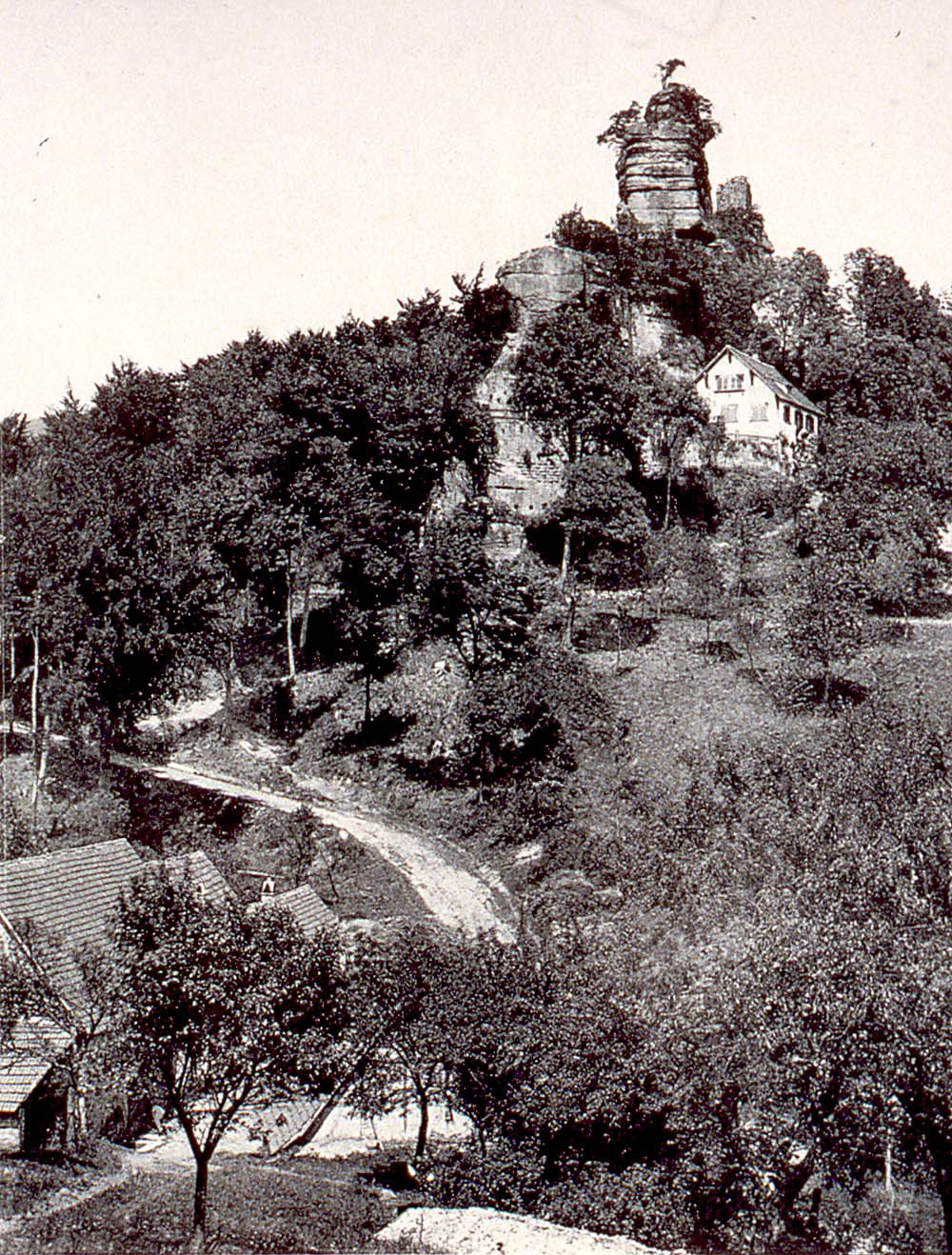
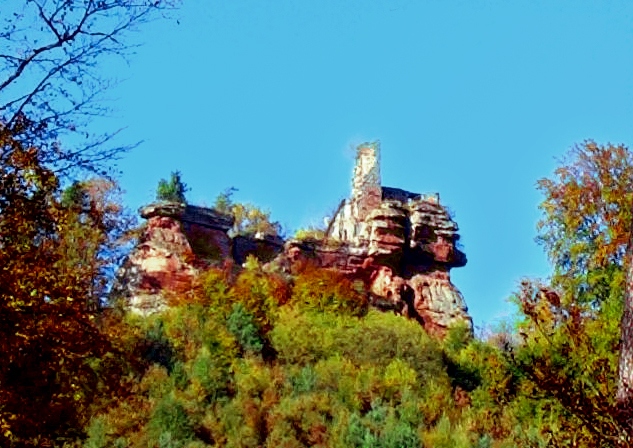
Schœneck Castle, also known as Château du Schœneck, stands as a remarkable example of a medieval hill castle nestled in the woods northeast of Dambach village in the Bas-Rhin department of France's Hauts-de-France region. The castle occupies a strategic position on a sandstone ridge in the Northern Vosges, historically controlling access along a key route leading south to Haguenau. Its origins trace back to the mid-12th century, with the earliest fortifications likely wooden before transitioning to stone construction in the mid-13th century, making it one of the oldest surviving castles in this part of Alsace.

Early history and medieval significance

The precise date of Schœneck Castle's foundation remains uncertain, but it was probably established in the late 12th or early 13th century under the auspices of the Hohenstaufen dynasty. Its initial purpose was to suppress banditry in the region and secure vital trade and military routes. The castle is first documented in 1287 as property of Bishop Conrad III of Lichtenberg of Strasbourg, who was allied with the Habsburgs. The bishop entrusted its upkeep to the noble Lichtenberg family, who held the castle as part of their extensive territories. The castle's location on a rocky crest with natural defenses made it a formidable stronghold in the High Medieval period.

Between 1335 and 1390, Schœneck underwent significant restoration and strengthening under Bishop Friedrich I von Lichtenberg. These efforts adapted the castle's defenses to evolving military technologies, including the early use of artillery. The castle was part of the Lichtenberg domain known as the Amt Wörth and functioned administratively as a Büttelei, a distinct jurisdictional unit.

Renaissance modernization and military role

In the 16th century, the castle passed through several noble hands, including the Counts of Zweibrücken-Bitsch and later the Counts of Hanau-Lichtenberg. From 1545 to 1547, the Eckbrecht von Dürkheim family held Schœneck as a fief and undertook extensive modernization to adapt the fortress for the use of firearms. This included the construction of 16th-century bastions equipped with cannon embrasures (Maulscharten) and reinforced curtain walls. These upgrades reflect the transition from medieval fortification methods to early modern military architecture.

During the Thirty Years' War (1618–1648), Schœneck Castle served as a refuge for local villagers, though its military importance waned as warfare evolved. The castle was garrisoned by a small force after the war, and a devastating forest fire in 1663 caused significant damage.

Sieges, destruction, and decline

Schœneck regained strategic importance during the Franco-Dutch War in the late 17th century. It withstood several sieges by French forces before finally falling in 1680 after a siege led by French generals Joseph de Montclar and Ezéchiel du Mas, Comte de Mélac. The castle was then deliberately slighted (partially demolished) to prevent future military use.

Following the French Revolution, the castle ruins were confiscated as national property and sold in 1820 to a private owner. Today, Schœneck Castle remains privately owned but is freely accessible to visitors, offering a fascinating glimpse into centuries of military and residential architecture.

Architectural features and castle layout

Schœneck Castle is uniquely built upon and around two narrow sandstone spurs rising between 10 and 15 meters above the surrounding terrain. The site is naturally defended by steep cliffs on three sides and separated from the nearby Fischerberg hill by a deep neck ditch nearly 20 meters wide. The castle complex is divided into two upper sections (Oberburgen) along the ridge and two lower castles (Unterburgen) at the base.

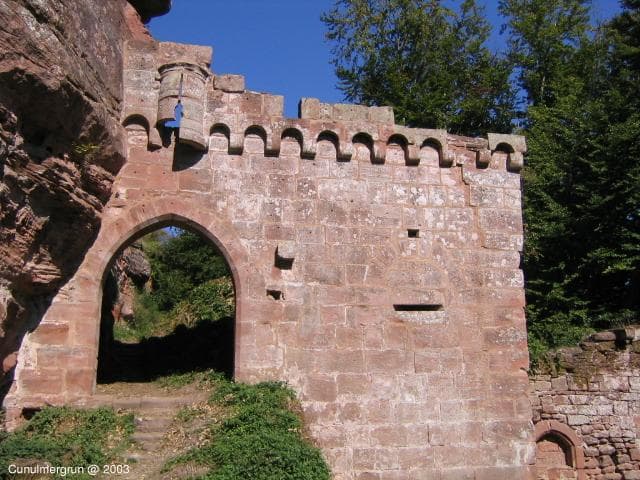
The masonry predominantly dates from the mid-13th century, constructed from locally quarried Buntsandstein sandstone. The castle exhibits a blend of rubble stone and finely dressed ashlar blocks characteristic of the 16th century Alsatian Renaissance. Defensive features include a southern entrance protected by a 16th-century outer ditch and two square bastion towers with cannon openings designed for early firearms.

The western lower castle measures approximately 40 by 10 meters and includes a 10-meter-deep well shaft, partial curtain walls, and a round tower with a vaulted basement. Attached is a large U-shaped artillery tower with walls up to three meters thick, featuring multiple gunports and a projecting guardroom. The eastern lower castle is accessed through four successive gates culminating in a pointed arch set in a semicircular bastion with a conical roof, enclosing a courtyard with a 20-meter-long curtain wall and a five-sided tower pierced by arrow slits.

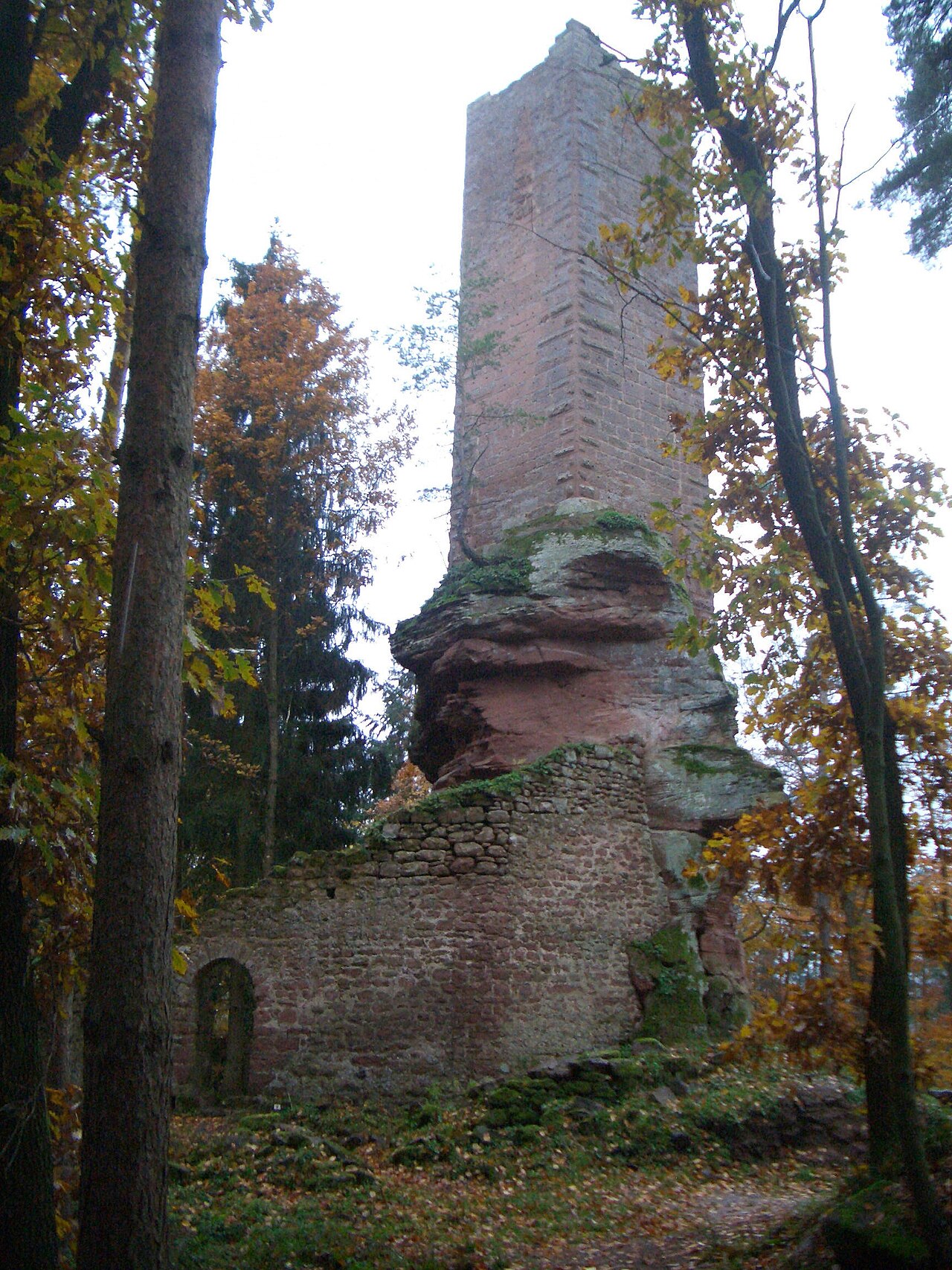
The upper southern castle consists of a single elongated building originally three stories high, with surviving walls up to 1.7 meters thick. The northern upper castle includes a narrow residential building believed to contain a small chapel, as indicated by an east-facing niche. Adjacent is a pentagonal bergfried (keep) constructed of rusticated ashlar blocks, standing to a height of seven courses.

Decorative elements such as Lombard friezes with semicircular arches adorn the lordly residences, reflecting the castle's architectural heritage. A hoist platform survives on site, likely used during construction to raise building materials. Archaeological excavations have uncovered a forge near the main gate, indicating both military and domestic activity.

Historical and cultural significance

Schœneck Castle embodies the evolution of castle architecture from the High Medieval period through the Renaissance and into the era of early modern warfare. Its adaptations to artillery and firearms illustrate the shifting nature of military technology and defense strategies. The castle's role as a refuge during the Thirty Years' War and its repeated sieges during the Franco-Dutch War highlight its strategic importance in regional conflicts.

Protected as a Monument historique since 1984, Schœneck Castle is a valuable heritage site that offers insights into the feudal history of Alsace and the broader geopolitical struggles of the Holy Roman Empire, France, and neighboring states. Its relatively good preservation owes much to its remote location and the lack of stone removal after its destruction.

Visiting schœneck castle today

Today, Schœneck Castle is freely accessible to visitors who can explore its extensive ruins and appreciate its dramatic setting on a sandstone ridge. The site provides a tangible connection to centuries of European history and castle architecture, from medieval fortifications to Renaissance military innovations. Visitors can observe the remains of bastions, towers, curtain walls, and residential quarters, each telling a story of adaptation and resilience.

The castle's natural surroundings in the Northern Vosges offer scenic hiking opportunities, making Schœneck both a cultural and outdoor destination. While privately owned, the castle remains an important landmark for history enthusiasts and scholars interested in the architectural evolution of fortified residences in northeastern France.

Frequently asked questions (FAQ)

How do I get to Schœneck Castle?
Schœneck Castle is located northeast of Dambach village in the Bas-Rhin department. It is accessible by local roads near the D53 and can be reached by hiking through forest trails in the Northern Vosges.
What is the historical significance of Schœneck Castle?
Schœneck Castle played a strategic role from the 13th century through the 17th century, serving as a military fortress, refuge during wars, and a symbol of regional power in Alsace.
Can I visit the interior of Schœneck Castle?
The castle is in ruins but freely accessible to the public. Visitors can explore the remains of bastions, towers, curtain walls, and residential structures, although no formal interior rooms are intact.
When is the best time to visit Schœneck Castle?
The best time to visit is during late spring to early autumn when forest trails are clear and weather conditions are favorable for hiking and outdoor exploration.
Is Schœneck Castle suitable for family visits?
Yes, the castle ruins and surrounding natural areas offer an educational and scenic experience suitable for families, but caution is advised due to uneven terrain and lack of modern facilities.

Photo gallery

Schœneck Castle
Click to view

Photo by Association Cunulmergrun•CC BY 2.5

1 photo • Click any image to view in full screen

Information

Hill Castle

Current owner

Private owner

Sources & official resources

Verify the information above using these authoritative references.

Loading map...

Visitor reviews

No reviews yet. Been here? Write the first review and help other travelers!

Write the first review

Visited this castle? Share your experience

Your review helps other travelers and adds first-hand knowledge to our encyclopedia.
Write a review

(5/5)

0/2000 characters

Your review will be visible after admin approval

Nearby castles

0.6 km
Château de Wineck — France castle

Château de Wineck

Dambach, France

The Château de Wineck stands as a notable example of a late medieval castle located in the commune of Dambach, in the Bas-Rhin département of France. Constructed around 1300 for the Windstein family, this castle was strategically built atop a rocky peak to serve as an observation post complementing the nearby Château de Schœneck. Its primary purpose was to enhance the defensive network of the region, overseeing the surrounding terrain and providing early warning against potential threats. Historical background and strategic importance The Château de Wineck was part of a broader system of fortifications during the late medieval period, a time marked by feudal conflicts and the need for vigilant territorial defense. The castle's location on a rocky outcrop offered natural protection and an elevated vantage point, key features for medieval military architecture. The Windstein family, prominent local nobility, commissioned the castle to assert their control and secure their lands. In the 17th century, the castle was dismantled under the orders of the King of France, reflecting the centralization of royal power and the decline of feudal strongholds. This dismantling was part of a wider policy to reduce the military capabilities of potentially rebellious nobles by destroying their fortresses. Architectural features and layout Keep and defensive walls The castle's most prominent surviving feature is the polygonal keep, whose corners remain partially intact. This keep originally protected a modest residential structure, now vanished, that would have housed the lord and his retinue. The polygonal design was a tactical choice, allowing defenders to cover multiple angles and reducing blind spots for attackers. Gallery and access Access to the castle is unique, involving a gallery cut directly into the rock. This narrow passage leads to a door positioned halfway up the cliff face, a defensive measure that limited the approach routes and made the castle difficult to assault. The gallery exemplifies the integration of natural rock formations into the castle's defensive strategy. Courtyard and enceinte The lower courtyard lies on the eastern side of the castle and is enclosed by a partly conserved enceinte (defensive wall). This courtyard would have served as a space for daily activities, storage, and possibly the accommodation of soldiers and servants. The enceinte provided an additional layer of defense, enclosing the castle's functional areas. Current condition and heritage status Today, the Château de Wineck remains in a state of ruins, with only fragments of the dressed stone walls and the polygonal keep standing. Despite its ruined condition, the castle is a significant cultural and historical monument. It has been officially listed as a monument historique by the French Ministry of Culture since 1985, recognizing its importance in French medieval heritage and its value for archaeological study. The site attracts visitors interested in medieval architecture and history, offering a glimpse into the defensive strategies of the period and the lifestyle of the regional nobility. The castle's dramatic setting on a rocky peak adds to its appeal, providing panoramic views of the surrounding landscape. Visiting Château de Wineck Visitors can explore the castle ruins by following the rock-cut gallery to the entrance. The path and remaining structures provide insight into medieval fortification techniques and the adaptation of architecture to natural terrain. While the castle is in ruins, the preserved elements allow for an appreciation of its original defensive purpose and architectural style. The castle's location in the Wineckerthal quarter of Dambach situates it within a region rich in history and natural beauty, making it a worthwhile destination for those interested in French medieval castles and the Alsace region's heritage. Architectural significance and legacy The polygonal keep of Château de Wineck is a distinctive feature reflecting the evolution of castle design in the late medieval period. Its shape provided enhanced defensive capabilities compared to earlier square keeps. The integration of the castle with the rocky landscape demonstrates medieval builders' skill in utilizing natural features for fortification. The castle's dismantling in the 17th century marks a historical shift in military architecture and political control, illustrating the transition from feudal fortresses to centralized state power. As a ruin, Château de Wineck offers valuable archaeological insights into construction methods, defensive strategies, and the social history of the region's nobility.

Late Medieval (14th–15th c.)
Details
2.8 km
Vieux-Windstein Castle — France castle

Vieux-Windstein Castle

Rue des Châteaux, France

Vieux-Windstein Castle, also known locally as Château du Vieux-Windstein or Burg Altwindstein, is a striking example of a high medieval hill castle ruin perched above the village of Windstein in the Bas-Rhin department of the Grand-Est region in France. This castle occupies a commanding position on a narrow sandstone outcrop in the area historically referred to as Northern Alsace or the Middle Vosges, a region rich in medieval fortifications and cultural heritage. The castle's origins trace back to the 12th century, with the first documented mention dating to 1201. It is widely believed that Frederick II, Duke of Swabia, a member of the powerful Hohenstaufen dynasty, initiated its construction in the first half of the 12th century. The castle served as a strategic stronghold for the Hohenstaufens from approximately 1155 until 1250, playing a critical role in the defense and administration of their imperial territories, including protection of the imperial palace at Haguenau. Historical development and ownership During the early 13th century, the lords of Windstein, the castle's original owners, ceded land below the castle to Neubourg Abbey for the construction of a new fortress. This event led to the distinction between the older castle, known as Vieux-Windstein (Old Windstein) or Hinterwindstein (Posterior Windstein), and the newly built Nouveau-Windstein (New Windstein) or Vorderwindstein (Anterior Windstein). In 1332, Vieux-Windstein came under siege by the forces of the Bishop of Strasbourg due to its reputation as a refuge for brigands. The attackers employed mining techniques on the western side of the castle rock, ultimately capturing and dismantling the fortress. Despite a formal ban on reconstruction, the castle was rebuilt later in the 14th century, demonstrating its continued strategic and symbolic importance. The castle suffered significant damage when it was burned down in 1515 and subsequently passed into the hands of the Dürkheim family. By the mid-17th century, Vieux-Windstein was reported to be in ruins, a state confirmed by its destruction in 1676 by the artillery of General Joseph de Montclar during the wars of King Louis XIV. This marked the end of the castle as a functional stronghold. Architectural features and layout Site and structure The castle is notable for its semi-troglodytic design, built into two steep sandstone spurs separated by a natural ditch formed from a geological fault, which was expanded during the castle's division into two parts. This unique topography provided natural defense advantages and influenced the castle's complex layout. Access to the southern platform of the castle is gained through a series of doors and pits, including a stone staircase cut directly into the rock. This platform hosts the remains of a Romanesque chapel, highlighting the religious aspect of the castle's function. Adjacent to the chapel are the ruins of residential buildings, including a tower leaning against the second rock spur. Atop this tower stands a distinctive pentagonal keep, a rare feature that would have served as the castle's last line of defense and lookout point. Defensive elements and water supply The castle's defensive design includes fortified walls, gates, and a deep well carved into the rock at the base of the southern spur, measuring approximately 40 meters in depth. This well was essential for sustaining the castle's inhabitants during sieges. The northern summit features remnants of a large habitable tower, manor house sections dating from the 13th and 14th centuries, and parts of a keep wall from the late 13th or early 14th century. Current condition and cultural significance Today, Vieux-Windstein Castle stands as a ruined monument, freely accessible to visitors who can explore its evocative remains and appreciate its historical context. Despite the scarcity of intact structures, the site offers a compelling glimpse into medieval fortification techniques, the lifestyle of feudal lords, and the turbulent history of the Alsace region. The castle has been officially recognized as a monument historique by the French Ministry of Culture since 1984, underscoring its importance as a cultural and historical landmark. Its proximity to the nearby Nouveau-Windstein Castle adds to the area's appeal for enthusiasts of medieval architecture and history. Visiting Vieux-Windstein Castle Visitors to Vieux-Windstein can explore the site independently, experiencing the dramatic setting atop the rocky spurs and the intriguing blend of natural and man-made defensive features. The castle's Romanesque chapel ruins and pentagonal keep remain key highlights. The surrounding landscape of the Middle Vosges provides scenic views and opportunities for hiking and photography. While the castle is in ruins, its evocative atmosphere and historical depth make it a worthwhile destination for those interested in medieval history, architecture, and the heritage of the Grand-Est region.

High Medieval (11th–13th c.)
Details
3 km
Lutzelhardt Castle — France castle

Lutzelhardt Castle

East of the D3 road, France

Lutzelhardt Castle, locally known as Château de Lutzelhardt, is a remarkable example of a medieval semi-troglodyte fortress nestled in the woods west of Obersteinbach village in the Bas-Rhin department, within the historic region of Northern Alsace, also called the Northern Vosges. This hill castle is uniquely perched on two narrow sandstone spurs about 20 meters high and extending roughly 60 meters in combined length, separated by a natural fault. Its strategic location atop these sandstone formations provided significant defensive advantages and exemplifies the medieval practice of integrating natural rock formations into castle architecture. Constructed probably around 1200 by the Vogt of Wasselonne, the castle was first documented in 1250. It was originally built to defend the seigneury of Bitche, a feudal domain in the region, and its significance was heightened by its proximity to the Abbey of Sturzelbronn, established circa 1135. This abbey later became the burial site for the Dukes of Lorraine, linking the castle to both military and symbolic regional power. Historical significance and ownership The castle's history is marked by a series of ownership changes reflecting the complex feudal politics of medieval Alsace. Initially held by the Lutzelhardt family, who served as Vögte or advocates for Wasselonne, it was sold in 1363 to the prominent Fleckenstein family. By 1395, some rights were partially transferred to Count Philipp I of Nassau. Subsequent owners included notable figures such as Wirich Puller von Hohenburg and Count Jakob of Zweibrücken-Bitsch. In 1638, ownership passed to the Landgraves of Hessen-Darmstadt. The castle endured multiple violent episodes: it was set ablaze by the citizens of Strasbourg in 1397, besieged and captured by forces from Wissembourg in 1462, and likely damaged during the Peasants' War of 1525. By 1538, it was already abandoned and in ruins. Further destruction probably occurred during the Thirty Years' War (1618-1648), a period of widespread conflict that devastated many fortifications across Europe. Architectural features and layout Château de Lutzelhardt is characterized by its semi-troglodytic design, meaning it incorporates natural rock formations into its defensive structures. The castle occupies a sandstone outcrop roughly 20 meters high, with usable surfaces extending about 60 meters in length and 10 meters in width. This natural foundation was exploited to enhance defense while minimizing construction effort. The keep and residential buildings At the highest point stands a small square keep (donjon) dating from the 13th century, constructed with finely dressed stones that emphasize its role as the fortress's most fortified section. Adjacent to the keep on the eastern edge of the rock are the remains of a residential building that housed the lord and his household. Though mostly ruined, the northern wall remains standing to ground floor height, offering insight into the castle's domestic arrangements. Courtyards and defensive structures Below the main rock platform lies a lower courtyard enclosed by remnants of curtain walls and featuring a visible doorway threshold. This courtyard is defined by earth mounds and contains two large cellars cut directly from the sandstone bedrock, one of which has a vaulted ceiling, demonstrating advanced medieval masonry skills. A rock-carved staircase connects this courtyard to the upper sections, following the natural contours of the sandstone. Additional defensive features include a ditch dug along the length of the rock opposite the courtyard, serving as a barrier against attackers. Fragments of retaining walls mark the castle's western boundary, hinting at the full extent of the original complex. Water management and other infrastructure The castle's design includes a cistern and either a well or a second cistern, essential for water storage during sieges. These features highlight the importance of sustainable living conditions in a fortress environment. Various other building remains scattered across the site suggest a once extensive complex, though their exact functions remain uncertain. Decline and preservation Following its abandonment in the mid-16th century, Lutzelhardt Castle fell into ruin. The damage inflicted during sieges and wars, particularly the Thirty Years' War, left the site largely destroyed. Despite this, the ruins have preserved significant architectural elements that provide valuable insights into medieval castle construction and defensive strategies. Today, the castle is state property and lies within a protected natural forest reserve, ensuring its conservation. Since the late 19th century, it has been officially recognized as a cultural heritage monument, underscoring its historical and architectural importance in the region. Visiting lutzelhardt castle The ruins of Lutzelhardt Castle are freely accessible to the public, offering visitors a chance to explore a fascinating medieval fortress integrated with natural sandstone formations. The site provides a unique glimpse into the medieval defensive architecture of the Northern Alsace region and the turbulent history that shaped it. Visitors can appreciate the castle's strategic hilltop location, the remains of its keep, residential quarters, courtyards, and defensive walls, as well as its ingenious use of the natural landscape. Its status as a protected monument ensures ongoing preservation efforts, making it a valuable destination for history enthusiasts and castle architecture aficionados alike.

High Medieval (11th–13th c.)
Details