
Vieux-Windstein Castle
Vieux-Windstein Castle, also known locally as Château du Vieux-Windstein or Burg Altwindstein, is a striking example of a high medieval hill castle ruin perched above the village of Windstein in the Bas-Rhin department of the Grand-Est region in France. This castle occupies a commanding position on a narrow sandstone outcrop in the area historically referred to as Northern Alsace or the Middle Vosges, a region rich in medieval fortifications and cultural heritage.
The castle's origins trace back to the 12th century, with the first documented mention dating to 1201. It is widely believed that Frederick II, Duke of Swabia, a member of the powerful Hohenstaufen dynasty, initiated its construction in the first half of the 12th century. The castle served as a strategic stronghold for the Hohenstaufens from approximately 1155 until 1250, playing a critical role in the defense and administration of their imperial territories, including protection of the imperial palace at Haguenau.
Historical development and ownership
During the early 13th century, the lords of Windstein, the castle's original owners, ceded land below the castle to Neubourg Abbey for the construction of a new fortress. This event led to the distinction between the older castle, known as Vieux-Windstein (Old Windstein) or Hinterwindstein (Posterior Windstein), and the newly built Nouveau-Windstein (New Windstein) or Vorderwindstein (Anterior Windstein).
In 1332, Vieux-Windstein came under siege by the forces of the Bishop of Strasbourg due to its reputation as a refuge for brigands. The attackers employed mining techniques on the western side of the castle rock, ultimately capturing and dismantling the fortress. Despite a formal ban on reconstruction, the castle was rebuilt later in the 14th century, demonstrating its continued strategic and symbolic importance.
The castle suffered significant damage when it was burned down in 1515 and subsequently passed into the hands of the Dürkheim family. By the mid-17th century, Vieux-Windstein was reported to be in ruins, a state confirmed by its destruction in 1676 by the artillery of General Joseph de Montclar during the wars of King Louis XIV. This marked the end of the castle as a functional stronghold.
Architectural features and layout
Site and structure
The castle is notable for its semi-troglodytic design, built into two steep sandstone spurs separated by a natural ditch formed from a geological fault, which was expanded during the castle's division into two parts. This unique topography provided natural defense advantages and influenced the castle's complex layout.
Access to the southern platform of the castle is gained through a series of doors and pits, including a stone staircase cut directly into the rock. This platform hosts the remains of a Romanesque chapel, highlighting the religious aspect of the castle's function. Adjacent to the chapel are the ruins of residential buildings, including a tower leaning against the second rock spur. Atop this tower stands a distinctive pentagonal keep, a rare feature that would have served as the castle's last line of defense and lookout point.
Defensive elements and water supply
The castle's defensive design includes fortified walls, gates, and a deep well carved into the rock at the base of the southern spur, measuring approximately 40 meters in depth. This well was essential for sustaining the castle's inhabitants during sieges. The northern summit features remnants of a large habitable tower, manor house sections dating from the 13th and 14th centuries, and parts of a keep wall from the late 13th or early 14th century.
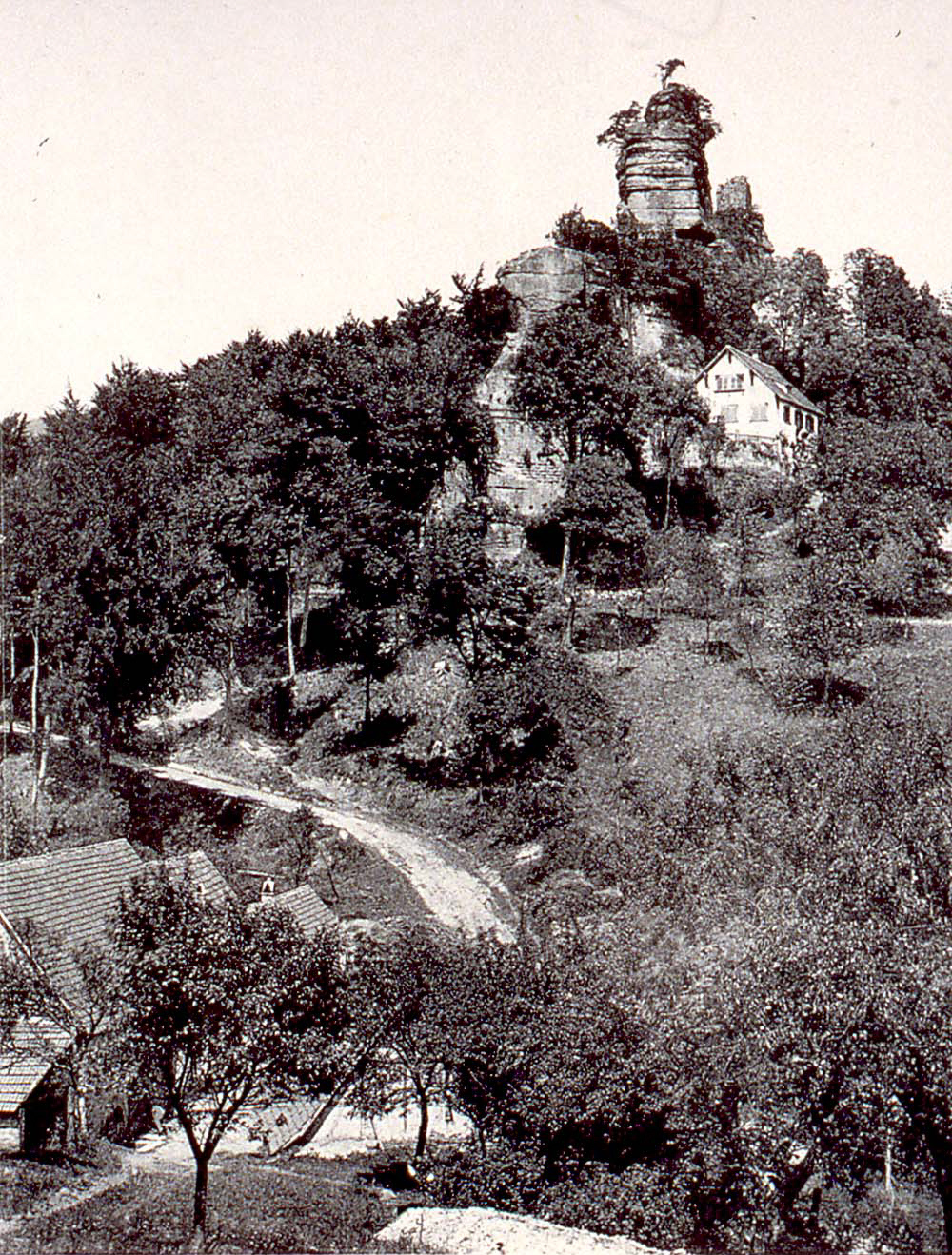
Photo by Emile Wagner (1850-1922) • Public domain
Current condition and cultural significance
Today, Vieux-Windstein Castle stands as a ruined monument, freely accessible to visitors who can explore its evocative remains and appreciate its historical context. Despite the scarcity of intact structures, the site offers a compelling glimpse into medieval fortification techniques, the lifestyle of feudal lords, and the turbulent history of the Alsace region.
The castle has been officially recognized as a monument historique by the French Ministry of Culture since 1984, underscoring its importance as a cultural and historical landmark. Its proximity to the nearby Nouveau-Windstein Castle adds to the area's appeal for enthusiasts of medieval architecture and history.
Visiting Vieux-Windstein Castle
Visitors to Vieux-Windstein can explore the site independently, experiencing the dramatic setting atop the rocky spurs and the intriguing blend of natural and man-made defensive features. The castle's Romanesque chapel ruins and pentagonal keep remain key highlights. The surrounding landscape of the Middle Vosges provides scenic views and opportunities for hiking and photography.
While the castle is in ruins, its evocative atmosphere and historical depth make it a worthwhile destination for those interested in medieval history, architecture, and the heritage of the Grand-Est region.
Frequently asked questions (FAQ)
- When was Vieux-Windstein Castle built and by whom?
- Vieux-Windstein Castle was likely built in the first half of the 12th century by Frederick II, Duke of Swabia, a member of the Hohenstaufen dynasty.
- What is the historical significance of Vieux-Windstein Castle?
- The castle served as a strategic stronghold for the Hohenstaufen dynasty and played a role in regional conflicts, including its siege in 1332 and destruction in 1676.
- Can visitors access Vieux-Windstein Castle freely?
- Yes, the castle ruins are freely accessible to the public, allowing visitors to explore the remains and enjoy scenic views of the surrounding area.
- What architectural features remain at Vieux-Windstein Castle?
- Visitors can see the remains of a Romanesque chapel, a pentagonal keep, residential towers, and a deep well carved into the rock.
- Why was Vieux-Windstein Castle dismantled and rebuilt?
- It was dismantled after being captured in 1332 due to its use as a brigand refuge but was rebuilt later in the 14th century despite a ban on reconstruction.
Photo gallery

Photo by Emile Wagner (1850-1922)•Public domain
Information
Address
Rue des Châteaux, Windstein, Bas-Rhin, France
Loading map...
Visitor reviews
No reviews yet. Been here? Write the first review and help other travelers!
Write the first reviewVisited this castle? Share your experience
Your review helps other travelers and adds first-hand knowledge to our encyclopedia.