Lutzelhardt Castle
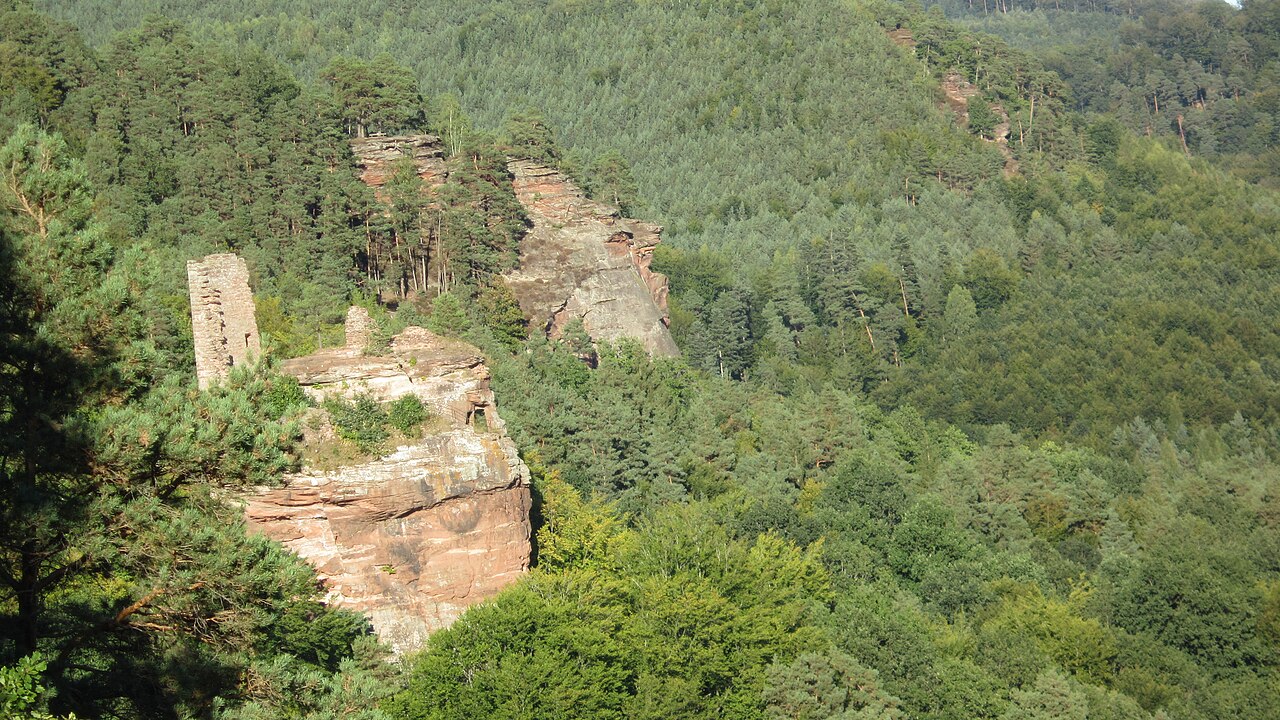
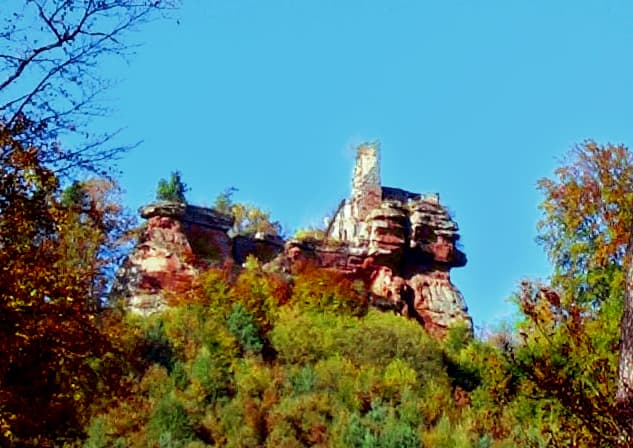
Lutzelhardt Castle, locally known as Château de Lutzelhardt, is a remarkable example of a medieval semi-troglodyte fortress nestled in the woods west of Obersteinbach village in the Bas-Rhin department, within the historic region of Northern Alsace, also called the Northern Vosges. This hill castle is uniquely perched on two narrow sandstone spurs about 20 meters high and extending roughly 60 meters in combined length, separated by a natural fault. Its strategic location atop these sandstone formations provided significant defensive advantages and exemplifies the medieval practice of integrating natural rock formations into castle architecture.
Constructed probably around 1200 by the Vogt of Wasselonne, the castle was first documented in 1250. It was originally built to defend the seigneury of Bitche, a feudal domain in the region, and its significance was heightened by its proximity to the Abbey of Sturzelbronn, established circa 1135. This abbey later became the burial site for the Dukes of Lorraine, linking the castle to both military and symbolic regional power.
Historical significance and ownership
The castle's history is marked by a series of ownership changes reflecting the complex feudal politics of medieval Alsace. Initially held by the Lutzelhardt family, who served as Vögte or advocates for Wasselonne, it was sold in 1363 to the prominent Fleckenstein family. By 1395, some rights were partially transferred to Count Philipp I of Nassau. Subsequent owners included notable figures such as Wirich Puller von Hohenburg and Count Jakob of Zweibrücken-Bitsch. In 1638, ownership passed to the Landgraves of Hessen-Darmstadt.
The castle endured multiple violent episodes: it was set ablaze by the citizens of Strasbourg in 1397, besieged and captured by forces from Wissembourg in 1462, and likely damaged during the Peasants' War of 1525. By 1538, it was already abandoned and in ruins. Further destruction probably occurred during the Thirty Years' War (1618-1648), a period of widespread conflict that devastated many fortifications across Europe.
Architectural features and layout
Château de Lutzelhardt is characterized by its semi-troglodytic design, meaning it incorporates natural rock formations into its defensive structures. The castle occupies a sandstone outcrop roughly 20 meters high, with usable surfaces extending about 60 meters in length and 10 meters in width. This natural foundation was exploited to enhance defense while minimizing construction effort.
The keep and residential buildings
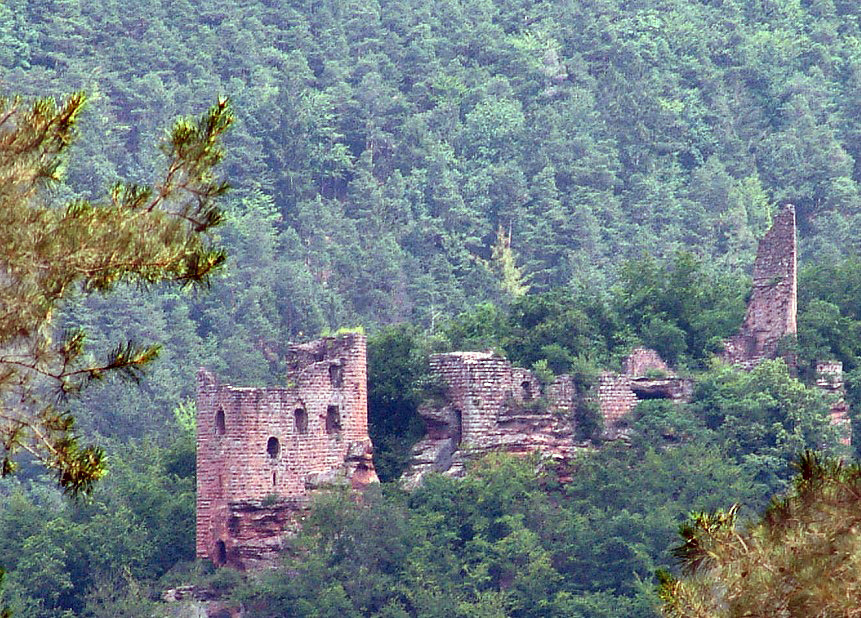
At the highest point stands a small square keep (donjon) dating from the 13th century, constructed with finely dressed stones that emphasize its role as the fortress's most fortified section. Adjacent to the keep on the eastern edge of the rock are the remains of a residential building that housed the lord and his household. Though mostly ruined, the northern wall remains standing to ground floor height, offering insight into the castle's domestic arrangements.
Courtyards and defensive structures
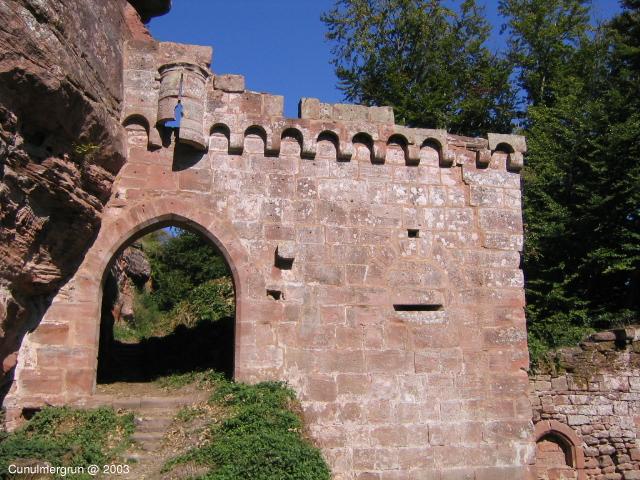
Below the main rock platform lies a lower courtyard enclosed by remnants of curtain walls and featuring a visible doorway threshold. This courtyard is defined by earth mounds and contains two large cellars cut directly from the sandstone bedrock, one of which has a vaulted ceiling, demonstrating advanced medieval masonry skills. A rock-carved staircase connects this courtyard to the upper sections, following the natural contours of the sandstone.
Additional defensive features include a ditch dug along the length of the rock opposite the courtyard, serving as a barrier against attackers. Fragments of retaining walls mark the castle's western boundary, hinting at the full extent of the original complex.
Water management and other infrastructure
The castle's design includes a cistern and either a well or a second cistern, essential for water storage during sieges. These features highlight the importance of sustainable living conditions in a fortress environment. Various other building remains scattered across the site suggest a once extensive complex, though their exact functions remain uncertain.
Decline and preservation
Following its abandonment in the mid-16th century, Lutzelhardt Castle fell into ruin. The damage inflicted during sieges and wars, particularly the Thirty Years' War, left the site largely destroyed. Despite this, the ruins have preserved significant architectural elements that provide valuable insights into medieval castle construction and defensive strategies.
Today, the castle is state property and lies within a protected natural forest reserve, ensuring its conservation. Since the late 19th century, it has been officially recognized as a cultural heritage monument, underscoring its historical and architectural importance in the region.
Visiting lutzelhardt castle
The ruins of Lutzelhardt Castle are freely accessible to the public, offering visitors a chance to explore a fascinating medieval fortress integrated with natural sandstone formations. The site provides a unique glimpse into the medieval defensive architecture of the Northern Alsace region and the turbulent history that shaped it.
Visitors can appreciate the castle's strategic hilltop location, the remains of its keep, residential quarters, courtyards, and defensive walls, as well as its ingenious use of the natural landscape. Its status as a protected monument ensures ongoing preservation efforts, making it a valuable destination for history enthusiasts and castle architecture aficionados alike.
Frequently asked questions (FAQ)
- What are the opening hours of Lutzelhardt Castle?
- Lutzelhardt Castle is typically open to visitors from 10 AM to 6 PM during the summer months, and from 10 AM to 4 PM in the winter. It is advisable to check the official website for any seasonal changes or special closures before your visit to ensure you have the most accurate information.
- When was Lutzelhardt Castle built?
- Lutzelhardt Castle was constructed in the late 12th century, serving as a strategic fortification during various conflicts in medieval France. Its historical significance is rooted in its role as a noble residence and military stronghold throughout the ages.
- Is it possible to access Lutzelhardt Castle with mobility aids?
- Yes, Lutzelhardt Castle has made efforts to accommodate visitors with mobility challenges. While some areas may have limited accessibility due to the castle's historical architecture, there are designated paths and facilities to assist visitors in enjoying their experience.
- What is the ticket price for visiting Lutzelhardt Castle?
- The ticket prices for Lutzelhardt Castle are generally around €8 for adults, with discounts available for children and seniors. Family passes may also be offered, making it an affordable outing for all ages.
- Can I take photographs inside Lutzelhardt Castle?
- Photography is permitted in most areas of Lutzelhardt Castle, allowing you to capture the stunning architecture and picturesque surroundings. However, be sure to respect any signs indicating restricted areas where photography may not be allowed.
- What is the best time to visit Lutzelhardt Castle?
- The best time to visit Lutzelhardt Castle is during the spring and early autumn when the weather is mild, and the surrounding landscape is in full bloom. Additionally, visiting during these seasons allows you to enjoy fewer crowds and a more tranquil experience.
- What nearby attractions can I visit while at Lutzelhardt Castle?
- While visiting Lutzelhardt Castle, you can explore several nearby attractions, including the charming village of Basse-Ham and the scenic hiking trails in the surrounding hills. These sites offer a perfect complement to your castle experience, showcasing the beauty of the region.
Photo gallery

Information
Website
Visit websiteSources & official resources
Verify the information above using these authoritative references.
Loading map...
Visitor reviews
No reviews yet. Been here? Write the first review and help other travelers!
Write the first reviewVisited this castle? Share your experience
Your review helps other travelers and adds first-hand knowledge to our encyclopedia.