Schlossturm
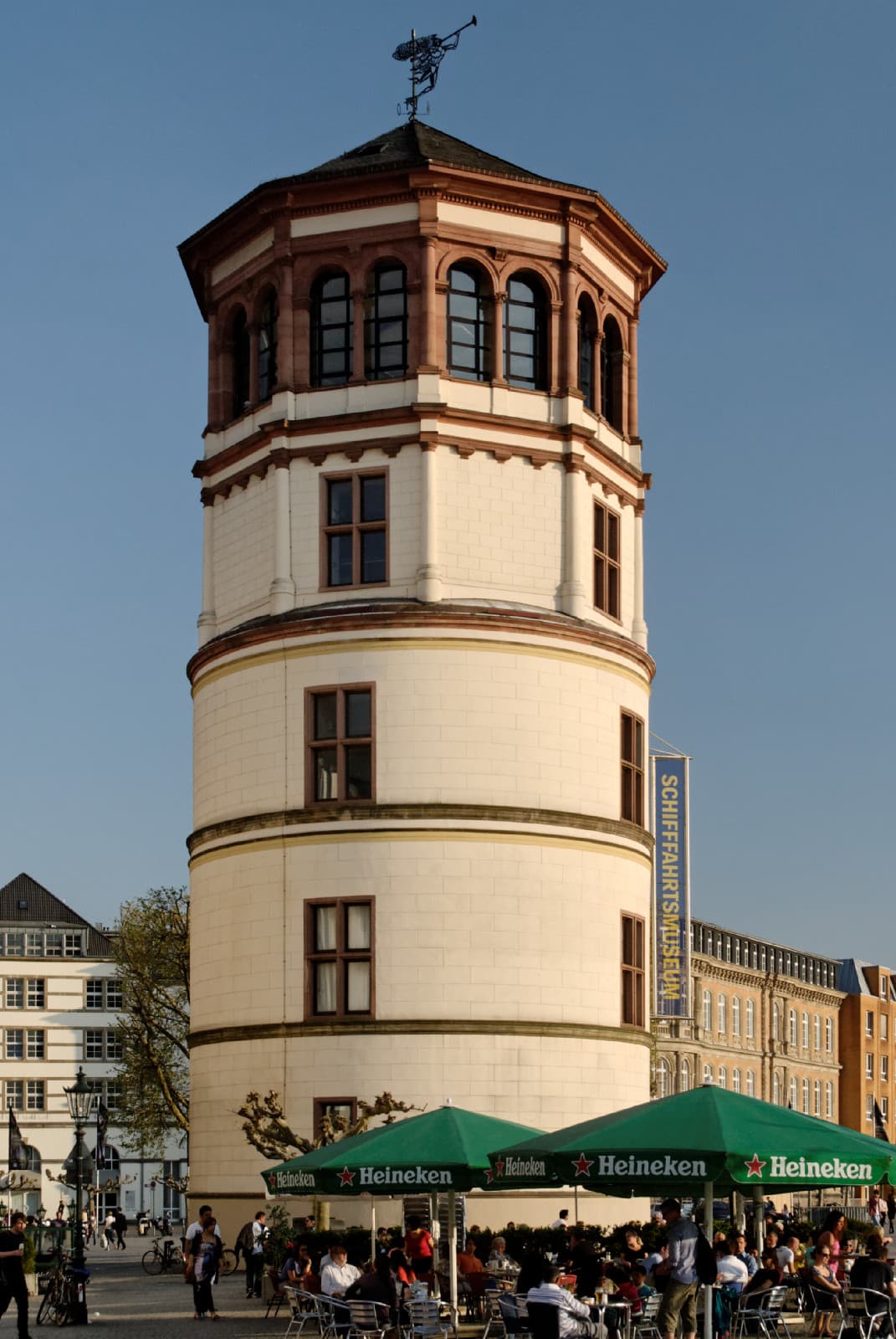
The Schlossturm in Düsseldorf stands as the sole surviving structure of the once extensive castle complex belonging to the Counts of Berg. This historic tower, prominently located on the riverside at the confluence of the Düssel and the Rhine, offers a tangible link to the city's medieval past. The first three storeys of the Schlossturm date back to the 13th century, marking it as a significant example of high medieval architecture in the region.
In 1552, the tower was notably enhanced by the Italian architect Alessandro Pasqualini, who added a distinctive fourth storey. This upper level is polygonal in shape and features elegant Tuscan columns, reflecting Renaissance influences and the architectural transition from medieval fortifications to more refined residential and ceremonial structures. The tower's design thus embodies a blend of medieval robustness and Renaissance elegance.
Historical development of the Düsseldorf castle complex
The original Düsseldorf castle was established around 1260 as a lowland castle on a small island at the mouth of the Düssel river. It served as the residence of the Counts of Düsseldorf and Berg, strategically positioned to control river traffic and local trade routes. Over the centuries, the castle underwent numerous expansions and renovations, reflecting the changing political and cultural landscape of the region.
Significant developments occurred under the rule of William, Duke of Jülich-Cleves-Berg in the mid-16th century, followed by further enhancements during the late 17th century under Jan Wellem, and again in the mid-18th century under Charles Theodore. These modifications transformed the castle from a fortified medieval stronghold into a more elaborate ducal and court residence, incorporating elements of Renaissance and Baroque architecture.
The Düsseldorf picture gallery
One of the castle's most internationally renowned features was the Düsseldorf Picture Gallery, constructed between 1709 and 1712 as the first independent building dedicated solely to housing an art collection. This gallery showcased a world-famous assemblage of Renaissance and Baroque paintings until its closure in 1805, attracting artists, collectors, and visitors from across Europe.
Later uses and destruction
After the gallery's closure, parts of the castle served various functions, including housing a mint for the Kingdom of Prussia from 1817 to 1848. From the mid-19th century, the castle also accommodated the Kunstakademie Düsseldorf (Düsseldorf Art Academy), which contributed to the city's cultural development. Under King Friedrich Wilhelm IV, the castle was further adapted to serve as the Parliament of the Rhine Province Provincial Diet.
Tragically, the castle complex was largely destroyed by fire during the night of 19 to 20 March 1872. This event marked the loss of a centuries-old landmark that had been central to Düsseldorf's urban life and identity. The remaining south wing was demolished in 1896, leaving the Schlossturm tower as the sole survivor.
Architectural features of the schlossturm
The Schlossturm is notable for its robust medieval construction combined with Renaissance stylistic elements. The lower three storeys exhibit the typical high medieval masonry techniques, with thick stone walls designed for defense. The upper polygonal storey added by Pasqualini introduces a lighter, more decorative aspect with its Tuscan columns and refined proportions.
The tower's location on the riverside enhances its prominence, historically serving as a lookout and control point over the Rhine and Düssel rivers. Today, the Schlossturm is topped by a distinctive face, a feature that adds to its unique character and serves as a recognizable symbol of Düsseldorf's heritage.
Current use and cultural significance
Today, the Schlossturm houses the museum of Rhine shipping, which explores the history and development of navigation and commerce on the Rhine river. The museum's exhibits include historic vessels, models, navigational instruments, and documents that illustrate the vital role of the Rhine in European trade and transportation.
The site known as Burgplatz now occupies the former castle grounds, with an outline of differently colored stones in the pavement marking the original floor plan of the Düsseldorf castle. This subtle memorialization allows visitors to visualize the scale and layout of the former complex despite the loss of most of its structures.
The Schlossturm remains a key cultural landmark in Düsseldorf, linking the city's medieval origins with its modern identity. Its preservation and adaptive reuse as a museum contribute to public understanding of regional history and architectural heritage.
Frequently asked questions (FAQ)
- What is the history behind the Schlossturm?
- The Schlossturm dates back to the 13th century as part of the Düsseldorf castle complex of the Counts of Berg. It was expanded in the 16th century by Alessandro Pasqualini and survived the castle's destruction in 1872.
- Can I visit the Schlossturm today?
- Yes, the Schlossturm is open to visitors daily from 10:00 to 18:00. It houses the museum of Rhine shipping, showcasing the region's maritime history.
- What architectural styles are visible in the Schlossturm?
- The tower combines high medieval masonry in its lower levels with Renaissance features such as Tuscan columns on the polygonal fourth storey added in the 16th century.
- How did the Düsseldorf castle complex change over time?
- Originally a 13th-century lowland castle, it was expanded under various rulers including William, Duke of Jülich-Cleves-Berg, Jan Wellem, and Charles Theodore, evolving into a ducal residence with Renaissance and Baroque elements.
- Is there any visible trace of the former castle besides the Schlossturm?
- Yes, the Burgplatz square features an outline of differently colored stones marking the original floor plan of the Düsseldorf castle, providing a visual reference to its past footprint.
Photo gallery

Information
Opening hours
10:00-18:00, daily
Ticket prices
€5 adult, €3 child
Current owner
Municipality of Düsseldorf
Loading map...
Visitor reviews
No reviews yet. Been here? Write the first review and help other travelers!
Write the first reviewVisited this castle? Share your experience
Your review helps other travelers and adds first-hand knowledge to our encyclopedia.