Kaiserpfalz Kaiserswerth
Kaiserpfalz Kaiserswerth stands as a remarkable medieval fortress ruin located in the municipality of Düsseldorf, Germany. This historic site, situated on the banks of the Rhine River, offers a profound glimpse into the military, administrative, and economic history of the region during the Middle Ages. Its origins date back to the early medieval period, with layers of history reflecting Frankish monastic foundations, imperial power struggles, and strategic river control.
The site originally began as a monastic settlement established around 700 AD by the monk Suitbert(us) on a man-made island formed in an old branch of the Rhine. Known as Kaiserswerth or "imperial island," this location was already significant due to a Frankish royal estate (Fronhof) fortified by earthworks and wooden palisades. The island’s strategic position at the crossroads of the Hellweg trade road and an ancient Roman road connecting Xanten and Neuss underscored its importance in regional commerce and defense. The monastery's foundation was supported by Pepin of Herstal and his wife Plectrude, emphasizing the site's religious and political significance in the late 7th and early 8th centuries.
The early medieval origins and imperial palace
The earliest documented castle at Kaiserswerth appears in 1016 when Emperor Henry II reconciled with Count Palatine Ezzo of Lotharingia, granting him the castle and surrounding lands. After Ezzo’s son died without heirs in 1047, the site returned to the royal crown. Around 1050, Emperor Henry III expanded the complex into a royal palace. Although no architectural remains from this Salian period survive, historical records reveal the site’s early role as an imperial residence.
A dramatic episode unfolded in 1062 during the regency of Agnes of Poitou for her son Henry IV. Archbishop Anno II of Cologne orchestrated the kidnapping of the young king at Kaiserswerth, a political coup that strained imperial-church relations. Following this event, Henry IV visited the palace only once more in 1101, and the site’s prominence waned for the next century.
The Hohenstaufen fortress and toll station
The fortress as it stands today largely dates from the late 12th century, when Emperor Frederick Barbarossa revitalized Kaiserswerth by relocating the Rhine toll station there in 1174. Under his son Henry VI, construction of a formidable fortress was completed by 1193. This structure was designed primarily as a fortified customs post rather than a royal residence, emphasizing the site's economic and strategic function in controlling river traffic.
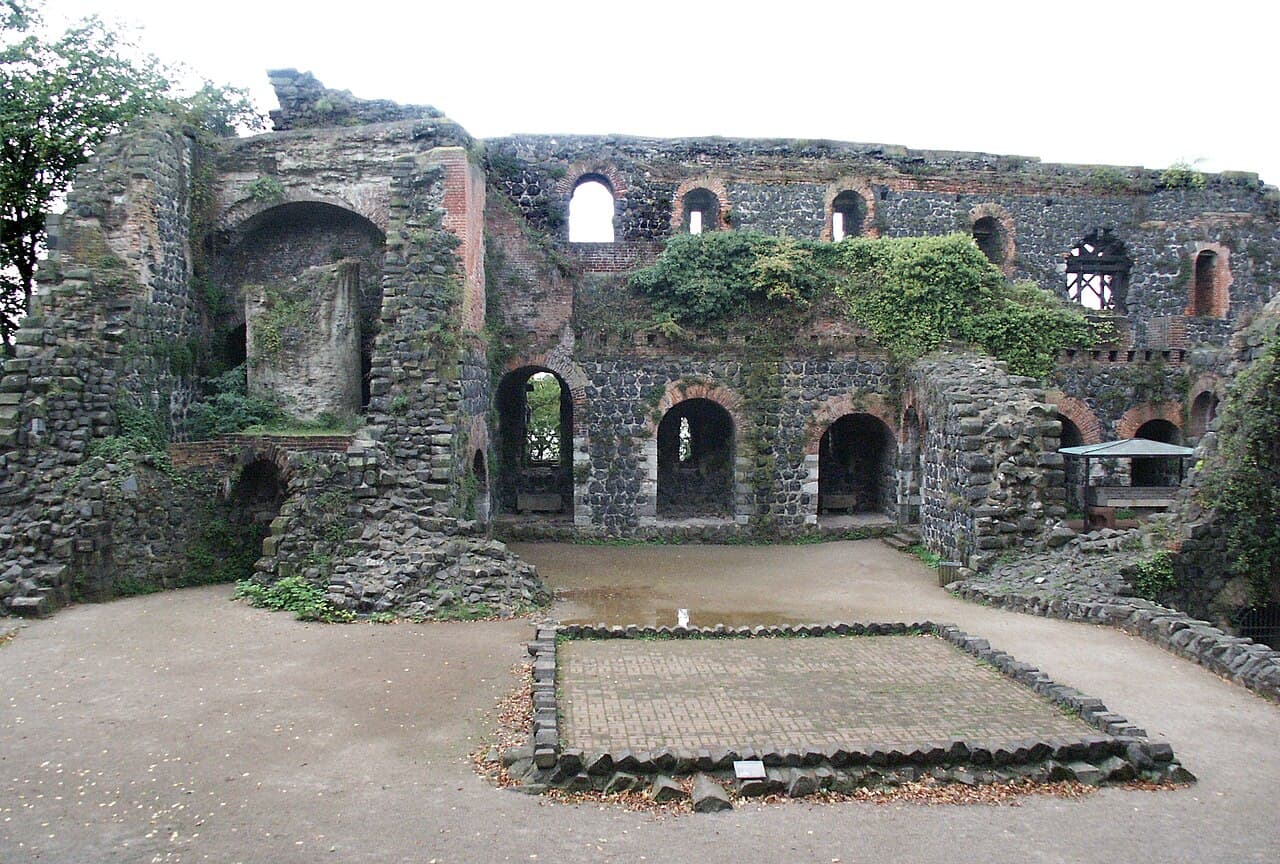
The fortress featured a massive three-storey palace (palas) and a centrally placed bergfried or keep, symbolizing military strength. The western palace wall, facing the Rhine, remains notably well preserved. It measures 50 meters long, 14 meters high, and 6 meters thick, built from irregular basalt blocks quarried from the nearby Drachenfels mountain and tuff stone. Its windows are framed by red volcanic brick arches and gray trachyte cornerstones. Archaeological evidence suggests the palace originally had an additional upper storey, with the ground floor serving economic functions and the upper floors containing living quarters and a grand banquet hall with a balcony overlooking the river.
The bergfried’s foundations form a square approximately eight by eight meters with walls 4.5 meters thick. Historical accounts estimate the tower once rose nearly 55 meters before its destruction in the early 18th century. A distinctive feature of the fortress is a tall cylindrical cistern on the southern side, rising about nine meters. Constructed of brick and tuff atop a 13-meter deep well lined with trachyte blocks, this cistern collected and filtered rainwater through sand, providing a vital water supply during sieges.
Defensive structures and layout
The fortress’s main entrance was located at the northeast, guarded by the Klever Tower (Kleverturm), which controlled access along the road to Kleve. The tower has undergone restoration in recent years. A modern wooden bridge now replaces the original drawbridge.
On the landward side, the fortress was protected by a semicircular curtain wall with two corner towers, supplemented by a moat and ditch. The Rhine River formed a natural defense on the opposite side. Excavations have revealed a large outer bailey enclosed by a crescent-shaped ring wall of tuff stone, containing a double tower to the north and a round shell tower to the south. A broad, water-filled moat further hindered attackers.
The site also contains an advanced medieval latrine system designed to drain refuse directly into the Rhine, a feature once mistaken for a courtyard. Large stone blocks from the fortress walls remain visible along the riverbed at low water.
Historical conflicts and decline
Kaiserswerth’s strategic importance made it a focal point in regional power struggles. During the German throne dispute (1212–1215), Emperor Otto IV imprisoned the Bishop of Münster there. The fortress endured several sieges, including a notable one in 1215 when Count Adolf III of Berg diverted a Rhine arm to enable a land assault, forcing the fortress’s surrender. Another prolonged siege in 1247 by Count William II of Holland ended with the defenders starving into submission.
From the late 13th century, Kaiserswerth changed hands multiple times among powers such as the Dutch, the Archbishopric of Cologne, and the duchies of Cleves and Jülich-Berg. The Archbishopric of Cologne maintained control from 1424 to 1774. During this period, Bishop Salentin von Isenburg led restoration efforts between 1567 and 1577. However, a catastrophic explosion in 1655 destroyed several buildings including the palace chapel.
The fortress suffered further damage during the Cologne War (1688–1689), when French-aligned forces held it. Allied Brandenburg, Dutch, and Münster troops besieged and captured Kaiserswerth in 1689, causing severe damage from artillery and fire. After its return to Cologne in 1692, restoration was attempted but the fortress never fully recovered.
The War of the Spanish Succession brought a devastating siege in 1702. Allied cannon fire, estimated at 12,000 shots, destroyed most of the town and heavily damaged the palace. On August 9, 1702, under orders from Johann Wilhelm II, the fortress’s main tower and landward walls were deliberately demolished to prevent further military use. The Treaty of Rastatt in 1714 returned control to Cologne, but the palace was never rebuilt. Only the church of Saint Suitbert was restored in 1717.
Preservation and archaeological significance
Ownership transitioned from ecclesiastical to municipal hands in 1838. Over the 19th and 20th centuries, the ruins were quarried for building materials and altered by flood control works, including a dam built in 1884. Archaeological excavations began in 1899 under Professor Paul Clemen and continued with further digs from 1967 to 1974. During the National Socialist era, the site served as a memorial and meeting place for the Hitler Youth.
Modern restoration efforts between 1997 and 2001 coincided with the 1300th anniversary of Kaiserswerth. In 1982, the ruins were officially protected as a historic monument. Today, the site includes contemporary artistic installations such as the 1980 bronze sculpture "Sidu" by Rudolf Heekers near the Klever Tower and the 2014 steel sculpture "Im Kontext" by Peter Schwickerath, which draws on the fortress’s Romanesque architectural motifs.
Architectural legacy
The ruins of Kaiserpfalz Kaiserswerth provide an exceptional example of a high medieval fortress that combined military, administrative, and economic functions. Its massive basalt and tuff walls, the towering bergfried, and the sophisticated water cistern system reflect advanced medieval engineering. The site’s layered history from monastic beginnings to imperial palace and fortress encapsulates the shifting political landscape of the Rhineland over centuries.
Visitors today can explore the imposing remains of the palas, the bergfried foundations, and the defensive walls, gaining insight into the strategic importance of river toll stations in medieval Europe. The ruins stand as a testament to the power struggles, architectural innovation, and historical transformations that shaped this region along the Rhine.
Frequently asked questions (FAQ)
- How do I get to Kaiserpfalz Kaiserswerth?
- Kaiserpfalz Kaiserswerth is located in Düsseldorf, Germany, and is accessible by public transport, car, or bicycle. It is situated near the Rhine River on Kaiserswerth island, with clear signage from the city center.
- What is the historical significance of Kaiserpfalz Kaiserswerth?
- The fortress served as an imperial palace, a fortified toll station, and a strategic military site from the early Middle Ages through the early modern period. It played roles in key historical events such as the kidnapping of Henry IV and several important sieges.
- Can I visit the ruins of the bergfried and palace?
- Yes, visitors can explore the well-preserved western palace wall, the bergfried foundations, and other ruins. Informational plaques provide historical context, and the site is open daily with free admission.
- When is the best time to visit Kaiserpfalz Kaiserswerth?
- The site is open year-round, but spring through early autumn offers the most pleasant weather for exploring the outdoor ruins and enjoying views of the Rhine.
- Are there any guided tours available at the site?
- Guided tours are occasionally offered by local historical societies and the municipality. Visitors should check the official Düsseldorf tourism website for current schedules and special events.

Information
Opening hours
10:00-18:00, daily
Ticket prices
Free
Current owner
Municipality of Düsseldorf
Loading map...
Visitor reviews
No reviews yet. Been here? Write the first review and help other travelers!
Write the first reviewVisited this castle? Share your experience
Your review helps other travelers and adds first-hand knowledge to our encyclopedia.