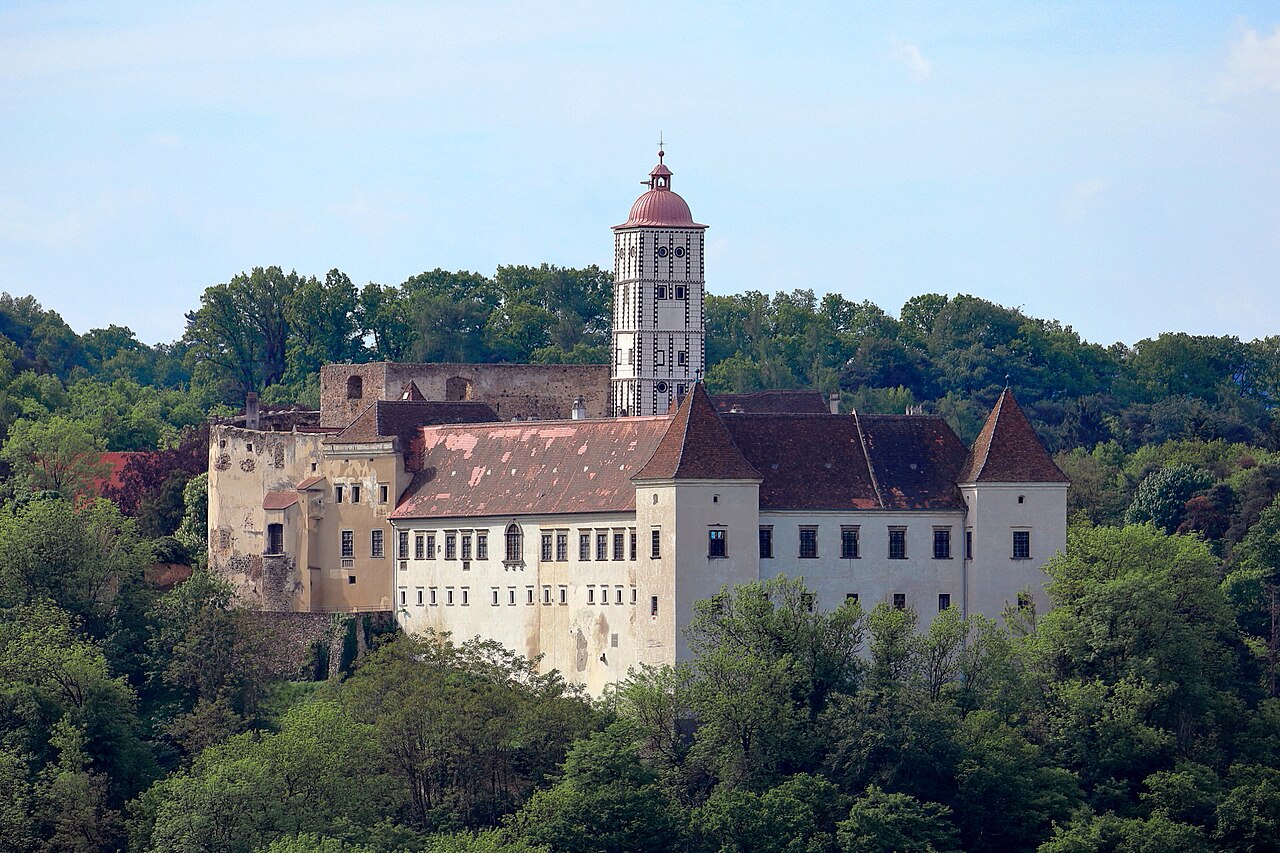
Schloss Schallaburg
Schloss Schallaburg stands as a remarkable example of Renaissance architecture nestled in the heart of Lower Austria, approximately six kilometers south of the historic town of Melk. This castle is not only a testament to the architectural evolution from medieval fortifications to Renaissance palatial grandeur but also a cultural landmark reflecting the religious and political shifts in Austrian history.
The site of Schloss Schallaburg reveals a long history of human settlement, with archaeological evidence suggesting Roman activity, possibly including a Roman fortification on the castle hill. Although detailed records from this early period are scarce, the castle's origins trace back to the 11th century, when it was first constructed as a stone fortress designed for defense and residence.
Medieval origins and early ownership
The earliest documented owner of the castle was Count Sieghard von Schala, who died in 1104. His lineage maintained control until the 12th century, with the castle first officially mentioned in 1242 under the name "Feste Schala." Throughout the 13th to 15th centuries, the noble family von Zelking held the castle, overseeing its role as a fortified stronghold in the region.
Transformation into a Renaissance palace
Between 1450 and 1614, the castle underwent a significant transformation under the ownership of the von Losenstein family. This period marked Schloss Schallaburg's evolution from a medieval fortress into a splendid Renaissance palace. The von Losensteins were influential in the region, notably promoting Protestantism during a time of religious upheaval in Lower Austria.
Hans Wilhelm von Losenstein, a prominent family member, founded the Hohe Schule Loosdorf, an educational institution dedicated to Protestant youth, highlighting the castle's role as a center of religious and cultural activity.
Subsequent ownership and religious shifts
Following Hans Wilhelm's death, financial difficulties led to the sale of the castle to the von Stubenberg family. Later, in 1660, the property passed to the Catholic Kletzl von Altenach family, reflecting the broader Counter-Reformation trends in the region. In 1762, ownership transferred to Bartholomäus III von Tinti, whose descendants retained the castle into the early 20th century.
20th-century renovations and modern use
Between 1906 and 1908, Baron Karl Gustav von Tinti undertook renovations of the castle's large arcaded courtyard, enhancing its Renaissance character. However, economic hardships led to the sale of the castle in 1940 to Josef Freiherr von Nagel-Doornick from Westphalia.
After World War II, the castle was confiscated from German ownership and managed by USIA enterprises before being transferred to the Republic of Austria under the State Treaty. In 1968, the state of Lower Austria acquired Schloss Schallaburg, initiating extensive restoration efforts led by architect Wilhelm Zotti. Since reopening as an international exhibition center in 1974, the castle has seen ongoing modernization, including climate control, safety upgrades, and energy efficiency improvements planned through 2024.
Architectural features and castle layout
Schloss Schallaburg is a well-preserved complex that harmoniously blends medieval, Renaissance, and Baroque architectural elements. The original medieval castle, dating from around 1100, featured a fortified ring wall enclosing a five-story main residential building known as the palas. This palas is distinguished by its rusticated quoins, a design element inspired by Roman stonework, underscoring the castle's deep historical roots.
The castle chapel, originally a small Romanesque round building, was expanded during the Gothic period and later altered in the Baroque era with a new altar and a wide apse window. Its three-aisled, four-bay crypt is supported by groin vaults, showcasing medieval architectural sophistication.
Defensive structures and adaptations
The castle's defensive ring wall was progressively heightened and adapted to accommodate firearms, featuring embrasures and a battlement walkway. The 15th and early 16th centuries saw the addition of a zwinger or outer ward, flanked by two towers: a south tower designed for hand firearms and an east tower likely serving as a late Gothic artillery tower.
Renaissance enhancements
Between 1570 and 1580, the northern facade of the palas was adorned with a Renaissance-style arcade gallery notable for its approximately 1600 terracotta elements, making it a unique example of German Renaissance architecture in Austria. The large trapezoidal courtyard, constructed around 1575, features Tuscan columns and terracotta cladding, reflecting the era's artistic tastes.
The northeast corner boasts an eight-story observation tower decorated with sgraffito, a technique involving layers of plaster scratched to reveal contrasting colors. This tower is divided by cornices, plaster bands, and pilasters, adding to the castle's visual richness.
Gatehouses and entrance
The castle's main entrance comprises two gatehouses: the "Jägerstöckl", a two-story longitudinal gatehouse with rusticated round-arched portals, and the "Försterstöckl", a two-story transverse gatehouse featuring a portal dated 1573 and bearing the Losenstein/Rogendorf coat of arms from 1598.
Gardens and grounds
The castle grounds include a garden located on the site of the former outer ward. This garden is thoughtfully designed with flower beds, pathways, and lawns, offering visitors a serene environment that complements the castle's historic ambiance.
Preservation and cultural significance
Thanks to extensive renovations throughout the 20th century and ongoing conservation efforts, Schloss Schallaburg retains its distinctive Renaissance appearance while preserving visible medieval and Baroque features. The castle serves as a cultural hub, hosting exhibitions and events that celebrate its rich heritage and architectural splendor.
Visitors to Schloss Schallaburg can explore a site where history, art, and architecture converge, offering a deep insight into Austria's medieval and Renaissance past. Its well-preserved structures and artistic details make it a must-visit destination for enthusiasts of castle architecture and European history.
Frequently asked questions (FAQ)
- What is the historical significance of Schloss Schallaburg?
- Schloss Schallaburg is one of Austria's most important Renaissance castles, dating back to the 11th century. It showcases the transition from a medieval fortress to a grand residence, reflecting the architectural and cultural developments of the time.
- When was Schloss Schallaburg constructed?
- The construction of Schloss Schallaburg began in the 11th century and continued over several centuries. It underwent significant renovations during the Renaissance, particularly in the 16th century, which shaped much of its current appearance.
- Can I take guided tours of Schloss Schallaburg?
- Yes, guided tours are available at Schloss Schallaburg, providing visitors with in-depth insights into its history and architecture. These tours are often led by knowledgeable guides who can answer questions and share fascinating stories about the castle.
- What are the opening hours for Schloss Schallaburg?
- Schloss Schallaburg is typically open to visitors from March to November, with varying hours depending on the season. It is advisable to check the official website for the most current opening times before planning your visit.
- Is it possible to access Schloss Schallaburg with a wheelchair?
- Yes, Schloss Schallaburg is committed to accessibility and offers facilities for visitors with mobility challenges. However, some areas may have limited access due to the castle's historical architecture, so it's best to inquire in advance.
- What is the best time to visit Schloss Schallaburg?
- The best time to visit Schloss Schallaburg is during the spring and early autumn when the weather is pleasant and the gardens are in full bloom. Additionally, visiting during weekdays can help avoid larger crowds typically seen on weekends.
- What are the ticket prices for Schloss Schallaburg?
- Ticket prices for Schloss Schallaburg can vary depending on age and group size, with discounts often available for students and seniors. Family tickets are also offered, making it an affordable option for visitors of all ages.
- Are there any nearby attractions to Schloss Schallaburg?
- Yes, Schloss Schallaburg is located near several other attractions, including the picturesque town of Melk and the stunning Melk Abbey. These sites can easily be included in a day trip for a comprehensive cultural experience.
Information
Website
Visit websiteSources & official resources
Verify the information above using these authoritative references.
Loading map...
Visitor reviews
No reviews yet. Been here? Write the first review and help other travelers!
Write the first reviewVisited this castle? Share your experience
Your review helps other travelers and adds first-hand knowledge to our encyclopedia.