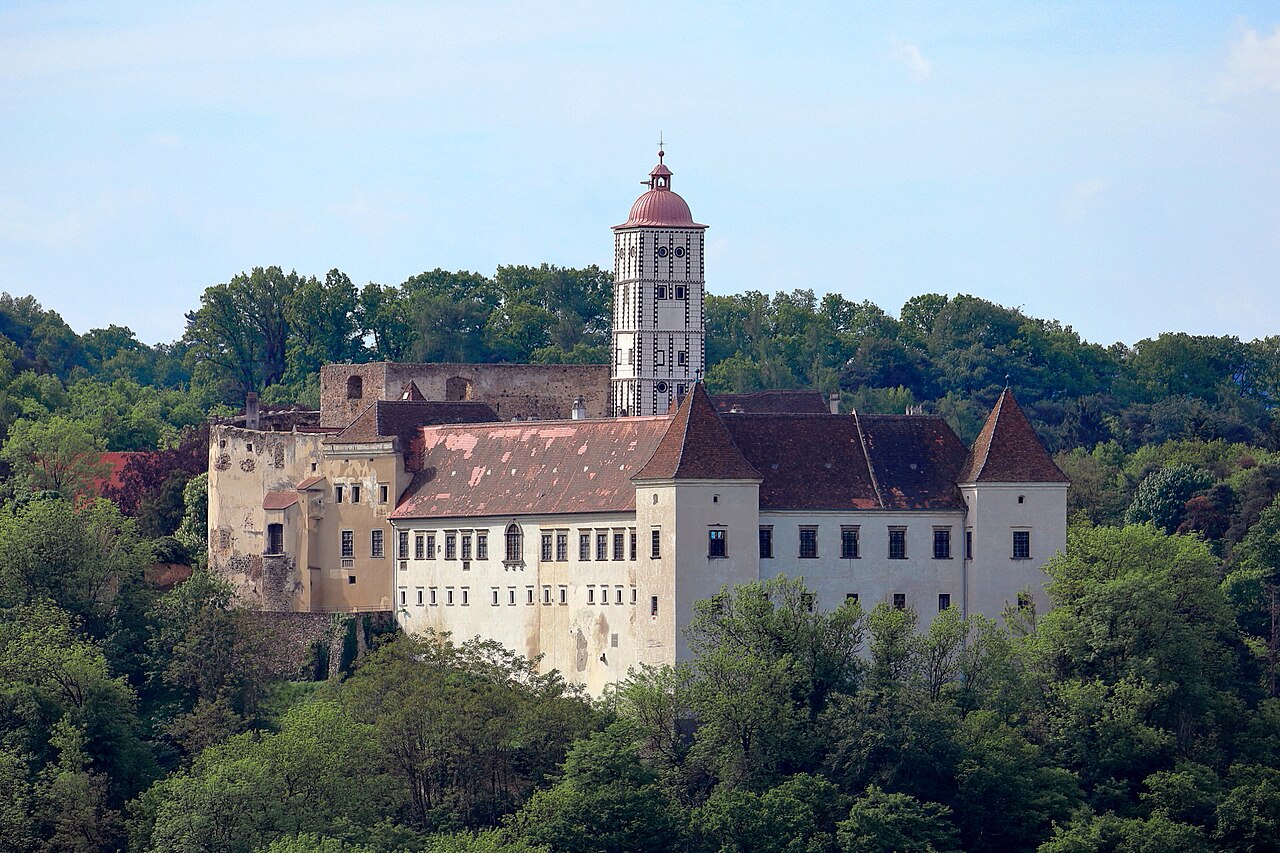
Burgruine Sichtenberg
Burgruine Sichtenberg stands as a compelling example of a medieval hill castle ruin situated near the municipality of Schollach in modern-day Austria. This castle, perched strategically on a wooded hill spur, reflects the feudal dynamics and architectural practices of the High Middle Ages. Its remains offer valuable insight into the defensive strategies and noble residences of the period.
The castle's origins likely date back to the late 12th century, with the earliest documented reference appearing shortly after the year 1200. Historical records mention a nobleman known as “Herr von Sichterberg” around 1170, who was part of the retinue of the influential Lords of Schalla. This association suggests that Burgruine Sichtenberg was an integral element within a network of local power, serving as a fortified residence for regional nobility.
Historical development and ownership
By the mid-13th century, the fiefdom encompassing Sichtenberg came under the control of the Redler family, a noble lineage that maintained possession until approximately 1540. The extinction of the Redler line led to a division of ownership among prominent families, including Sophie and Christoph von Althan zu Murstetten and Klara and Ulrich von Neydegg. This period marked a transition in the castle's stewardship, reflecting the complexities of inheritance and noble alliances.
At the close of the 16th century, the estate surrounding the castle was acquired by Wilhelm von Losenstein, lord of the nearby Schallaburg estate. Despite this acquisition, Burgruine Sichtenberg itself experienced decline, becoming uninhabitable by the time of the Thirty Years’ War in the early 17th century. Since then, it has remained a ruin, emblematic of the shifting political and military landscapes of the region.
Architectural features and defensive design
The castle's layout capitalizes on its elevated position, occupying an area roughly 40 by 40 meters. Its placement on a steep hill spur provided natural defenses, with steep slopes enveloping most sides. On the less precipitous southern and eastern approaches, a deep neck ditch was excavated to bolster protection, reaching depths of approximately 10 meters and still visible today.
Encircling the inner ward are remnants of zwinger walls, which are outer defensive walls designed to create a killing zone between the castle's core and attackers. These walls, surviving in sections, originally rose to heights of up to 25 meters and were deliberately constructed without windows to maximize defensive strength and minimize vulnerabilities.
Central to the castle's defense was the bergfried, a tall, slender tower typical of Central European castles, serving as a refuge and lookout point. The bergfried at Sichtenberg measured approximately 3 by 3 meters, with fragments of one corner still visible, offering a tangible link to the castle’s original fortification.
Additional surviving elements include parts of the ring wall that enclosed the inner castle. This wall incorporates loopholes, narrow vertical slits that allowed defenders to observe and fire arrows or early firearms while remaining protected. At one end of the wall, the remains of a round bastion tower attest to later fortification efforts, aimed at strengthening defensive coverage and adapting to evolving military technologies.
Strategic significance and landscape integration
Burgruine Sichtenberg’s location on a hill spur provided a commanding view of the surrounding landscape, enabling early detection of approaching threats. The combination of natural topography and man-made defenses exemplifies medieval military architecture's reliance on terrain advantages. The steep slopes and deep ditches created formidable obstacles for attackers, while the concentric defensive walls allowed defenders to mount layered resistance.
The castle’s design reflects the transitional nature of medieval fortifications, where traditional high walls and towers were augmented by innovations such as bastions to counter advances in siege warfare. This evolution underscores the dynamic interplay between offensive and defensive strategies during the High and Late Middle Ages.
Preservation and modern access
Today, Burgruine Sichtenberg remains a partially preserved ruin, with significant portions of its defensive walls and structural elements still standing. Although privately owned, the site has been freely accessible to the public since 2016, reflecting a growing appreciation for cultural heritage and medieval architecture in Austria.
Local initiatives have focused on stabilizing the ruins and preventing further deterioration, ensuring that visitors can safely explore the site and appreciate its historical significance. The castle’s enduring presence offers a window into the feudal past and the architectural ingenuity of medieval builders.
Visiting burgruine sichtenberg
Visitors to Burgruine Sichtenberg can explore the ruins set amidst a scenic wooded environment, experiencing firsthand the defensive features such as the neck ditch, zwinger walls, and bergfried remains. The site’s hilltop position provides panoramic views of the surrounding Austrian countryside, enhancing its appeal as a destination for history enthusiasts and hikers alike.
While facilities are limited due to the castle’s ruinous state and private ownership, the open access policy allows for flexible visiting times. Prospective visitors are encouraged to wear appropriate footwear for uneven terrain and to respect the site’s fragile condition.
Frequently asked questions (FAQ)
- How do I get to Burgruine Sichtenberg?
- Burgruine Sichtenberg is located near the municipality of Schollach in Austria. Visitors typically reach the site by car or local transport, followed by a short hike up the wooded hill spur where the castle stands.
- What is the historical significance of Burgruine Sichtenberg?
- Burgruine Sichtenberg is significant as a medieval hill castle reflecting feudal power structures and defensive architecture from the High Middle Ages. It was associated with noble families such as the Lords of Schalla and the Redler family.
- Can I explore the castle ruins freely?
- Yes, since 2016 the ruins of Burgruine Sichtenberg have been freely accessible to the public. Visitors can explore the remains, including the bergfried and zwinger walls, but should exercise caution due to uneven terrain and fragile structures.
- When was Burgruine Sichtenberg built?
- The castle likely dates back to the late 12th century, with the earliest documented reference shortly after 1200. It was constructed during the High Medieval period.
- What architectural features are notable at Burgruine Sichtenberg?
- Notable features include the bergfried, zwinger walls up to 25 meters high, a deep neck ditch about 10 meters deep, loopholes in the ring wall, and a round bastion tower, illustrating medieval defensive design.
Information
Current owner
Private owner
Loading map...
Visitor reviews
No reviews yet. Been here? Write the first review and help other travelers!
Write the first reviewVisited this castle? Share your experience
Your review helps other travelers and adds first-hand knowledge to our encyclopedia.