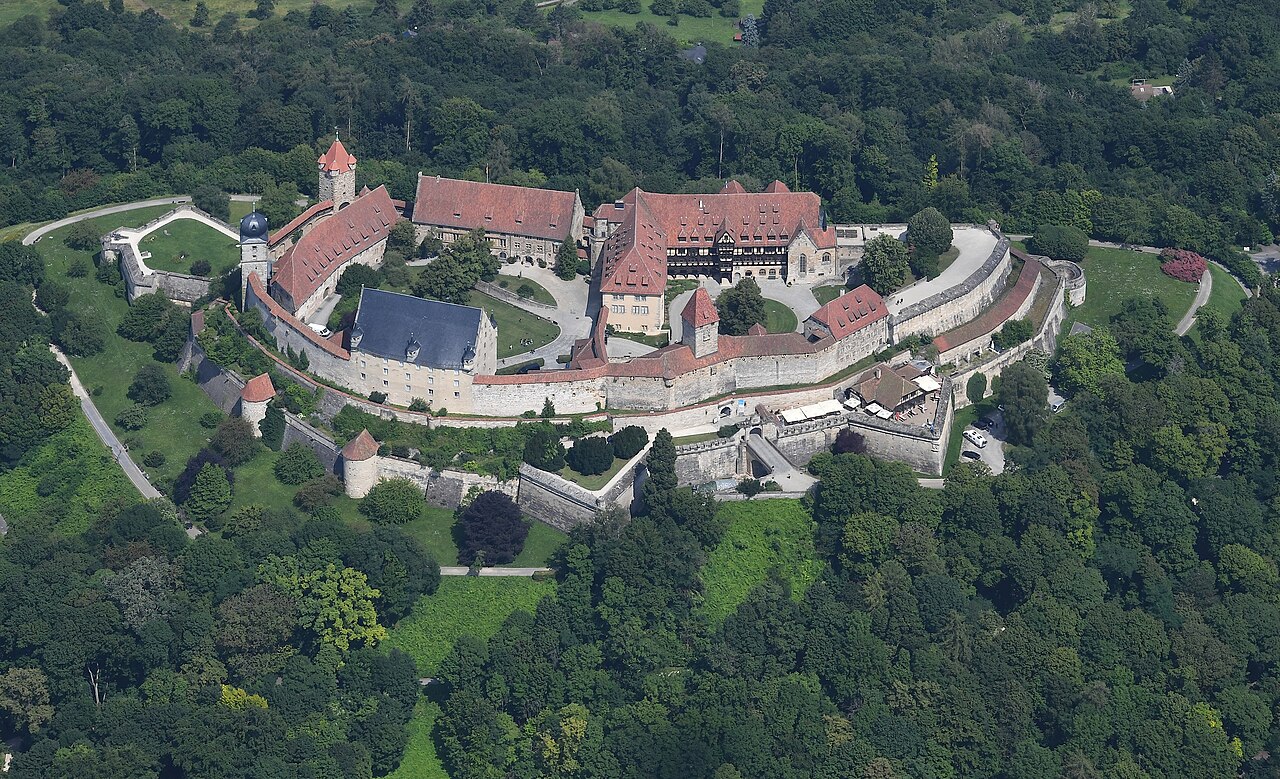
Burg Rauenstein stands as a significant example of a medieval hill castle located in the municipality of Frankenblick, Germany. This fortress, perched on a natural spur at an elevation of 510 meters, was constructed by the noble Schaumberg family in the 14th century and served as their administrative and defensive seat for several centuries. The castle's strategic position and complex fortifications reflect its role in regional governance and military defense during the late medieval period.
Historical background and regional significance
The site of Burg Rauenstein likely functioned as an administrative residence known as a Kemenate before 1340, where the Schaumbergs managed extensive estates and sovereign rights. These rights included high jurisdictional authority, the ability to escort and collect tolls, mining privileges, enforcement of game laws, and church patronage, underscoring the family's significant influence in the region. In 1349, the castle, then called "Haus Ruhestein," was officially authorized to be fortified by Regent Jutta von Henneberg, with the condition that it remain a fief under the House of Henneberg. This authorization was reaffirmed in 1351 by Margrave Friedrich the Strict of Meissen, who also imposed obligations related to Saxon manorial tenure.
By the late 14th century, the Schaumbergs had consolidated their control over the surrounding lands. By 1398, their domain included 25 forested mountains, six villages with freehold land, and the neighboring Hiftenberger houses. The nearby village of Rauenstein, first documented in 1455, predates the castle and was acquired by the Schaumberg family, highlighting the castle's role within a broader territorial network.
Architectural features and castle layout
Burg Rauenstein is classified as a spur castle, built on a natural rocky outcrop that provided natural defensive advantages. The surviving ruins reveal a complex layout with multiple defensive layers typical of high medieval military architecture. The most prominent surviving structure is the bergfried, a large main tower that served both as a lookout point and a last refuge during sieges. This tower has thick walls constructed using durable medieval masonry techniques and has been the focus of restoration efforts since 2006 to stabilize and preserve its structure.
Surrounding the bergfried are remnants of a ring wall, which once formed a continuous curtain protecting the castle's inner buildings. The ring wall controlled access and provided a formidable barrier against attackers. Near the entrance, the remains of a gatehouse mark the original controlled entry point, while sections of shell towers — rounded defensive towers designed to strengthen vulnerable points in the curtain wall — remain visible. These features collectively demonstrate the castle's layered defensive design, combining natural topography with man-made fortifications.
Impact of the Thirty Years’ War and subsequent decline
The Thirty Years’ War (1618–1648) was a pivotal period for Burg Rauenstein. The Schaumberg family abandoned the castle in 1632, and in 1640, imperial forces partially demolished the fortress to prevent its use by enemy troops. Although briefly reoccupied between 1669 and 1670 by the castle bailiff Georg Dietrich zu Klein-Ziegenfeld, the castle ceased to function as a noble residence thereafter.
In 1687, Hans Siegmund von Schaumberg regained full rights to the property but did not restore the castle. Instead, he built a new palace at the castle's foot, which later served as the town hall and now houses the Rauenstein porcelain collection. This shift marked the beginning of the castle's long decline as a residential and administrative center.
Ownership passed to Duke Anton Ulrich of Saxe-Meiningen in 1729 after the Schaumberg family left the region. The castle remained neglected for centuries, with its ruins gradually deteriorating due to natural decay and incomplete restoration attempts during the late 20th century.
Modern preservation and cultural significance
Restoration and preservation efforts began in earnest in the early 21st century. The Thuringian-Franconian Historical Society, founded in 2004, has played a key role in advocating for the castle's conservation. In 2006, the municipality of Effelder-Rauenstein acquired the site and initiated restoration work, particularly focusing on the bergfried to prevent further collapse. Volunteer groups continue to maintain the ruins, preserving them as a cultural heritage site and a testament to the region's medieval history.
Close to the castle ruins lies the Maria Georg chapel, the castle's former private place of worship. Positioned slightly below the main structure, the chapel offers valuable insight into the religious practices associated with the castle's occupants, although detailed architectural descriptions and the current condition are limited.
Architectural and archaeological context
While no significant inscriptions, decorative elements, or archaeological artifacts such as tools or pottery have been documented at Burg Rauenstein, the remaining structures provide important evidence of medieval castle construction and defensive strategies. The combination of natural topography and fortified masonry reflects typical high medieval hill castle architecture in central Germany.
The bergfried's robust construction and the strategic placement of the ring wall and shell towers illustrate the emphasis on both defense and control over the surrounding territory. The castle's layout, though partially ruined, reveals a multi-layered approach to fortification that was common in the region during the 14th and 15th centuries.
The bergfried: central defensive tower
The bergfried is the centerpiece of Burg Rauenstein's defensive system. Traditionally, such towers served multiple purposes: as watchtowers for early warning, as strongholds of last resort during sieges, and as symbols of noble authority. The restoration work has helped preserve this vital feature, allowing visitors to appreciate its imposing presence and historical importance.
Ring wall and gatehouse remains
The surviving sections of the ring wall and gatehouse provide tangible evidence of the castle's controlled access and fortified perimeter. The gatehouse would have been the primary point of entry, guarded and fortified to prevent unauthorized access. The ring wall's remnants reveal the defensive perimeter that protected the inner courtyard and residential buildings from attack.
Visitor information and cultural heritage
Today, Burg Rauenstein is recognized as a valuable cultural monument reflecting the medieval history of the Thuringian-Franconian border region. Visitors can explore the ruins and the bergfried, gaining insight into medieval fortification techniques and noble life. The nearby village and the former palace building, now housing the porcelain collection, complement the historical experience.
Ongoing preservation efforts ensure that Burg Rauenstein remains accessible and informative for future generations, highlighting the importance of conserving medieval heritage sites within Germany's rich historical landscape.
Frequently asked questions (FAQ)
- How do I get to Burg Rauenstein?
- Burg Rauenstein is located in the picturesque Thuringian Forest, and it's easily accessible by car or public transport. If you're driving, you can find parking nearby. Public transport options include regional trains and buses that connect to the castle.
- What is the historical significance of Burg Rauenstein?
- Burg Rauenstein dates back to the 12th century and played a crucial role in the defense of the region. It was once a stronghold for the noble family of the Counts of Schwarzburg and has witnessed many historical events over the centuries. Today, it serves as a symbol of medieval architecture and local heritage.
- When was Burg Rauenstein built?
- Construction of Burg Rauenstein began in 1150 and was completed in the late 12th century. Over the years, the castle has undergone various renovations, preserving its historical character while adapting to modern needs. Its long history reflects the changing political landscape of the region.
- Can I visit Burg Rauenstein with my family?
- Yes, Burg Rauenstein is family-friendly and offers various activities for visitors of all ages. There are guided tours that provide engaging stories about the castle's history, as well as scenic walking paths around the grounds. Children will enjoy exploring the castle's features and learning about medieval life.
- Why is Burg Rauenstein a popular tourist destination?
- Burg Rauenstein attracts visitors due to its stunning architecture and breathtaking views of the surrounding landscape. The castle offers a glimpse into Germany's medieval past, making it a favorite among history enthusiasts. Additionally, nearby hiking trails and local attractions enhance the overall visitor experience.
- Is it possible to host events at Burg Rauenstein?
- Yes, Burg Rauenstein can be rented for special events, including weddings and corporate gatherings. The castle's unique setting provides a memorable backdrop for any occasion. It's recommended to contact the management for more details on availability and services offered.
- What are the opening hours for Burg Rauenstein?
- Burg Rauenstein is open to visitors from March to October, typically from 10 AM to 6 PM. During the winter months, the castle may have reduced hours or be closed, so it's best to check the official website for the latest information before planning your visit. Guided tours are often available during open hours.
- What are the ticket prices for visiting Burg Rauenstein?
- Tickets for Burg Rauenstein are reasonably priced, with discounts available for children, students, and seniors. Admission fees contribute to the maintenance and preservation of the castle. Be sure to check the website for current pricing and any special offers that may be available during your visit.
- What nearby attractions can I explore when visiting Burg Rauenstein?
- While visiting Burg Rauenstein, you can also explore the beautiful Thuringian Forest, perfect for hiking and nature walks. Other attractions include the charming town of Rauenstein and nearby historical sites such as the castles of Schwarzburg and Rosenburg. These sites complement your visit and provide a fuller experience of the region.
Information
Website
Visit websiteSources & official resources
Verify the information above using these authoritative references.
Loading map...
Visitor reviews
No reviews yet. Been here? Write the first review and help other travelers!
Write the first reviewVisited this castle? Share your experience
Your review helps other travelers and adds first-hand knowledge to our encyclopedia.