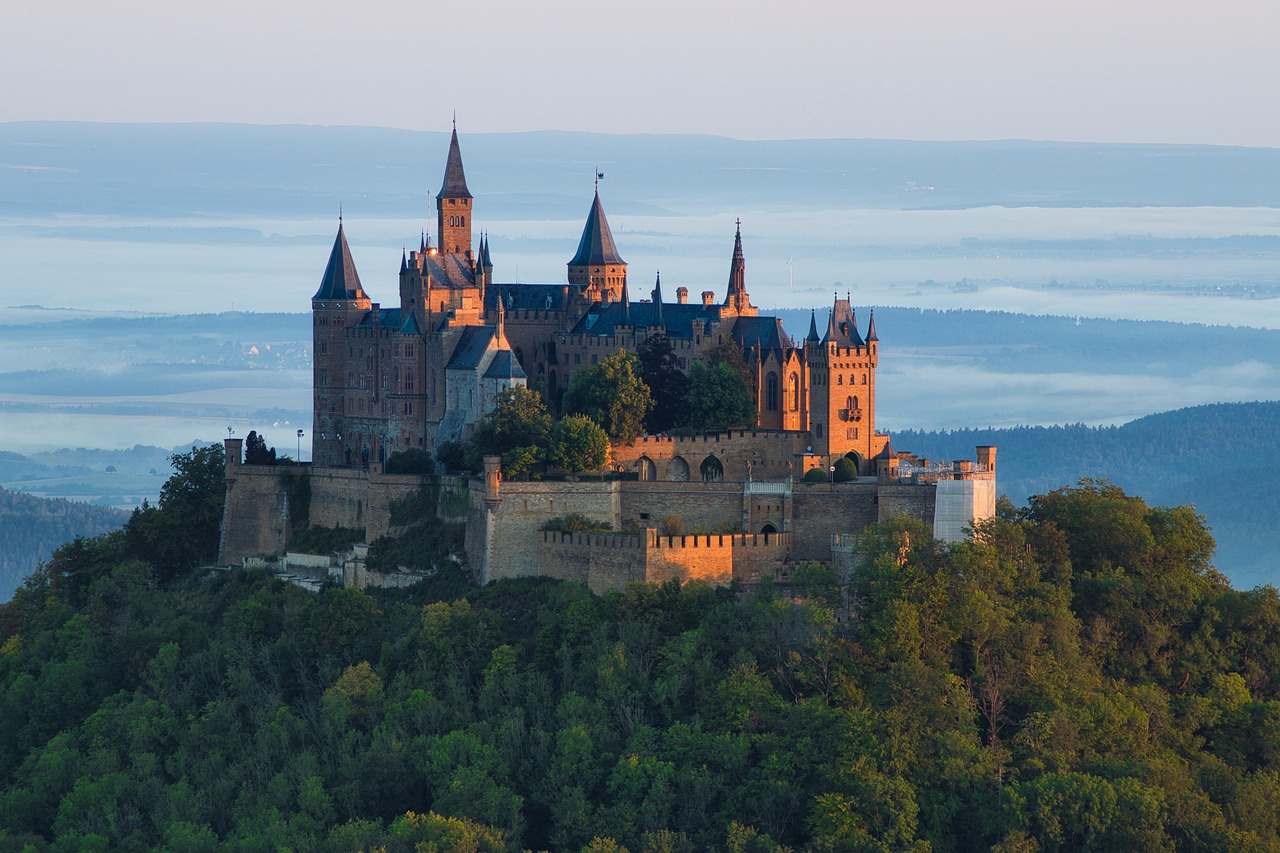
Schloß Lindich
Schloß Lindich stands as a remarkable example of 18th-century rococo architecture nestled in the town of Hechingen, Germany. Constructed between 1738 and 1741 by the princely House of Hohenzollern-Hechingen, this palace was originally conceived as a hunting lodge and pleasure retreat. Its elevated position on a hillside offers commanding views over the Zollernalb landscape and a direct sightline to the nearby Burg Hohenzollern, the ancestral stronghold of the Hohenzollern family.
The palace's creation was overseen by Prince Friedrich Ludwig of Hohenzollern-Hechingen, who sought a refined yet functional residence that reflected the aristocratic tastes of the early 18th century. Schloß Lindich's design embodies the rococo style with its elegant two-story square floor plan crowned by a distinctive mansard roof. Atop the roof sits a lantern-like structure adorned with a decorative vase, adding a vertical accent typical of the period's ornamental preferences. The main facade is marked by a modest portico supported by two columns, inviting visitors into a grand entrance hall highlighted by gracefully rounded arches and a sweeping staircase that serves as a focal point of the interior.
Architectural features and estate layout
The palace's interior retains many original elements, including finely crafted coffered wood floors that demonstrate the high level of craftsmanship prevalent during the rococo period. The spatial organization inside emphasizes both aesthetic appeal and social function, with the entrance hall designed to impress guests and accommodate princely gatherings.
Surrounding the main building is a semicircular arrangement of six cavalier houses that complement the palace's architectural unity. These auxiliary buildings include an orangery, two residential houses (one converted into a restaurant), two former stables now adapted for residential use, and a kitchen building featuring a vaulted cellar also repurposed for living quarters. All these outbuildings share the characteristic mansard roofs, creating a cohesive visual ensemble.
Beyond this semicircle lies the former carriage house, which was transformed into a residential building following renovations in the late 20th century. The entire estate is set within a carefully designed park characterized by a star-shaped network of pathways that radiate outward from the palace, a landscaping style that enhances the centrality and prominence of the main building within its natural setting.
Historical significance and notable visitors
Schloß Lindich's history is intertwined with the fortunes of the House of Hohenzollern-Hechingen, a noble family of significant regional influence. The palace was not only a private retreat but also a venue for cultural and political encounters. Over the centuries, it hosted several distinguished figures, including Emperor Napoleon III, the celebrated poet Ludwig Uhland, the renowned composer Hector Berlioz, and the virtuoso pianist Franz Liszt. These visits underscore the palace's role as a cultural hub and a symbol of aristocratic prestige.
Approximately thirty years after its construction, the estate's layout influenced the design of Schloss Solitude by Duke Carl Eugen of Württemberg, highlighting Schloß Lindich's architectural importance beyond its immediate region.
20th-century transformations and modern use
The 20th century brought significant changes to Schloß Lindich's function and ownership. In the early 1930s, the palace briefly served as an SA sports school, reflecting the turbulent political climate of the era. After World War II, the estate's outbuildings were repurposed for practical uses, including modest lodging, offices for the princely forestry administration, and facilities for a local horseback riding club.
From the mid-1940s until 1976, Schloß Lindich gained new scientific and cultural significance as the site of the Fürstin-Eugénie-Institut für Heilpflanzenforschung, an independent medicinal plant research institute founded by botanist Karl Hummel. The institute maintained extensive gardens of medicinal herbs and hosted interdisciplinary discussions known as the “Lindicher Gespräche”, fostering collaboration among experts from diverse fields.
In 1984, ownership passed from the Hohenzollern-Sigmaringen family to a cooperative of eighteen private individuals. Subsequent renovations included the conversion of parts of the palace into apartments by 1987 and a detailed restoration of the facade completed in 2005. Today, Schloß Lindich functions as a private residential complex, preserving its architectural heritage while adapting to contemporary living standards.
Location and natural setting
Situated at approximately 543 meters above sea level, Schloß Lindich enjoys a commanding vantage point framed by mixed forests and rolling hills characteristic of the Zollernalb region. It lies about 5.6 kilometers southeast of Burg Hohenzollern, which itself is perched at 855 meters elevation, linking the two sites visually and historically. The palace's elevated position not only provided strategic views but also enhanced its role as a scenic retreat.
The surrounding parkland and forested areas contribute to the estate's tranquil atmosphere, offering visitors and residents alike a connection to nature alongside architectural grandeur. The star-shaped pathways in the park remain a notable feature, reflecting 18th-century landscape design principles that emphasized symmetry and the integration of built and natural environments.
Architectural legacy and cultural importance
Schloß Lindich represents an important chapter in the architectural and cultural history of southwestern Germany. Its rococo design, combined with its function as a princely hunting lodge, illustrates the lifestyle and aesthetic preferences of the German nobility during the early to mid-18th century. The palace's influence on later architectural projects, such as Schloss Solitude, attests to its significance within the broader context of German baroque and rococo architecture.
Moreover, the palace's role as a cultural venue hosting prominent historical figures and scholarly gatherings enriches its heritage value. The preservation of original architectural features alongside thoughtful modern adaptations ensures that Schloß Lindich remains a living monument to its storied past.
Frequently asked questions (FAQ)
- When was Schloß Lindich built and by whom?
- Schloß Lindich was constructed between 1738 and 1741 under the direction of Prince Friedrich Ludwig of Hohenzollern-Hechingen as a hunting lodge and pleasure retreat.
- What architectural style characterizes Schloß Lindich?
- The palace is designed in the rococo style, featuring a mansard roof, a lantern structure, and coffered wood floors typical of the 18th century.
- Can visitors tour Schloß Lindich today?
- Schloß Lindich is currently a private residential complex, so public tours are generally not available. Visitors can appreciate its exterior and park from nearby public areas.
- What notable historical figures visited Schloß Lindich?
- Notable visitors include Emperor Napoleon III, poet Ludwig Uhland, composer Hector Berlioz, and pianist Franz Liszt, highlighting its cultural significance.
- What is the relationship between Schloß Lindich and Burg Hohenzollern?
- Schloß Lindich is located about 5.6 kilometers southeast of Burg Hohenzollern and offers clear views of this ancestral family castle, linking the two historically and visually.
Information
Current owner
Private cooperative
Loading map...
Visitor reviews
No reviews yet. Been here? Write the first review and help other travelers!
Write the first reviewVisited this castle? Share your experience
Your review helps other travelers and adds first-hand knowledge to our encyclopedia.