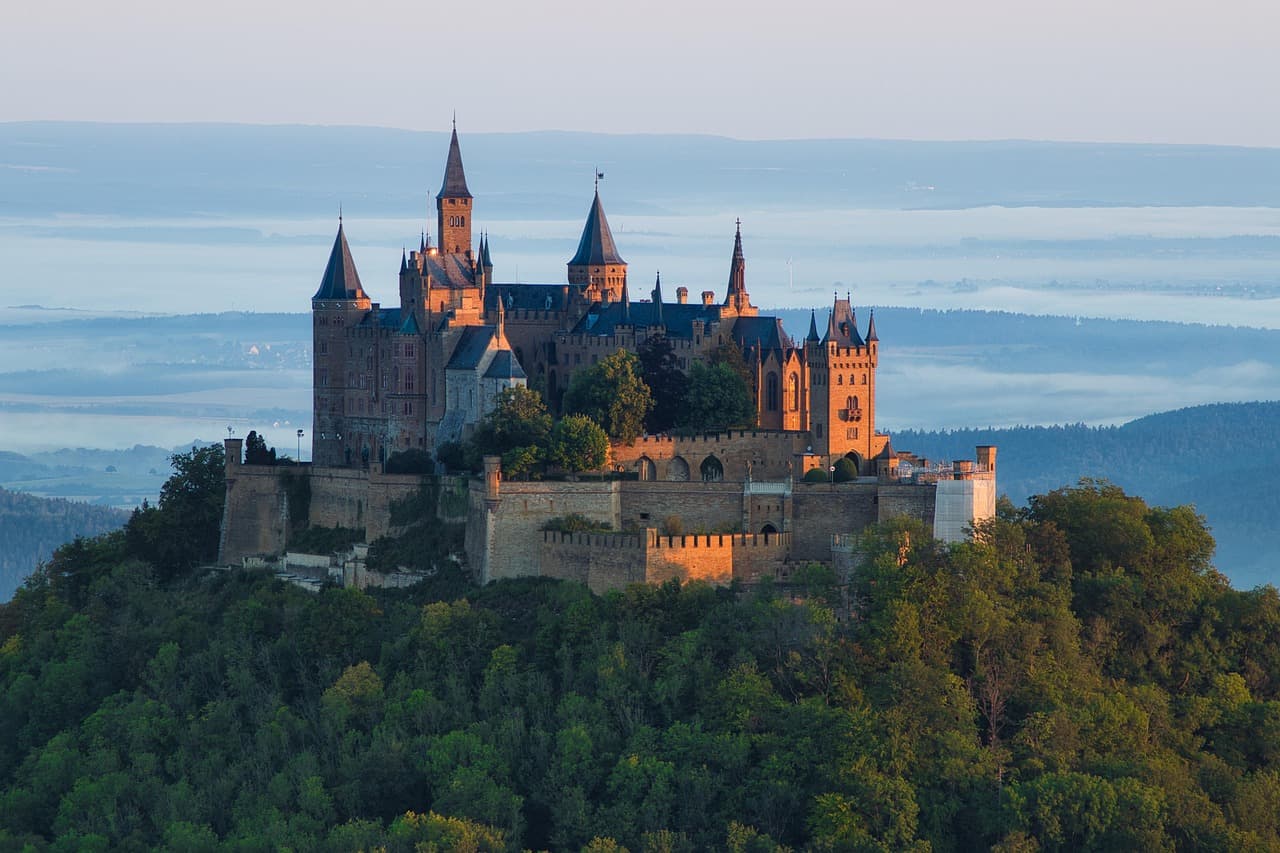
Hohenzollern Castle
Hohenzollern Castle is a striking example of 19th-century neo-Gothic architecture perched atop Mount Hohenzollern in the Swabian Jura of Baden-Württemberg, Germany. As the ancestral seat of the imperial House of Hohenzollern, the castle commands sweeping views over the surrounding landscape, standing 234 meters above the nearby towns of Hechingen and Bisingen. This hilltop fortress is not only an architectural marvel but also a symbol of dynastic pride, embodying nearly a millennium of history through its three successive incarnations.
The current structure, completed between 1846 and 1867, is the third castle built on this site. It represents a romanticized vision of medieval fortifications combined with palatial elegance, reflecting the 19th-century fascination with Gothic Revival styles and the desire to memorialize the Hohenzollern lineage in stone and mortar.
Historical development and significance
The first castle and medieval origins
The origins of Hohenzollern Castle date back to the early 11th century, with the earliest documented mention of "Castro Zolre" appearing in 1267. This initial fortress served as the stronghold of the Counts of Zollern, the ancestors of the House of Hohenzollern. Positioned strategically on a limestone peak, the castle was a formidable defensive site and a symbol of feudal power in the region. Medieval chroniclers lauded it as the "crown of all castles in Swabia," underscoring its prominence.
Destruction and rebuilding in the late medieval period
In 1423, the castle faced a decisive siege by the Swabian League, lasting approximately ten months. This military action was triggered by political disputes involving Count Friedrich XII of Zollern. The siege ended with the complete destruction of the original castle, marking a turning point in its history.
Between 1454 and 1461, a second castle was constructed on the site. This new fortress was larger and more heavily fortified, designed to serve as a refuge for the Catholic Swabian branch of the Hohenzollerns. It withstood the ravages of the Thirty Years' War, although it was captured by Württemberg forces in 1634 and later occupied by French troops during the War of the Austrian Succession in 1744-1745.
Decline and partial demolition
By the late 18th century, the castle's military importance had diminished significantly. It gradually fell into disrepair, and much of the structure was demolished. By the early 19th century, only the St. Michael's Chapel remained intact, serving as a poignant reminder of the castle's medieval past.
Construction of the third castle: 19th-century neo-Gothic masterpiece
Commission and architectural inspiration
The present-day Hohenzollern Castle was commissioned by King Frederick William IV of Prussia, a member of the Hohenzollern family, and constructed between 1846 and 1867. The architect Friedrich August Stüler was responsible for the design, which drew heavily on English Gothic Revival architecture and the elegant châteaux of the Loire Valley in France. This fusion of influences resulted in a castle that is both a fortified stronghold and a romantic palace.
Design and layout
The castle is arranged in a U-shaped complex that nearly covers the entire summit of Mount Hohenzollern. It features four main towers aligned with defensive bastions: the Emperor's Tower, Bishop's Tower, Margrave's Tower, and Michael's Tower. Each tower is embellished with pinnacles and intricate stone carvings characteristic of the neo-Gothic style.
The entrance is marked by the impressive Eagle Gate (Adlertor), which includes a drawbridge leading into a winding zwinger. This outer defensive enclosure was designed to slow and expose attackers, a medieval military strategy reinterpreted in the 19th century to enhance the castle's historic authenticity.
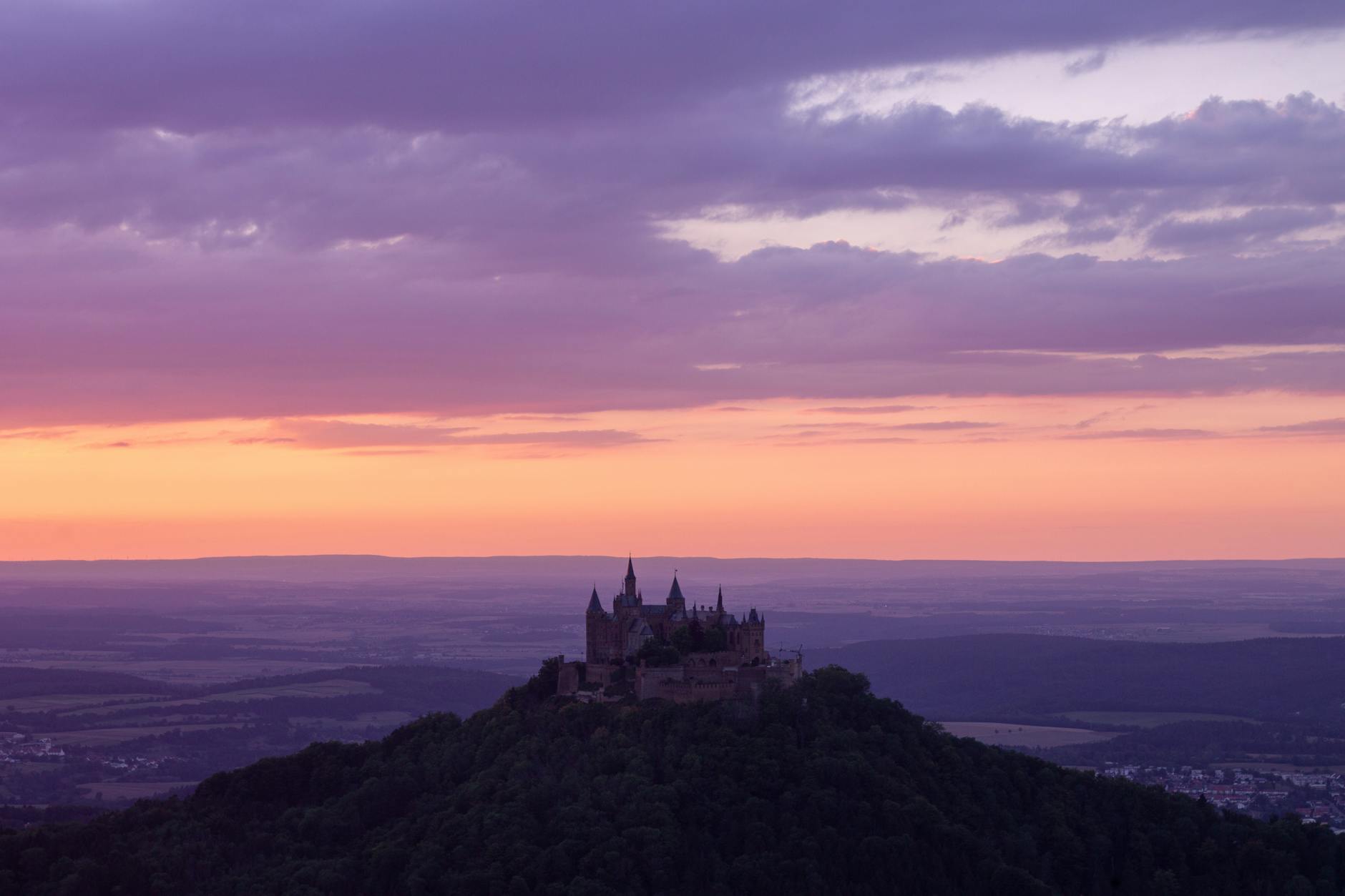
Photo by Florian Süß
Photo by Florian Süß
Architectural features and interior highlights
Interior decoration and symbolism
The castle's interiors are richly appointed, with the Count's Hall (Grafensaal) as the centerpiece. This grand hall features a rib-vaulted ceiling supported by eight free-standing red marble columns. The stained-glass windows, created by Stüler, display grisaille artwork depicting the history of the House of Hohenzollern in muted monochrome tones, lending a solemn and dignified atmosphere.
The Ancestry Hall contains a painted family tree chronicling the Hohenzollern lineage, while the library is decorated with murals by Wilhelm Peters illustrating key moments in the family's history. The Margrave's Tower houses the King's parlor, a private room used for intimate gatherings.
Religious chapels within the castle
Religious life is represented by three chapels within the castle complex. The Catholic St. Michael's Chapel is a rare survivor from the second castle, featuring net rib vaults and stained-glass windows dating from around 1280-1290. The Protestant Christus Chapel, designed by Stüler in the 19th century, draws inspiration from Naumburg Cathedral and reflects the religious diversity of the Hohenzollern family. Additionally, the Russian Orthodox Resurrection Chapel was added in the 20th century, demonstrating the castle's ongoing evolution and cultural inclusivity.
Historical artifacts and cultural importance
Prussian heritage collection
Hohenzollern Castle houses an extensive collection of artifacts related to Prussian history and the Hohenzollern dynasty. Highlights include the diamond-studded Crown of Wilhelm II and personal items belonging to King Frederick the Great, such as his military uniform (notably bearing a bullet hole), snuffbox, crutches, and musical flutes. A letter from US President George Washington thanking Baron von Steuben, a Hohenzollern descendant, for his service during the American Revolutionary War is also preserved here.
Royal caskets and statues
Between 1952 and 1991, the castle chapel served as the resting place for the caskets of Frederick William I and Frederick the Great before their return to Potsdam after German reunification. The castle also displays statues of Prussian kings relocated from Berlin's former Ruhmeshalle, reinforcing its role as a monument to Prussian legacy and identity.
Modern use and tourism
Ownership and visitor experience
Today, Hohenzollern Castle remains privately owned by the House of Hohenzollern, with the Brandenburg-Prussian branch holding two-thirds and the Swabian branch the remainder. It is among Germany's most visited castles, attracting over 350,000 visitors annually. The castle offers amenities such as a café-restaurant and a summer dining terrace beneath historic linden trees, enhancing the visitor experience.
Media and cultural events
The castle has served as a filming location for various movies and television productions, including the 2016 thriller "A Cure for Wellness" and the 2017 TV adaptation of "The Worst Witch." Since 1952, the Princess Kira of Prussia Foundation has organized annual summer camps for children at the castle, promoting cultural education and heritage appreciation.
Scenic location and views
Visitors are drawn not only by the castle's architectural grandeur and historical significance but also by its commanding position on Mount Hohenzollern. The summit offers panoramic views of the Swabian Alps and the surrounding countryside, making it a popular destination for sightseeing and photography.
Geographical and structural context
Mount Hohenzollern and site characteristics
Mount Hohenzollern is an isolated limestone peak rising to 855 meters above sea level, part of the Swabian Jura mountain range. The castle complex occupies nearly the entire summit, integrating military fortifications with residential and ceremonial buildings. Originally, the landscaped gardens were designed by the renowned landscape architect Peter Joseph Lenné, though the original planting scheme has evolved over time.
Materials and construction techniques
The castle is primarily constructed from Malm limestone, a durable and aesthetically pleasing local stone. The strategic location and architectural design reflect the evolution of hilltop castles from medieval defensive fortresses to romanticized 19th-century palatial monuments, embodying both historical function and artistic expression.
Frequently asked questions (FAQ)
- When was hohenzollern castle originally built?
- The first castle on Mount Hohenzollern was likely constructed in the early 11th century, with written records dating back to 1267.
- What architectural style is hohenzollern castle built in?
- The current castle, built between 1846 and 1867, is designed in the Neo-Gothic style, inspired by English Gothic Revival and the châteaux of the Loire Valley.
- Can I visit the interior of hohenzollern castle?
- Yes, the castle interior is open to visitors and features richly decorated halls, chapels, and a treasure chamber with historical artifacts.
- What are some notable artifacts housed in hohenzollern castle?
- The castle houses the Crown of Wilhelm II, personal effects of Frederick the Great, and a letter from George Washington to Baron von Steuben.
- How do I get to hohenzollern castle from Stuttgart?
- Hohenzollern Castle is approximately 50 kilometers south of Stuttgart. Visitors can reach it by car or regional train to Hechingen followed by a shuttle or hike to the castle.
- What is the best time to visit hohenzollern castle?
- The castle is open daily from 09:00 to 18:00, with spring to early autumn offering the best weather and views for visitors.
- Are there any special events held at hohenzollern castle?
- Yes, the Princess Kira of Prussia Foundation organizes annual summer camps for children, and the castle hosts various cultural events and exhibitions throughout the year.
Photo gallery

Photo by andrsltt
Photo by andrsltt


Information
Opening hours
09:00-18:00, daily
Ticket prices
€12 adult, €8 child
Architect
Friedrich August Stüler
Current owner
House of Hohenzollern
Website
Visit websiteAddress
Burg Hohenzollern, 72379 Hechingen, Germany
Sources & official resources
Verify the information above using these authoritative references.
Loading map...
Visitor reviews
Based on 1 review
Tom P
Beautiful castle!!! <3
Visited this castle? Share your experience
Your review helps other travelers and adds first-hand knowledge to our encyclopedia.


