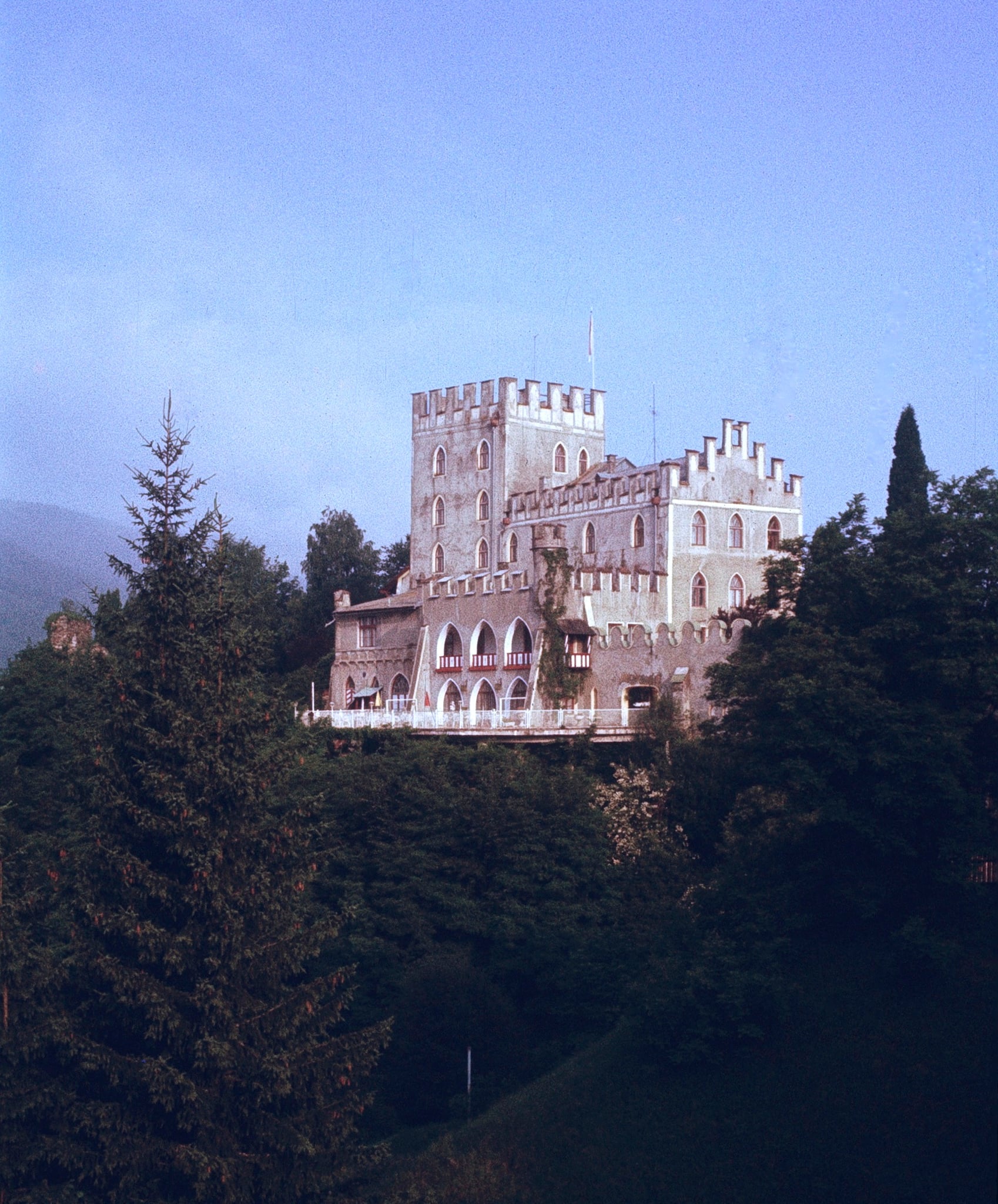
Schloss Kaps

Schloss Kaps: historic hill castle near Kitzbühel, Austria
Kitzbühel, Austria
Archaeological Site

Schloss Kaps, also known as Kapsburg, is a historic hill castle located near the municipality of Kitzbühel in the Tyrol region of Austria. Perched at an elevation of approximately 804 meters, the castle occupies a strategic mountainous site nestled between lower hills and the higher peaks of the Kitzbüheler Horn. Despite its prominent location, the castle’s origins remain uncertain, with no definitive records detailing its foundation, builders, or initial purpose.

The castle’s history is largely undocumented, and it does not appear in surviving medieval chronicles or administrative documents. There are no recorded accounts of military engagements, sieges, or significant events associated with Schloss Kaps. The absence of such references suggests that the castle may have served a modest role, possibly as a local noble residence or a minor defensive outpost within the region’s complex feudal landscape.

Historical context of Schloss Kaps

The Tyrol region where Schloss Kaps is situated has a rich history influenced by various European powers, including the Holy Roman Empire and later the Habsburg dynasty. Castles in this area often functioned as administrative centers, military fortifications, or noble estates. However, Schloss Kaps stands out for the scarcity of historical documentation, which makes its precise role and timeline difficult to ascertain.

Possible origins and ownership

While no specific information exists about the castle’s founders or early occupants, it is plausible that Schloss Kaps was established during the High Medieval period, a time when many hill castles were constructed across Tyrol to assert territorial control and provide defense. The name "Kapsburg" suggests a traditional naming convention for castles in German-speaking regions, combining the locality name with "burg," meaning fortress or castle.

Architectural features and site characteristics

Due to the lack of archaeological excavation and detailed study, the architectural style and layout of Schloss Kaps remain largely unknown. No comprehensive descriptions of surviving walls, towers, gates, or interior chambers have been documented. The absence of such data limits understanding of the castle’s design, construction techniques, and defensive capabilities.

Location and natural environment

The castle’s position at a significant elevation within a mountainous and forested landscape would have provided natural defensive advantages. The surrounding environment features a boreal climate characterized by cool temperatures and substantial annual rainfall, conditions that may have influenced building materials and preservation of any remains.

Preservation and remains

Today, Schloss Kaps is primarily recognized through its presence in the landscape rather than through extensive physical remains. The site lacks detailed archaeological records or visible structural elements that would allow for a clear reconstruction of its original form. No inscriptions, decorative features, or artifacts have been reported, further complicating efforts to understand its historical and architectural significance.

Significance and cultural heritage

Despite the limited information, Schloss Kaps contributes to the cultural tapestry of Tyrol’s medieval heritage. Its enduring name and strategic location reflect the historical pattern of castle-building in alpine regions, where fortifications often served dual roles as defensive structures and symbols of local power.

Visitors and scholars interested in the medieval history of Tyrol may find Schloss Kaps a compelling subject for further research, particularly through archaeological investigation that could illuminate the castle’s origins, construction phases, and role within the region’s feudal system.

Visiting Schloss Kaps

As the site is primarily a historical landmark without extensive preserved structures, visitors should prepare for a natural setting experience. The castle’s elevated location offers scenic views of the surrounding Tyrolean Alps and the Kitzbühel area. Hiking trails in the vicinity provide access to the site, allowing exploration of the landscape that once hosted this enigmatic hill castle.

Due to the lack of developed tourist facilities or detailed onsite information, visitors are encouraged to consult local guides or heritage organizations in Kitzbühel for additional context and historical background when planning a visit.

Frequently asked questions (FAQ)

What is the historical significance of Schloss Kaps?
Schloss Kaps is a historic hill castle near Kitzbühel with uncertain origins and limited documentation, reflecting typical medieval fortifications in the Tyrol region.
Can I visit Schloss Kaps today?
Yes, visitors can access the Schloss Kaps site, which is primarily a natural landmark with limited preserved structures, offering scenic views and hiking opportunities.
Where is Schloss Kaps located?
Schloss Kaps is located near the town of Kitzbühel in the Tyrol region of Austria, situated at an elevation of 804 meters in a mountainous area.
Are there any visible remains of Schloss Kaps?
The castle has minimal visible remains, and no detailed archaeological studies have documented its structural features, making it primarily a historical site within the landscape.
What is the best time to visit Schloss Kaps?
The best time to visit Schloss Kaps is during the warmer months when hiking conditions are favorable, typically from late spring to early autumn.

Information

Hill Castle

Loading map...

Visitor reviews

No reviews yet. Been here? Write the first review and help other travelers!

Write the first review

Visited this castle? Share your experience

Your review helps other travelers and adds first-hand knowledge to our encyclopedia.
Write a review

(5/5)

0/2000 characters

Your review will be visible after admin approval

Nearby castles

18.4 km
Mittersill Castle — Austria castle

Mittersill Castle

Mittersill, Austria

Mittersill Castle stands as a remarkable example of a high medieval hill castle in the Austrian Alps, with origins dating back to the 12th century. Situated strategically on the northern side of the Salzach River near the town of Mittersill, the castle's location was chosen to control vital trans-Alpine trade routes, including the Pass Thurn and the southern Felber valley. This position made it a crucial stronghold for overseeing merchant traffic and regional governance throughout its extensive history. The earliest known records indicate that the castle was established by the Counts of Lechsgemünd, who made it their family seat during the period when the Duchy of Bavaria held sway over the Pinzgau region. By 1228, the castle came under the control of the Archbishopric of Salzburg, serving as the episcopal seat and a regional court for nearly six centuries. This long tenure included its use as a site for witch trials from the 16th to the 18th centuries, reflecting the castle's judicial and administrative importance. Architectural evolution and defensive features The original castle was constructed in a distinctive horseshoe shape with an opening to the east and a defensive wall to the south, designed to maximize control over the surrounding terrain and trade routes. The western side was notably fortified with two large round towers added during the 16th-century reconstruction, enhancing the castle's defensive capabilities against evolving military threats. One of the castle's most iconic features is the "Witches' Tower" (Hexenturm) located at the southwestern corner, which houses a castle chapel on its upper floor. The chapel, dedicated to the Holy Trinity and completed in 1533, displays the archbishop's coat of arms on its ceiling, symbolizing the ecclesiastical authority that governed the castle. The castle's wehrgang or defensive walkway encircles the central courtyard, allowing guards to patrol and defend the fortress effectively. The main entrance on the eastern side features a gatehouse built in 1537, reinforcing the castle's fortifications after it was destroyed during the German Peasants' War in 1526. Historical significance and events Mittersill Castle's history is marked by significant upheavals and transformations. During the German Peasants' War of 1525-1526, the castle was plundered and burned by rebellious peasants. Reconstruction began in 1537, funded by imposing the rebuilding costs on the local populace, under the authority of Archbishop Matthäus Lang. This rebuilding incorporated newer defensive technologies and modern comforts, reflecting Renaissance influences while preserving medieval elements. Throughout the 16th and 17th centuries, the castle underwent several repairs following fires in 1555 and 1597, with additions such as stables, bathing facilities, tiled stoves for heating, and a fish pond within the moat, signifying its evolution from a purely military fortress to a noble residence. After the secularization of the Archbishopric of Salzburg in 1803, the castle's role shifted. It housed the imperial-royal district court from 1816 and continued to serve administrative functions until the mid-19th century. The castle chapel was closed in 1845, marking the end of its ecclesiastical use. Modern era transformations and notable residents The castle changed ownership multiple times during the 19th and 20th centuries, with notable figures including Countess Marie Larisch von Moennich, who commissioned renovations by architect Carl Gangolf Kayser in the 1880s. The castle also became a cultural hub under owners like painter Hugo von Grundherr, who remodeled it in a romantic style and curated an art collection. From 1935 to 1967, under Baron Hubert von Pantz, Mittersill Castle gained prominence as a glamorous private hotel and sports club, attracting distinguished guests such as Dutch Queen Juliana, Prince Bernhard, the Shah of Persia, Clark Gable, Henry Ford, Bob Hope, and Aristotle Onassis. However, a lightning strike in 1938 caused significant fire damage, requiring extensive restoration. During the Nazi period, the castle was repurposed as a research institute affiliated with the Ahnenerbe and served briefly as a subcamp of the Mauthausen concentration camp, where female prisoners were detained under harsh conditions until liberation in 1945. Architectural details and current condition Mittersill Castle's layout features a nearly flat central courtyard surrounded by a horseshoe-shaped complex of buildings. The wehrgang provides a protected walkway for defense, and the main gatehouse on the eastern side remains a prominent architectural element dating from the 16th century. The two large round towers on the western side offer commanding views and defensive strength, while the Hexenturm's chapel with its late Gothic winged altar from around 1450 is a significant religious and artistic treasure. The castle's original keep was lowered and integrated into later structures, concealing its medieval origins. Functional additions such as stables, bathing facilities, and a fish pond reflect the castle's adaptation to residential and noble use over time. The removal of the drawbridge around 1800 illustrates the shift away from medieval defensive needs. Despite suffering multiple fires, especially the devastating 1938 blaze, the castle has been carefully restored to preserve its 16th-century character. Since 1993, it has been protected as an important cultural heritage monument in Austria. Today, Mittersill Castle operates as a hotel, blending historical ambiance with modern hospitality. Cultural importance and heritage protection As a site with continuous occupation and adaptation from the high medieval period through modern times, Mittersill Castle embodies the complex history of the Pinzgau region. Its role as a military fortress, regional court, noble residence, and cultural venue reflects the evolving political and social landscape of Austria. The castle's architectural features, including its Renaissance-era fortifications and Gothic chapel, offer valuable insights into the defensive and residential styles of different historical periods. Its preservation as a cultural monument ensures that this heritage remains accessible to visitors and scholars alike.

High Medieval (11th–13th c.)
Details
19.6 km
Itter Castle — Austria castle

Itter Castle

Itter, Austria

Itter Castle stands prominently in the village of Itter in the Austrian region of Tirol. This 19th-century hill castle is renowned not only for its architectural charm but also for its remarkable role during World War II as a prison for high-profile French detainees. The castle's history spans centuries, with origins tracing back to medieval fortifications and a series of transformations reflecting the complex political and cultural shifts in the region. Medieval origins and early history The site of Itter Castle was first documented in 1241, although earlier structures may have existed as far back as the 10th century. Initially, the surrounding Brixental valley belonged to the Prince-Bishops of Regensburg. The castle functioned as an administrative center under the Counts of Ortenburg, who acted as Vogt bailiffs overseeing the bishop's interests. Its strategic position served to protect Regensburg's estates from incursions by the neighboring Archbishops of Salzburg. In 1312, the Brixental was acquired by Salzburg, and by 1380, the Prince-Bishops of Regensburg sold Itter Castle to Archbishop Pilgrim II of Salzburg. The castle endured significant damage during the German Peasants' War of 1526, reflecting the widespread social upheaval of the period. By the 17th century, the administrative seat moved to Hopfgarten, leading to the castle's decline and eventual use as a quarry post-1805. 19th-century reconstruction and cultural significance The present-day castle was constructed beginning in 1878 on the foundations of the medieval fortress. This reconstruction embraced the Tudor Revival architectural style, a popular historicist movement that sought to evoke the romanticism of late medieval English architecture. The castle's elegant design features characteristic elements such as steeply pitched roofs, ornate chimneys, and decorative half-timbering. In 1884, Itter Castle was purchased by Sophie Menter, a celebrated pianist and composer who studied under Franz Liszt. The castle became a cultural hub, hosting illustrious guests including Liszt himself and the young Arthur Rubinstein. Notably, the renowned composer Pyotr Ilyich Tchaikovsky orchestrated one of his compositions during a visit in 1892. These connections highlight the castle's role as a center of artistic creativity in the late 19th century. After Menter sold the castle in 1902, it underwent further remodeling to enhance its Tudor Revival character, reflecting the tastes of subsequent private owners. Wartime role and the battle for itter castle During World War II, beginning in 1943, Itter Castle was repurposed as a prison for prominent French prisoners deemed valuable by the Nazi regime. Functioning as a subcamp of the Dachau concentration camp, it held notable figures including former French prime ministers and generals. The castle's remote location and fortified structure made it a secure detention site. The castle is most famous for the extraordinary Battle for Castle Itter in May 1945, one of the war's strangest engagements. In this unique confrontation, the U.S. Army, elements of the German Wehrmacht, the Austrian Resistance, and the imprisoned French VIPs banded together to defend the castle against an assault by the Waffen SS. This rare alliance underscored the chaotic final days of the war in Europe and highlighted the castle's strategic and symbolic importance. Post-war period and modern status Following the war, Itter Castle fell into disrepair until 1950, when it was acquired by Willi Woldrich and converted into a luxury hotel. Despite its historic allure, the hotel struggled financially and changed ownership multiple times. In 1985, it was sold to a private owner and has since remained in private hands, not open to the public. The castle today is restored and retains much of its Tudor Revival style charm. Its rich history, from medieval fortress to cultural salon to wartime prison, makes Itter Castle a unique testament to the layered history of Tirol and Austria. Architectural features and layout Itter Castle's architecture reflects its complex history. The castle is built on a hilltop, typical of hill castles designed for defense and surveillance. Its layout includes a central courtyard surrounded by fortified walls, with towers and battlements that echo its medieval origins. The 19th-century reconstruction introduced Tudor Revival elements such as decorative chimneys, gabled roofs, and half-timbered facades, blending historic fortification with romantic architectural flourishes. Inside, the castle features grand halls and chambers that once hosted prominent cultural figures. The combination of defensive structures and elegant residential spaces illustrates the castle's evolution from a military stronghold to a refined noble residence. Visiting information and cultural legacy Although Itter Castle is privately owned and not accessible to the public, its story continues to captivate historians and enthusiasts of castle architecture and World War II history. The castle's role in the Battle for Castle Itter remains a subject of study and commemoration, symbolizing unexpected alliances and the complexities of war. Its architectural significance as a 19th-century Tudor Revival hill castle in Tirol also contributes to Austria's rich heritage of historic castles, combining medieval foundations with romantic historicism and cultural associations with prominent artists and musicians.

Modern (19th–20th c.)
Details
19.9 km

Castle Itter

Itter, Austria

Castle Itter, located in the scenic region of Tirol, Austria, is renowned for its remarkable role during the final weeks of the European theater of World War II. This fortress is famously known as the site of the "strangest battle of World War II," where an extraordinary alliance of German Wehrmacht soldiers and American troops joined forces to defend a group of high-profile French prisoners against an assault by the Waffen-SS. This unlikely coalition highlights the complex and chaotic nature of the war's closing days. The origins of Castle Itter date back to the ninth century, when it was first constructed by the Bavarians. Initially serving as a private residence, the castle's strategic location and robust defensive features made it a significant stronghold over the centuries. Its architecture reflects the evolution of medieval fortifications, including thick stone walls, bastioned defenses, and a commanding position overlooking the surrounding valley. Castle itter's transformation during world war ii Following the Anschluss of Austria in 1938, Castle Itter was repurposed in May 1943 as a prison for prominent French prisoners of war. These detainees were considered valuable due to their political or military significance, including former prime ministers, generals, and cultural figures. The castle's isolated and fortified nature made it an ideal location for such high-value captives. For two years, the prisoners were held within the castle's stone walls, guarded by a contingent of German soldiers. However, as the war drew to a close in early 1945, the situation became increasingly unstable. The death of Adolf Hitler in April 1945 precipitated a collapse in Nazi command, leading to confusion and desertions among the guards. The battle for castle itter: an unprecedented alliance In the days following Hitler's suicide, the castle's German guards and commander abandoned their posts, effectively leaving the prisoners unprotected. Recognizing the imminent threat posed by the Waffen-SS, who sought to recapture the castle and eliminate the prisoners, an extraordinary alliance was formed. American soldiers, including members of the 12th Armored Division, joined forces with the remaining German Wehrmacht troops loyal to the castle's defense. Together, they prepared to repel the SS attack. This collaboration between former enemies was unprecedented and underscored the chaotic and fluid allegiances during the war's final days. The battle itself was brief but intense. The defenders utilized the castle's bastioned fortifications to withstand the Waffen-SS assault, protecting the prisoners until reinforcements arrived. This unique engagement is often cited as a symbol of unexpected cooperation in the face of shared humanity and survival. Architectural features and strategic significance Castle Itter is classified as a bastioned fortress, characterized by angular bastions designed to provide overlapping fields of fire and improved defense against artillery. Its location on a hillside overlooking the valley provided natural defensive advantages, including visibility and difficult access for attackers. The castle's stone curtain walls and battlements were complemented by a moat and gatehouse, typical of medieval fortifications intended to repel invaders. Over time, modifications were made to adapt the structure for changing military technologies and residential needs, but its core defensive features remained intact through World War II. Historical legacy and current status Today, Castle Itter stands as a monument to one of the most unusual episodes of World War II. Its preservation allows visitors to explore the site where former enemies united against a common threat. The castle's history offers profound insights into the complexities of war, the shifting allegiances, and the human stories behind military conflicts. Preserved in a well-preserved state, the castle attracts historians, military enthusiasts, and tourists interested in its unique past and architectural heritage. It remains a potent symbol of resilience and cooperation amidst the devastation of war. Visiting castle itter Visitors to Castle Itter can explore its courtyards, battlements, and chambers, gaining a tangible sense of its defensive capabilities and historical significance. The castle's location in the picturesque Tirol region offers additional attractions, including alpine landscapes and cultural sites. While the castle is accessible to the public, it is advisable to check current visiting hours and ticketing information, as these may vary seasonally. Guided tours often provide detailed narratives of the castle's role in World War II and its architectural evolution.

Details