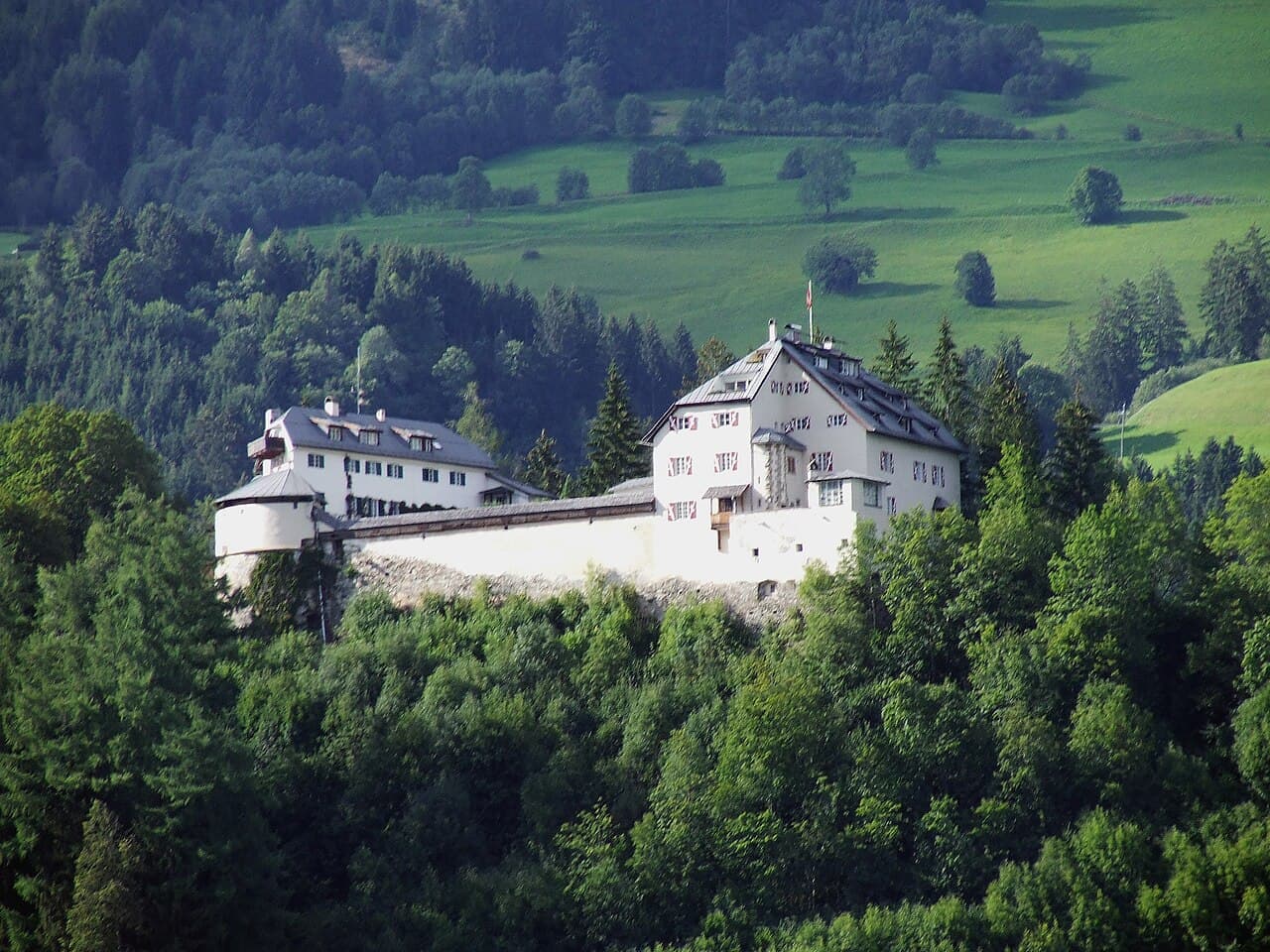
Mittersill Castle
Mittersill Castle stands as a remarkable example of a high medieval hill castle in the Austrian Alps, with origins dating back to the 12th century. Situated strategically on the northern side of the Salzach River near the town of Mittersill, the castle's location was chosen to control vital trans-Alpine trade routes, including the Pass Thurn and the southern Felber valley. This position made it a crucial stronghold for overseeing merchant traffic and regional governance throughout its extensive history.
The earliest known records indicate that the castle was established by the Counts of Lechsgemünd, who made it their family seat during the period when the Duchy of Bavaria held sway over the Pinzgau region. By 1228, the castle came under the control of the Archbishopric of Salzburg, serving as the episcopal seat and a regional court for nearly six centuries. This long tenure included its use as a site for witch trials from the 16th to the 18th centuries, reflecting the castle's judicial and administrative importance.
Architectural evolution and defensive features
The original castle was constructed in a distinctive horseshoe shape with an opening to the east and a defensive wall to the south, designed to maximize control over the surrounding terrain and trade routes. The western side was notably fortified with two large round towers added during the 16th-century reconstruction, enhancing the castle's defensive capabilities against evolving military threats.
One of the castle's most iconic features is the "Witches' Tower" (Hexenturm) located at the southwestern corner, which houses a castle chapel on its upper floor. The chapel, dedicated to the Holy Trinity and completed in 1533, displays the archbishop's coat of arms on its ceiling, symbolizing the ecclesiastical authority that governed the castle.
The castle's wehrgang or defensive walkway encircles the central courtyard, allowing guards to patrol and defend the fortress effectively. The main entrance on the eastern side features a gatehouse built in 1537, reinforcing the castle's fortifications after it was destroyed during the German Peasants' War in 1526.
Historical significance and events
Mittersill Castle's history is marked by significant upheavals and transformations. During the German Peasants' War of 1525-1526, the castle was plundered and burned by rebellious peasants. Reconstruction began in 1537, funded by imposing the rebuilding costs on the local populace, under the authority of Archbishop Matthäus Lang. This rebuilding incorporated newer defensive technologies and modern comforts, reflecting Renaissance influences while preserving medieval elements.
Throughout the 16th and 17th centuries, the castle underwent several repairs following fires in 1555 and 1597, with additions such as stables, bathing facilities, tiled stoves for heating, and a fish pond within the moat, signifying its evolution from a purely military fortress to a noble residence.
After the secularization of the Archbishopric of Salzburg in 1803, the castle's role shifted. It housed the imperial-royal district court from 1816 and continued to serve administrative functions until the mid-19th century. The castle chapel was closed in 1845, marking the end of its ecclesiastical use.
Modern era transformations and notable residents
The castle changed ownership multiple times during the 19th and 20th centuries, with notable figures including Countess Marie Larisch von Moennich, who commissioned renovations by architect Carl Gangolf Kayser in the 1880s. The castle also became a cultural hub under owners like painter Hugo von Grundherr, who remodeled it in a romantic style and curated an art collection.
From 1935 to 1967, under Baron Hubert von Pantz, Mittersill Castle gained prominence as a glamorous private hotel and sports club, attracting distinguished guests such as Dutch Queen Juliana, Prince Bernhard, the Shah of Persia, Clark Gable, Henry Ford, Bob Hope, and Aristotle Onassis. However, a lightning strike in 1938 caused significant fire damage, requiring extensive restoration.
During the Nazi period, the castle was repurposed as a research institute affiliated with the Ahnenerbe and served briefly as a subcamp of the Mauthausen concentration camp, where female prisoners were detained under harsh conditions until liberation in 1945.
Architectural details and current condition
Mittersill Castle's layout features a nearly flat central courtyard surrounded by a horseshoe-shaped complex of buildings. The wehrgang provides a protected walkway for defense, and the main gatehouse on the eastern side remains a prominent architectural element dating from the 16th century.
The two large round towers on the western side offer commanding views and defensive strength, while the Hexenturm's chapel with its late Gothic winged altar from around 1450 is a significant religious and artistic treasure. The castle's original keep was lowered and integrated into later structures, concealing its medieval origins.
Functional additions such as stables, bathing facilities, and a fish pond reflect the castle's adaptation to residential and noble use over time. The removal of the drawbridge around 1800 illustrates the shift away from medieval defensive needs.
Despite suffering multiple fires, especially the devastating 1938 blaze, the castle has been carefully restored to preserve its 16th-century character. Since 1993, it has been protected as an important cultural heritage monument in Austria. Today, Mittersill Castle operates as a hotel, blending historical ambiance with modern hospitality.
Cultural importance and heritage protection
As a site with continuous occupation and adaptation from the high medieval period through modern times, Mittersill Castle embodies the complex history of the Pinzgau region. Its role as a military fortress, regional court, noble residence, and cultural venue reflects the evolving political and social landscape of Austria.
The castle's architectural features, including its Renaissance-era fortifications and Gothic chapel, offer valuable insights into the defensive and residential styles of different historical periods. Its preservation as a cultural monument ensures that this heritage remains accessible to visitors and scholars alike.
Frequently asked questions (FAQ)
- How do I get to Mittersill Castle?
- Mittersill Castle is conveniently located in the picturesque town of Mittersill, Austria. You can reach it by car, with ample parking available nearby, or by public transport via the local bus service that connects to major train lines in the region.
- What is the historical significance of Mittersill Castle?
- Mittersill Castle dates back to the 12th century and played a crucial role in the defense of the region during various conflicts. Its well-preserved architecture and historical artifacts provide insight into the medieval life and the strategic importance of the area.
- When was Mittersill Castle last renovated?
- The last major renovation of Mittersill Castle took place in the late 20th century, focusing on restoring its medieval features while modernizing facilities for visitors. This renovation has helped maintain the castle’s structural integrity and has enhanced the overall visitor experience.
- Can I take guided tours of Mittersill Castle?
- Yes, guided tours are available and provide an in-depth look at the castle's history, architecture, and the surrounding area. These tours are conducted by knowledgeable guides who can answer questions and share fascinating stories about the castle.
- Why is Mittersill Castle a popular tourist attraction?
- Mittersill Castle attracts visitors due to its stunning architecture, rich history, and breathtaking views of the Hohe Tauern mountains. It also hosts various cultural events and exhibitions throughout the year, making it a vibrant part of the local community.
- Is it possible to host events at Mittersill Castle?
- Yes, Mittersill Castle offers facilities for hosting private events, including weddings, corporate gatherings, and special celebrations. The unique setting combined with the castle's historical ambiance makes it a memorable venue for any occasion.
- What are the opening hours of Mittersill Castle?
- Mittersill Castle is typically open to visitors from April to October, with varying hours depending on the season. It’s best to check the official website for the most current opening hours before planning your visit.
- What are the ticket prices for visiting Mittersill Castle?
- Ticket prices for Mittersill Castle vary depending on age and group size, with discounts available for students and seniors. Children under a certain age often enter for free, making it an affordable outing for families.
- When is the best time to visit Mittersill Castle?
- The best time to visit Mittersill Castle is during the late spring and early fall when the weather is pleasant, and the surrounding scenery is at its most beautiful. Additionally, visiting during these months allows you to enjoy various outdoor activities and events hosted by the castle.
- What nearby attractions can I explore after visiting Mittersill Castle?
- After visiting Mittersill Castle, you can explore the charming town of Mittersill, known for its traditional architecture and local shops. Additionally, the nearby Hohe Tauern National Park offers stunning hiking trails and natural beauty, perfect for outdoor enthusiasts.
Photo gallery

Information
Website
Visit websiteSources & official resources
Verify the information above using these authoritative references.
Loading map...
Visitor reviews
No reviews yet. Been here? Write the first review and help other travelers!
Write the first reviewVisited this castle? Share your experience
Your review helps other travelers and adds first-hand knowledge to our encyclopedia.



