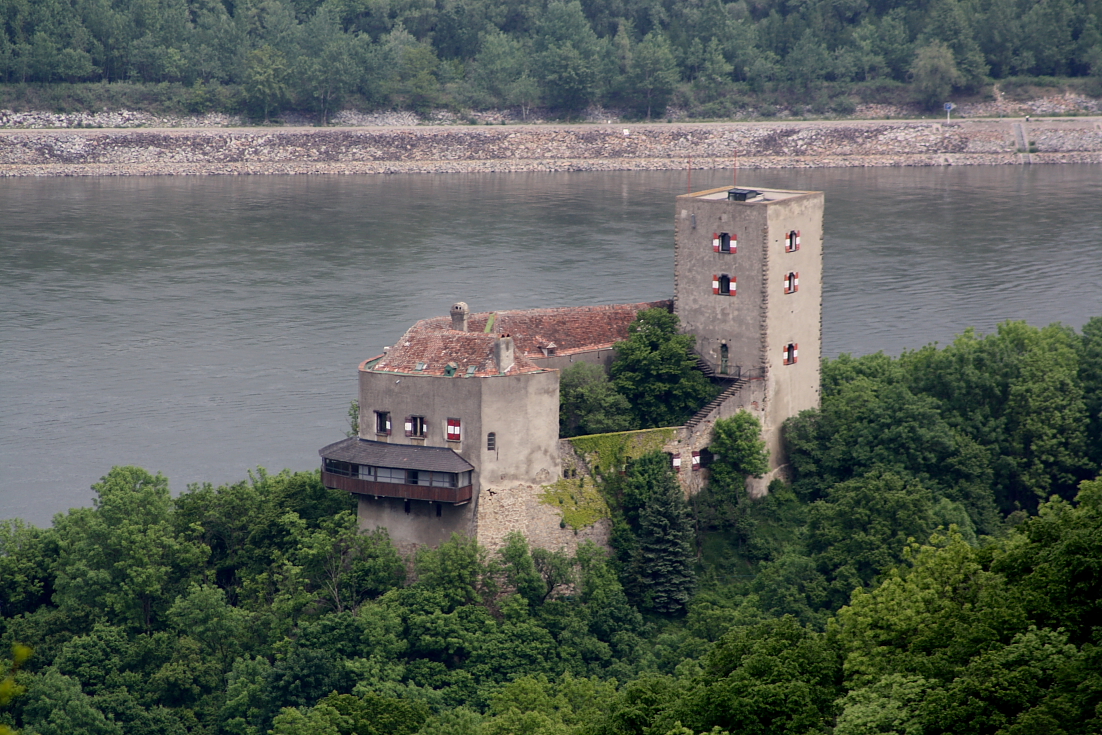
Schloss Juliusburg
Schloss Juliusburg stands as a remarkable example of a Renaissance hill castle in the municipality of Stetteldorf am Wagram, Austria. Constructed in the late 16th century by the noble Hardegg family, it embodies the transition from fortified medieval residences to more refined aristocratic estates. The castle’s strategic location on the southern edge of the Wagram ridge provides commanding views over the surrounding landscape and reflects the defensive considerations of its era.
The castle’s foundation began in 1582 when Count Julius II of Hardegg acquired the Stetteldorf estate and market from the Starhemberg family. Unlike many castles built atop previous fortifications, Schloss Juliusburg was established on a new site, marking a deliberate effort to create a modern Renaissance residence. By 1588, under the direction of architect Andreas Piazoll, the castle’s core structure was completed, featuring an L-shaped layout that defines its present form.
During its initial phase, the estate was developed not only as a noble residence but also as an agricultural hub, with facilities such as a sheepfold, granary, and mill. This integration of agricultural enterprise with aristocratic living was typical of the period and region, reflecting the economic foundations of noble estates in Austria.
The architectural evolution of Schloss Juliusburg
Renaissance origins and layout
The original castle is characterized by its L-shaped Renaissance core, positioned to maximize the defensive advantage of the steep escarpment on which it sits. The two main wings enclose an almost square courtyard, creating a protected inner space essential for security and privacy. The longest wing, forming the southern boundary, dates from the initial construction and features a three-story structure with a steep mansard roof added during later Baroque renovations.
Inside, the castle preserves significant architectural details from its Renaissance origins. The ground floor rooms often display cross-ribbed vaults made of plaster, supported by Tuscan half-columns. These vaults are a medieval architectural element that was retained and adapted in the Renaissance period, demonstrating continuity and evolution in construction techniques. Additionally, several rooms contain stucco mirror vaults from the 16th and 17th centuries, which are intricate plaster ceilings designed to create the illusion of reflective surfaces, enhancing the interior’s elegance.
Baroque transformation and fortifications
Between 1705 and 1709, Schloss Juliusburg underwent a significant transformation under Johann Julius IV Count Hardegg. The castle was remodeled in the Baroque style by architects Johann Jacob Castelli and later Johann Lukas von Hildebrandt. This period introduced a grand double gate set into the ramparts, emphasizing the castle’s fortified character while also enhancing its ceremonial entrance.
Defensive features were further enhanced in the late 16th century by Count Georg Friedrich Hardegg, who added a moat around three sides of the castle and constructed three round bastions. These fortifications reflected the military threats of the time and the need to protect the estate from incursions.
Unfortunately, a severe earthquake in 1749 caused substantial damage, leading to the dismantling of a prominent three-story tower topped with a Baroque onion dome. This distinctive architectural element was typical of Baroque ecclesiastical and secular buildings, contributing to the castle’s skyline before its removal.
Gardens and landscape features
The castle’s grounds were historically enhanced with a formal garden designed around 1602 by a gardener from Vincenza. This garden was enclosed by a wall punctuated with round towers capped by pointed roofs, and access was controlled through portals. The garden’s layout included gravel pathways, water basins, fountains adorned with statues, and several garden buildings such as a pavilion, hunting lodge, and hermitage.
These features are documented in a 1672 engraving and early 18th-century frescoes by Johann Melchior Thalmann in the castle’s festival hall. The garden’s design reflects Renaissance and early Baroque ideals of symmetry, order, and the integration of nature and art, enhancing the castle’s status as a noble residence.
Historical significance and events
Schloss Juliusburg holds a notable place in European history, particularly for its role during the Ottoman siege of Vienna in 1683. The castle served as the site of a crucial war council where Polish King Jan Sobieski, Duke Charles of Lorraine, and German princes planned the liberation of Vienna from Ottoman forces. The wing now known as the Sobieski wing commemorates this gathering and includes a former tower linked to the event.
In 1645, during the Swedish military campaign led by Lennart Torstensson, the castle was looted despite its fortifications. Later, in 1675, the castle’s garden received imperial attention when Emperor Leopold I and his consort visited, underscoring the estate’s prestige.
The Hardegg family maintained the estate’s agricultural importance, notably through a stud farm in nearby Schmida, which contributed to the region’s economic and social stature.
20th-century challenges and restoration efforts
Schloss Juliusburg faced significant challenges during the 20th century, particularly in 1945 when it suffered plundering and destruction in the final stages of World War II. Many valuable artworks, interior furnishings, and archival materials were lost, impacting the castle’s cultural heritage.
In the 1950s, restoration efforts began to revive the castle’s historical interior. Wall paintings depicting the heraldry and possessions of the older Hardegg family line were rediscovered in the largest hall, known as the playroom. These artworks were restored by Countess Mechthild von Hardegg, preserving an important visual record of the family’s legacy.
Further restoration in the early 21st century was undertaken by Georg Stradiot, a descendant of the Hardegg family, who reacquired related estates and focused on stabilizing the castle’s structure. These efforts addressed the structural weaknesses introduced by earlier Baroque modifications and ensured the preservation of Schloss Juliusburg as a cultural landmark.
Architectural details and layout today
Today, Schloss Juliusburg remains a well-preserved example of Renaissance and Baroque architecture. Its L-shaped layout atop a steep escarpment, enclosing a nearly square courtyard, creates a distinct and defensible space. The castle’s economic buildings surround this courtyard, reflecting the estate’s dual role as a noble residence and agricultural center.
The southern wing, with its Baroque façade and mansard roof, illustrates the castle’s architectural evolution. Inside, the combination of cross-ribbed vaults, Tuscan half-columns, and stucco mirror vaults offers insight into the craftsmanship and stylistic preferences spanning the Renaissance and Baroque periods.
The imposing double gate designed by Johann Lukas von Hildebrandt remains a focal point, symbolizing the castle’s fortified past and ceremonial grandeur. Although the three-story tower with its onion dome was lost to earthquake damage, the castle’s overall silhouette continues to impress visitors.
Schloss Juliusburg’s gardens, once a showcase of Renaissance landscape design, are still remembered through historical documents and frescoes, adding to the estate’s cultural significance.
As a site of historical events, architectural innovation, and noble heritage, Schloss Juliusburg offers a rich narrative that reflects broader European trends in castle construction, aristocratic life, and military history from the late 16th century onward.
Frequently asked questions (FAQ)
- How do I get to Schloss Juliusburg?
- Schloss Juliusburg can be easily accessed by public transport, with regular bus and train services connecting it to major cities in Austria. If you are driving, there is ample parking available near the castle, making it convenient for visitors.
- What are the opening hours of Schloss Juliusburg?
- Schloss Juliusburg is open to the public daily from 9 AM to 5 PM. During the summer months, the hours may extend, so it's advisable to check the official website for the most current information before your visit.
- Is there an entry fee to visit Schloss Juliusburg?
- Yes, there is a small entrance fee to explore the castle grounds and its exhibits. Tickets are reasonably priced, and discounts may be available for students, seniors, and families.
- When was Schloss Juliusburg built?
- Schloss Juliusburg was constructed in the late 16th century, showcasing a blend of Renaissance and Baroque architectural styles. Its rich history and beautiful design make it a significant landmark in the region.
- Can I take guided tours at Schloss Juliusburg?
- Yes, guided tours are available, providing visitors with a deeper insight into the castle's history and architecture. Tours are conducted in multiple languages and are a great way to enhance your experience.
- What is the historical significance of Schloss Juliusburg?
- Schloss Juliusburg played a vital role in the region's history as a noble residence and a center of political power. Its well-preserved architecture and historical artifacts offer a glimpse into the lives of those who once inhabited it.
- Why is Schloss Juliusburg a popular tourist destination?
- Schloss Juliusburg attracts visitors for its stunning architecture, rich history, and picturesque surroundings. The castle offers a unique blend of cultural heritage and scenic beauty, making it a must-visit for history and architecture enthusiasts.
- Is it possible to host events at Schloss Juliusburg?
- Yes, Schloss Juliusburg provides facilities for hosting various events, including weddings, conferences, and private gatherings. The enchanting setting and historical ambiance create a memorable experience for any occasion.
- What are some nearby attractions to Schloss Juliusburg?
- Visitors to Schloss Juliusburg can also explore nearby attractions such as beautiful parks, local museums, and charming villages that offer a taste of Austrian culture. These sites provide additional opportunities for sightseeing and leisure activities.
- When is the best time to visit Schloss Juliusburg?
- The best time to visit Schloss Juliusburg is during the spring and early fall when the weather is pleasant and the gardens are in full bloom. These seasons also tend to be less crowded, allowing for a more enjoyable experience.
Information
Loading map...
Visitor reviews
No reviews yet. Been here? Write the first review and help other travelers!
Write the first reviewVisited this castle? Share your experience
Your review helps other travelers and adds first-hand knowledge to our encyclopedia.