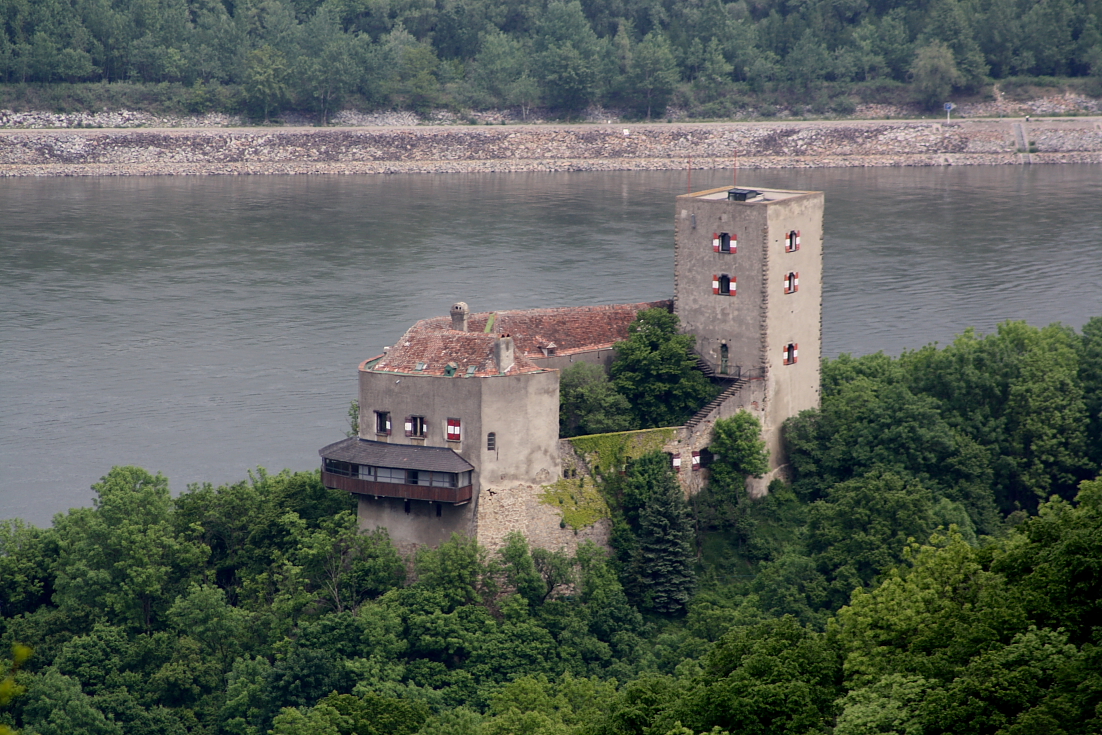
Burg Greifenstein
Burg Greifenstein stands majestically on a rocky hill above the southern bank of the Danube River near the village of Greifenstein in Lower Austria, northwest of Vienna. This high medieval hill castle is a remarkable testament to centuries of strategic military importance, architectural evolution, and shifting ownership. Its commanding position allowed it to oversee the Danube bend and serve as a vital part of the region's defense system since its construction in the 11th century.
The castle's origins are closely tied to the Bishopric of Passau, which likely commissioned its initial construction to secure their feudal interests along this critical waterway. Before the medieval fortress was established, the site may have hosted a Roman observation tower, highlighting the location's long-standing military significance. The first documented mention of Burg Greifenstein dates to 1135, associated with Dietrich von Greifenstein, a probable vassal of the Passau bishops.
Strategic location and early history
Perched on a steep hill, Burg Greifenstein was part of a network of fortifications guarding the Danube and controlling access through the Korneuburg Gate, west of the Vienna Gate. Its beacon fire station enabled communication with nearby castles such as Burg Kreuzenstein and Leopoldsberg, forming an early warning system against invasions.
In 1247, Bishop Rüdiger von Bergheim expanded the castle significantly, reinforcing its defensive capabilities. Despite its strength, the castle experienced turbulent times, including a siege in 1365 by the citizens of Klosterneuburg, the motives for which remain unclear. Between 1485 and 1490, Hungarian forces occupied the fortress, demonstrating its continued military relevance.
Sieges, decline, and changing roles
The castle faced a critical moment during the 1529 Ottoman siege of Vienna, when Ottoman troops captured Burg Greifenstein, which was nearly undefended at the time. The invaders destroyed its valuable archives, marking a significant loss to the castle's historical records. Following this event, the castle was rebuilt but gradually lost its strategic importance as military technology and political landscapes evolved.
By the 16th century, Burg Greifenstein transitioned from a fortress to a prison for the ecclesiastical court, detaining clerics and laypeople alike in its tower dungeon. This shift reflects the changing functions of castles during the Renaissance, moving from purely military strongholds to administrative and judicial centers.
The castle remained inhabited until approximately 1770, after which it was abandoned and fell into disrepair. Ownership remained with the Bishops of Passau until the secularization reforms of 1803 under Emperor Joseph II, who sold the property publicly.
19th-century restoration and romantic revival
In 1807, Johann I of Liechtenstein acquired Burg Greifenstein and undertook extensive restoration work, completed by 1818. His renovations preserved the castle's medieval core while introducing elements of the Romantic revival style popular in the 19th century. This transformation reflected contemporary ideals of chivalry and medievalism, turning the fortress into a "knight's castle" with aesthetic enhancements rather than purely defensive features.
Prince Alois II of Liechtenstein later enriched the castle's interiors with artworks and weapons transferred from other family estates, notably Schloss Seebenstein. Around 1850, Gothic-inspired decorations adorned the interiors, emphasizing the castle's historical ambiance.
20th-century changes and preservation efforts
Throughout the 20th century, Burg Greifenstein changed hands several times. Notable owners included Hugo Kostenitz in 1918, Maximilian Mautner in 1931, and Johannes Hübner in 1960, who restored parts of the castle and opened a restaurant and exhibition spaces to the public.
In 1931, Mautner added historically styled windows— a two-part Gothic window and a three-part Romanesque window— enhancing the castle's authentic medieval appearance. These additions contributed to the castle's architectural diversity, blending genuine medieval structures with 19th and 20th-century revivalist elements.
Unfortunately, a major fire in 2006 destroyed the restaurant and the ceiling of the knights' hall, leading to the closure of public access. Despite this setback, the castle's robust stone structures and medieval features remain visible, preserving its historical character.
Architectural features and layout
Burg Greifenstein is constructed primarily from stone, featuring a massive square bergfried or keep, which served as the last line of defense and a lookout point. The palas, or main residential building, dates back to the 12th century and retains much of its medieval masonry.
A castle chapel documented from the 14th century adds to the site's historical depth, reflecting the religious functions integrated into medieval castles. The outer bailey or vorwerk, added during the Renaissance period halfway down the slope, expanded the castle's defensive and functional space.
Early 19th-century renovations introduced Romantic architectural elements such as a gatehouse with machicolations, a gallery, and a viewing terrace, blending medieval fortification features with aesthetic enhancements. Interior decorations from the mid-19th century showcase Gothic revival influences, including art and weaponry collections that enrich the castle's cultural heritage.
Surroundings and panoramic views
The castle overlooks the Danube and the southern peaks of the Vienna Woods, offering commanding views of the surrounding landscape. A nearby lookout tower on Tempelberg hill provides an even more expansive panorama, highlighting the castle's strategic placement in controlling river traffic and regional routes.
Current status and accessibility
Today, Burg Greifenstein remains privately owned and was sold in 2017 to logistics entrepreneur Ernst Strobl. Since the 2006 fire, public access has been restricted, and the castle is not regularly open for visitors. Its condition is considered partially preserved, with significant medieval structures intact despite the damages.
The castle is occasionally featured in cultural events and exhibitions when accessible, maintaining its historical significance in the region. Its rich history, architectural layers, and scenic location continue to attract interest from historians, architects, and castle enthusiasts alike.
Notable historical significance
- Strategic military role guarding the Danube and controlling key regional gates from the 11th century onwards.
- Transition from fortress to prison in the 16th century, reflecting broader shifts in castle functions during the Renaissance.
- Romantic revival restoration in the early 19th century, preserving medieval elements while adding aesthetic features.
- Architectural diversity combining medieval masonry with Gothic and Romanesque revival features from the 19th and 20th centuries.
- Historical resilience through sieges, occupations, fires, and restorations over nearly a millennium.
Visitor information
While Burg Greifenstein is currently not open to the public due to restoration needs and private ownership, its exterior and surrounding landscapes can be appreciated from nearby vantage points. The castle’s prominent position and historical importance make it a significant landmark in Lower Austria’s cultural heritage.
Frequently asked questions (FAQ)
- How do I get to Burg Greifenstein?
- Burg Greifenstein is located in Sankt Andrä-Wördern, Austria, easily accessible by car or public transportation. If traveling by train, the nearest station is Tulln, from where you can take a local bus or taxi to reach the castle.
- What is the historical significance of Burg Greifenstein?
- Burg Greifenstein dates back to the 12th century and played a crucial role in the defense of the region during various conflicts. The castle is notable for its well-preserved architecture and its connection to the noble families that inhabited it throughout history.
- When was Burg Greifenstein built?
- Construction of Burg Greifenstein began in the early 12th century, with significant expansions and renovations occurring in subsequent centuries. Its strategic location made it an essential fortification during medieval times.
- Can I take guided tours of the castle?
- Yes, guided tours are available for visitors who wish to learn more about the history and architecture of Burg Greifenstein. These tours typically cover the main areas of the castle and provide in-depth information about its significance and the stories of its past.
- Why is Burg Greifenstein popular among tourists?
- Burg Greifenstein attracts visitors for its stunning views of the Danube River and its impressive medieval architecture. The castle also offers a glimpse into the rich history of Austria, making it a fascinating destination for history enthusiasts and families alike.
- Is it possible to visit Burg Greifenstein year-round?
- Yes, Burg Greifenstein is open to visitors throughout the year, but hours may vary seasonally. It's advisable to check the official website for the most current opening hours before planning your visit.
- What are the ticket prices for visiting the castle?
- Ticket prices for Burg Greifenstein are quite reasonable, with discounts available for students, seniors, and groups. Children under a certain age may enter for free, making it an affordable family outing.
- What is the best time to visit Burg Greifenstein?
- The best time to visit Burg Greifenstein is during the spring and early autumn months when the weather is mild and the surrounding landscape is particularly beautiful. Additionally, these seasons often have fewer crowds, allowing for a more enjoyable experience.
- Are there any nearby attractions to explore after visiting the castle?
- Yes, after visiting Burg Greifenstein, you can explore the beautiful towns along the Danube River, such as Tulln and Klosterneuburg. These areas offer charming streets, local cuisine, and additional historical sites to enrich your visit.
Information
Website
Visit websiteSources & official resources
Verify the information above using these authoritative references.
Loading map...
Visitor reviews
No reviews yet. Been here? Write the first review and help other travelers!
Write the first reviewVisited this castle? Share your experience
Your review helps other travelers and adds first-hand knowledge to our encyclopedia.