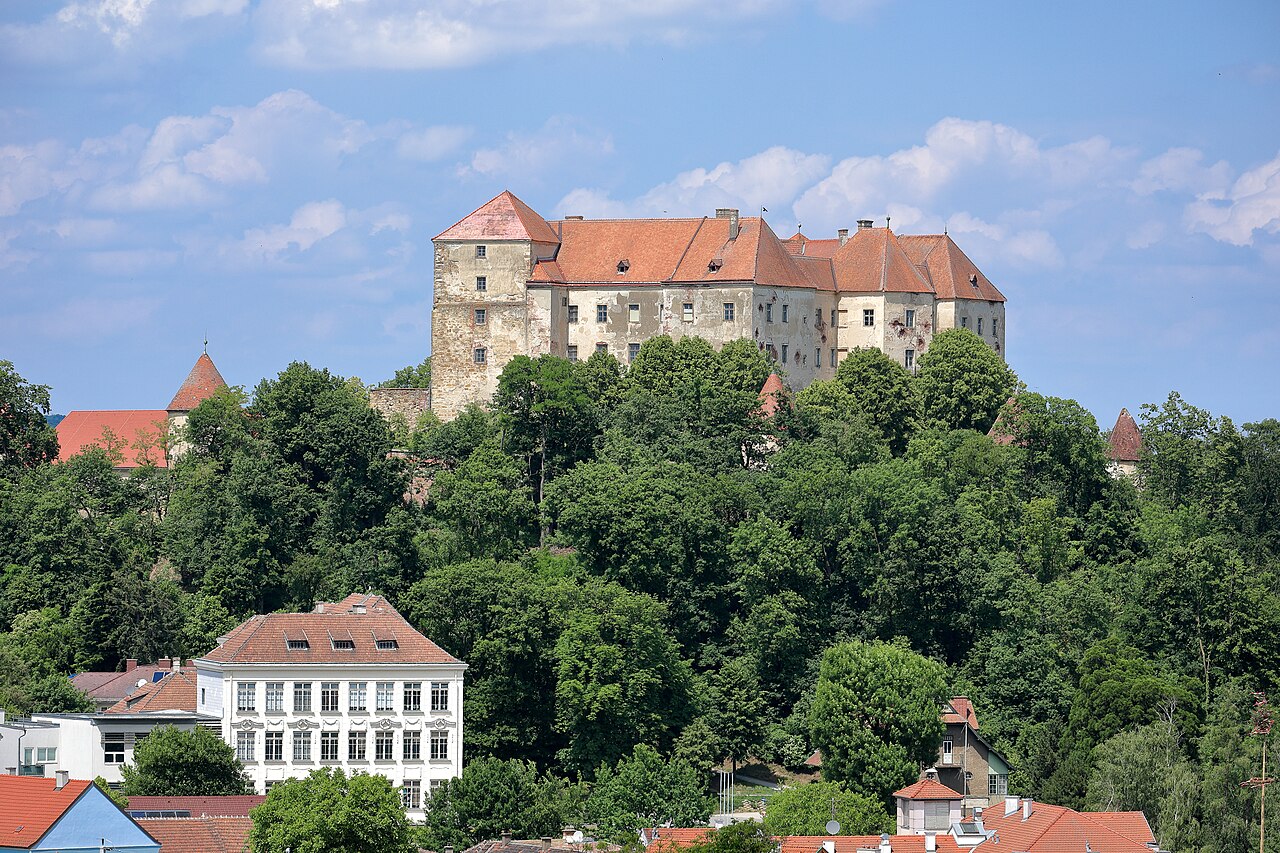
Schloss Atzenbrugg
Schloss Atzenbrugg is a historic hill castle located in the market town of Atzenbrugg, Austria. With origins tracing back to the early 12th century, the castle stands as a testament to the region's rich medieval heritage and evolving cultural significance. The name "Atzenbrugg" derives from a local noble named Azzo, whose documented possession of the site marks one of the earliest references to the castle's existence. However, archaeological evidence indicates that the area had been inhabited since much earlier periods, including the Celtic and Carolingian eras, highlighting a long continuum of human settlement prior to the castle's construction.
Originally built as a fortified residence, Schloss Atzenbrugg was designed with defensive features typical of smaller medieval manor houses, notably a surrounding ring moat that encircled the main structure. This moat served as a key protective element against potential attacks, emphasizing the strategic importance of the castle within the local landscape. The castle's layout also included a chapel, which was expanded and consecrated to Saint Catherine in 1398, reflecting the integration of religious functions within the fortified complex.
Medieval origins and ecclesiastical ties
The castle first appears in historical records in the early 12th century, linked to the noble Azzo. By the late 14th century, ownership had passed to the Stift Klosterneuburg monastery in 1379, a significant ecclesiastical institution in the region. This transfer of ownership underscores the castle's role not only as a defensive and residential site but also as part of the monastic landholdings that shaped medieval Austrian territorial control.
The expansion of the castle chapel in 1398 and its consecration to Saint Catherine signify the importance of religious observance within the castle grounds. Such chapels were common in medieval castles, serving the spiritual needs of the inhabitants and reinforcing the castle's status as a noble residence with ecclesiastical connections.
Destruction and restoration following the ottoman siege
Schloss Atzenbrugg suffered considerable damage during the second Ottoman siege of Vienna between 1683 and 1686. This conflict was part of the larger Ottoman-Habsburg wars that shaped Central European history in the 17th century. The castle's fortifications and residential structures were heavily affected by the siege, necessitating extensive restoration work.
Restoration efforts began swiftly after the siege, with notable contributions from the Italian stucco artist Domenico Piazzol in 1691. Piazzol's work focused on decorative plaster elements, enhancing the castle's interiors with ornamental stucco that likely reflected contemporary Baroque artistic influences. Further restorative work around 1746 helped to stabilize and preserve the structure, although specific details of these later renovations remain less documented.
Cultural significance in the 19th century and schubert connections
In the early 19th century, Schloss Atzenbrugg became a cultural hub under the stewardship of Joseph Derffel, a jurist and estate overseer. His nephew, Franz von Schober, played a pivotal role in transforming the castle into a center for musical and social gatherings. This period is particularly notable for its association with the celebrated composer Franz Schubert, who frequented the castle and the nearby Aumühle estate for intimate concerts and social events known as Schubertiades.
These gatherings, primarily held between 1820 and 1822, fostered a vibrant artistic community and contributed to the cultural legacy of the castle. Schubert's presence and the musical activities at Schloss Atzenbrugg highlight the castle's evolution from a medieval fortress to a site of artistic and intellectual significance.
Modern preservation and museum establishment
Since 1977, the castle has been owned by the municipality of Atzenbrugg, which has dedicated it as a museum celebrating the life and works of Franz Schubert. The museum houses a collection of personal artifacts related to Schubert and his circle, including a rare and cherished lock of Schubert's hair. This unique exhibit originated from the collection of Ignaz Weinmann, a dedicated Schubert researcher, and is now preserved by the Vienna Library.
The latter part of the 20th century saw significant efforts to revitalize the castle's cultural role, with figures such as Rosa Schwab organizing concert cycles featuring internationally acclaimed Schubert interpreters. These events not only enriched the castle's cultural offerings but also generated funds for ongoing restoration projects, ensuring the preservation of the historic structure.
In 1996, the Schubert Museum at Schloss Atzenbrugg received the prestigious Austrian Museum Award recognition prize, acknowledging its importance as a cultural and historical institution. Continuing this legacy, Ildikó Raimondi was appointed artistic director of the Atzenbrugg Schubertiades in February 2024, maintaining the castle's vibrant connection to music and the arts.
Architectural features and present condition
The architectural layout of Schloss Atzenbrugg retains many elements characteristic of its medieval origins. The original ring-shaped moat remains a defining feature, illustrating the castle's defensive design. The chapel dedicated to Saint Catherine continues to be a significant part of the complex, symbolizing the fusion of spiritual and residential functions.
The castle's restoration after the Ottoman siege introduced Baroque decorative elements, particularly through the work of Domenico Piazzol, which added artistic refinement to the structure's interiors. Subsequent preservation efforts have maintained the castle in a well-preserved state, allowing visitors to experience a blend of medieval fortification and later artistic enhancements.
Today, Schloss Atzenbrugg stands as a protected historic monument and museum, attracting visitors interested in medieval architecture, Austrian history, and classical music heritage. Its proximity to the Aumühle site further enriches its cultural context, linking two important venues of early 19th-century musical gatherings.
The chapel of saint catherine
The castle chapel, expanded in 1398, is notable for its medieval architectural features and its role as a spiritual center within the castle. Its dedication to Saint Catherine reflects common medieval patronage practices and provides insight into the religious life of the castle's inhabitants.
Decorative stucco and baroque influences
The 1691 restoration led by Domenico Piazzol introduced elaborate stucco work, which likely enhanced the castle's interiors with intricate plaster decorations typical of the Baroque period. This artistic intervention represents a significant phase in the castle's architectural evolution.
Frequently asked questions (FAQ)
- How do I get to Schloss Atzenbrugg?
- Schloss Atzenbrugg is conveniently located near Vienna, making it accessible by car and public transportation. Visitors can take a train to Atzenbrugg station, followed by a short walk to the castle grounds.
- What is the historical significance of Schloss Atzenbrugg?
- Schloss Atzenbrugg dates back to the 13th century and has served as a residence for various noble families. Its rich history includes connections to the Habsburgs and significant events in Austrian history, making it a vital part of the region's cultural heritage.
- When was Schloss Atzenbrugg built?
- Construction of Schloss Atzenbrugg began in the early 1200s, with various renovations and expansions occurring over the centuries. The castle showcases a blend of architectural styles that reflect its long history and the eras it has witnessed.
- Can I visit Schloss Atzenbrugg year-round?
- Yes, Schloss Atzenbrugg is open to visitors throughout the year, though specific opening hours may vary by season. It's advisable to check the official website for the most current visiting information and any special events.
- Why is the architecture of Schloss Atzenbrugg unique?
- The architecture of Schloss Atzenbrugg reflects a mixture of Gothic and Renaissance styles, providing a fascinating glimpse into the evolution of castle design. Notable features include its impressive towers, ornate interiors, and beautifully landscaped gardens.
- Is it possible to hold events at Schloss Atzenbrugg?
- Yes, Schloss Atzenbrugg offers facilities for hosting various events, including weddings, conferences, and private gatherings. The picturesque setting and historical ambiance make it a popular choice for unforgettable celebrations.
- What are the ticket prices for Schloss Atzenbrugg?
- Ticket prices for Schloss Atzenbrugg vary depending on the type of tour and age of the visitor. Discounts are typically available for children, students, and seniors, so it's best to check the official website for the latest pricing information.
- What are the opening hours of Schloss Atzenbrugg?
- Schloss Atzenbrugg generally opens from 10 AM to 5 PM, with extended hours during peak tourist season. It's recommended to verify the hours on the castle's website before planning your visit, as they may change for special events or holidays.
- What nearby attractions should I visit while at Schloss Atzenbrugg?
- While visiting Schloss Atzenbrugg, you can explore nearby attractions such as the picturesque town of Tulln, famous for its gardens and art exhibitions. Additionally, the Danube River offers beautiful scenic walks and cycling paths for those looking to enjoy the natural landscape.
Information
Website
Visit websiteSources & official resources
Verify the information above using these authoritative references.
Loading map...
Visitor reviews
No reviews yet. Been here? Write the first review and help other travelers!
Write the first reviewVisited this castle? Share your experience
Your review helps other travelers and adds first-hand knowledge to our encyclopedia.