Schloss Hollenburg
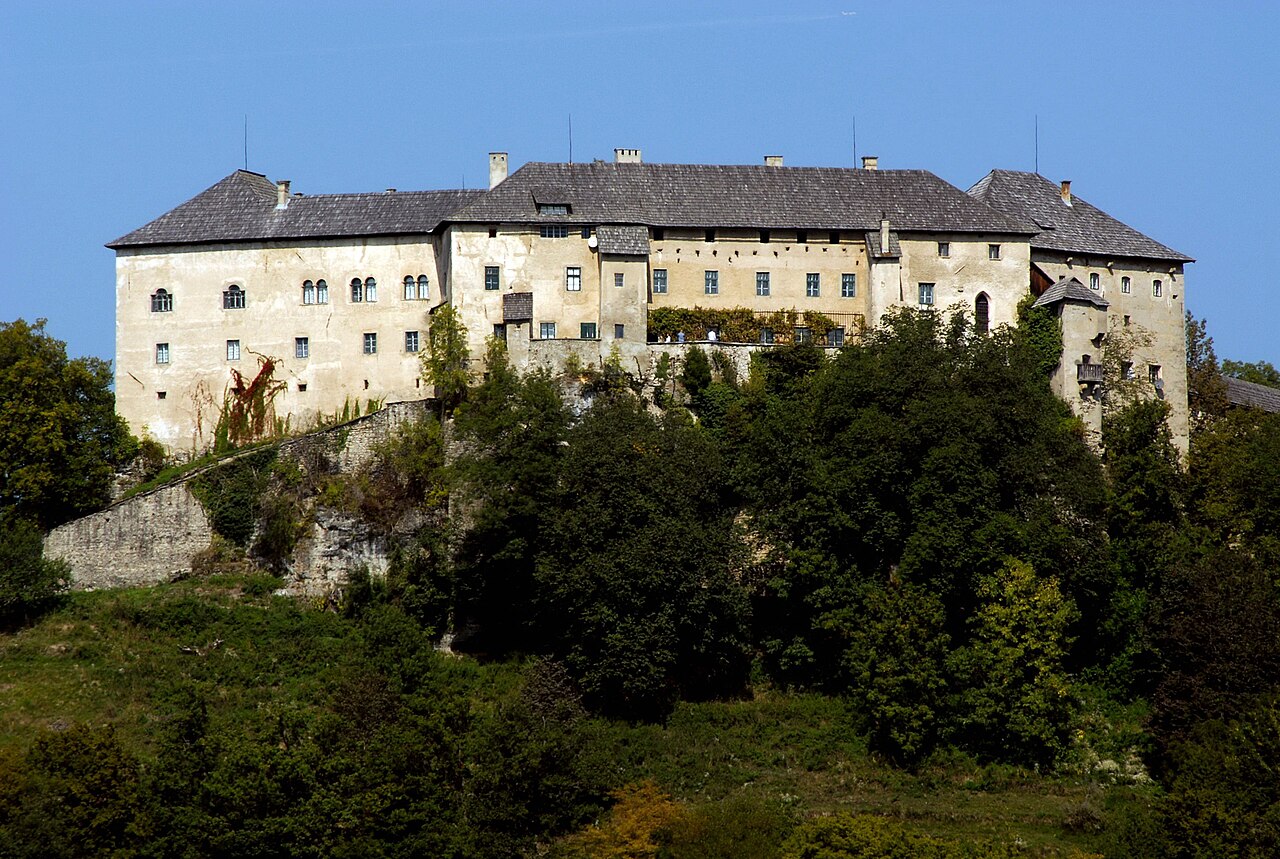
Schloss Hollenburg stands prominently on a rocky outcrop on the northern slope of the Drava valley, at an elevation of 561 metres above sea level. This hill castle owes its historical significance to its strategic location overseeing a crucial crossing of the Drava river and the vital road leading to the Loibl Pass and the March of Carniola. Its position allowed control over important trade routes and military movements during the High Medieval period.
The castle's origins trace back to the 12th century, when it was initially constructed to serve as a fortified stronghold. Over the centuries, it witnessed several ownership changes and architectural transformations, reflecting the evolving tastes and political circumstances of its proprietors.
Historical background and ownership
In 1514, during the tumultuous period of the War of the League of Cambrai against Venice, the financially strained Habsburg emperor Maximilian I sold Schloss Hollenburg to Lord Siegmund of Dietrichstein. This transaction elevated Siegmund to the rank of Freiherr (Baron), marking the beginning of the Dietrichstein family's long-standing association with the castle.
The Dietrichsteins undertook significant renovations, rebuilding the castle in the Renaissance style, with the reconstruction completed in 1588. Their stewardship continued until the extinction of their branch in 1861, after which the castle changed hands to the Wittgenstein family in 1913.
Architectural evolution and features
The castle's architectural fabric reveals a blend of medieval fortification elements and Renaissance aesthetics. The original High Medieval hill castle design featured robust defensive structures adapted to its rocky terrain, including thick curtain walls and strategic vantage points.
The Renaissance rebuilding introduced more refined elements such as symmetrical layouts, ornamental stonework, and enhanced residential comfort, reflecting the period's architectural trends. The castle complex extends along both sides of a federal road, with a notable administrative building on the south side facing the street. This building is flanked by two two-story wings that enclose a single-story central section. Behind these wings lie two courtyards, one to the southeast and another to the southwest, the latter bordered by an additional southern building.
On the north side of the road, following the demolition of an older Freisinger Pflegehof, a three-story residential building was constructed, featuring nine window axes facing the street. This building connects on its first floor via a covered passage to a two-story ancillary structure.
The castle grounds also include a large park with a distinctive garden pavilion, enhancing the estate's landscape and providing a serene setting that contrasts with the castle's defensive origins.
19th-century developments and current status
Contrary to earlier historical phases, the current castle complex seen today largely results from early 19th-century developments. In 1811, the estate was acquired by Johann Jakob von Geymüller, a prominent banker who was later ennobled as a baron. Between 1812 and 1814, von Geymüller commissioned the construction of the present castle complex, which has remained in the Geymüller family since, passing down to the current owner, Rudolf Geymüller.
This phase of construction replaced the old Freisinger Pflegehof and introduced new residential and administrative buildings, reflecting the tastes and needs of the period rather than medieval military functions. The castle complex today is recognized as a protected historic monument, preserving its architectural and cultural heritage.
Architectural details and site layout
The castle's layout is characterized by a combination of functional and aesthetic elements. The southern administrative building facing the street is a key feature, flanked by two wings that create a courtyard space. The courtyards serve both practical and social functions, typical of Renaissance and later estate designs.
The three-story residential building on the north side, with its nine window axes, exemplifies early 19th-century residential architecture, while the covered passage connecting it to an ancillary building adds to the complex's cohesion and utility.
The large park behind the castle, featuring a garden pavilion, offers a peaceful retreat and enhances the estate's visual appeal. Despite the castle's long history, there are no known archaeological excavations or inscriptions documented on site, and no significant decorative details survive from the earliest phases.
Cultural significance and preservation
Schloss Hollenburg represents a layered historical narrative, from its medieval origins as a strategic hill castle to its Renaissance transformation and 19th-century residential redevelopment. Its continuous ownership by prominent families like the Dietrichsteins and the Geymüllers underscores its importance in regional history.
Today, the castle stands as a testament to architectural evolution and historical continuity in Kottmannsdorf, Austria. Its status as a protected monument ensures ongoing preservation efforts, allowing visitors and scholars to appreciate its multifaceted heritage.
Visiting information and accessibility
While Schloss Hollenburg remains a private estate, its historical and architectural significance attracts interest from historians and castle enthusiasts. Visitors should verify access permissions and visiting hours in advance, as the castle is not generally open to the public. The surrounding area of Kottmannsdorf offers scenic views of the Drava valley and nearby cultural landmarks, making it a worthwhile destination for those interested in Austrian history and architecture.
Frequently asked questions (FAQ)
- What is the historical significance of Schloss Hollenburg?
- Schloss Hollenburg was strategically important due to its location on the Drava river crossing and the road to the Loibl Pass, controlling key trade and military routes since the 12th century.
- When was Schloss Hollenburg rebuilt in Renaissance style?
- The castle was rebuilt in Renaissance style by the Dietrichstein family, with renovations completed in 1588, reflecting the architectural trends of that period.
- Who owns Schloss Hollenburg today?
- The castle is currently owned by the Geymüller family, who acquired it in the early 19th century and have maintained it through generations.
- Can visitors tour Schloss Hollenburg?
- Schloss Hollenburg is a private estate and is generally not open to the public. Visitors should check for any special access or events before planning a visit.
- What architectural features characterize Schloss Hollenburg?
- The castle features a combination of medieval defensive elements, Renaissance symmetrical layouts, and early 19th-century residential buildings, including courtyards and a garden pavilion.
Information
Website
Visit websiteSources & official resources
Verify the information above using these authoritative references.
Loading map...
Visitor reviews
No reviews yet. Been here? Write the first review and help other travelers!
Write the first reviewVisited this castle? Share your experience
Your review helps other travelers and adds first-hand knowledge to our encyclopedia.