Hollenburg Castle
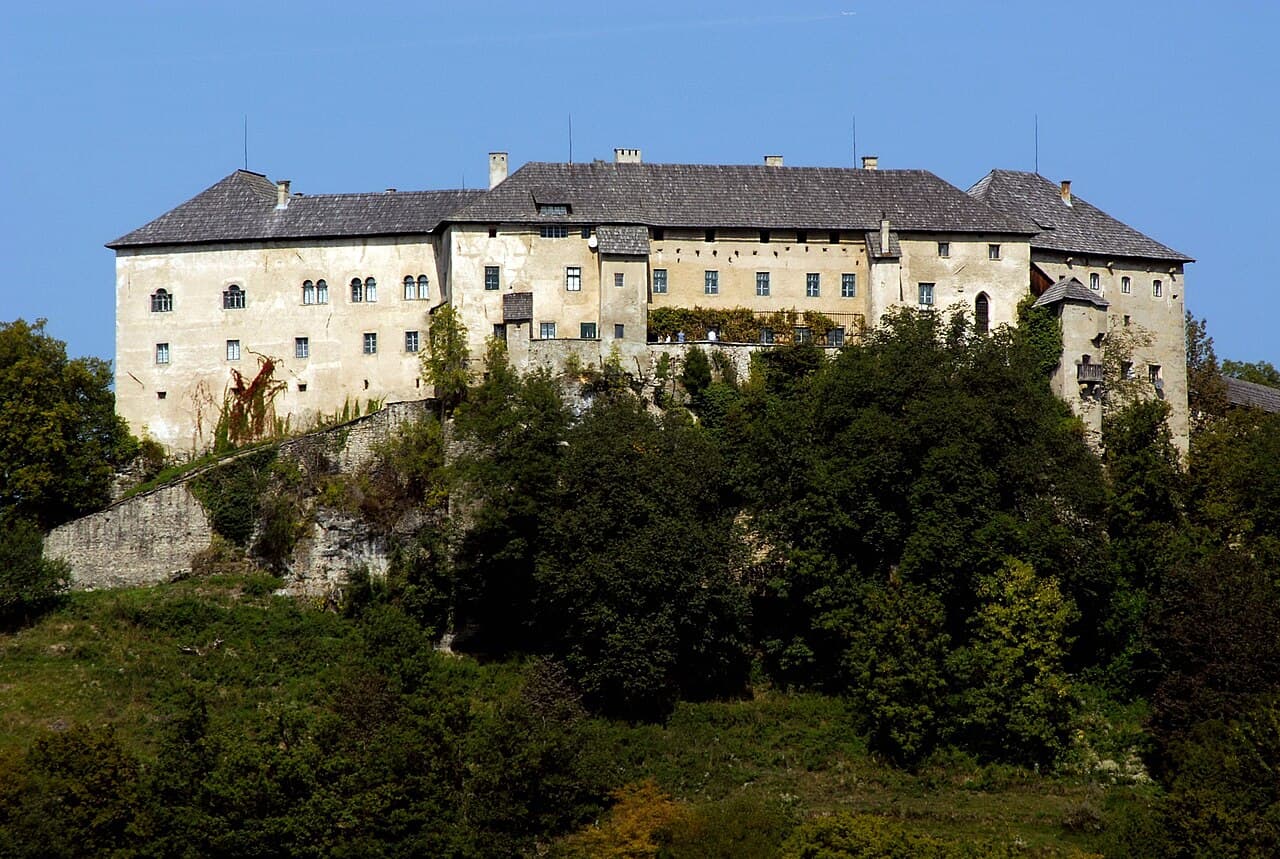
Hollenburg Castle, also known as Burg Hollenburg or Humberk in Slovene, is a high medieval hill castle located near Köttmannsdorf in the Austrian region of Carinthia. Perched on a prominent rock on the northern slope of the Drava valley at an elevation of 561 metres (1,841 ft), the castle commands strategic views over the river and the surrounding landscape. Its position was historically significant, overlooking a vital crossing of the Drava River and the important route leading to the Loibl Pass and the March of Carniola, making it a key defensive and control point in medieval times.
Early history and strategic importance
The earliest known mention of the castle dates back to 1142, when Swiker, Lord of Hollenburg, appeared as a witness in the foundation deed of Viktring Abbey. Swiker was likely a vassal of the ducal House of Sponheim, which held significant power in the Duchy of Carinthia during the high medieval period. His son, Reginher, who was later Lord of Steuerberg, is noted for his participation in the Second Crusade in 1147 alongside King Conrad III of Germany. Reginher subsequently served as a ministerialis under Margrave Ottokar IV of Styria, indicating the family's continued prominence in regional affairs.
The castle's strategic location made it a critical military and administrative center. Control of the crossing over the Drava River allowed its lords to monitor and regulate trade and travel between Carinthia and neighboring regions. The road to the Loibl Pass was a key alpine route connecting the Duchy of Carinthia with the March of Carniola, further enhancing the castle's importance in controlling regional traffic and defense.
Ownership transitions and architectural changes
After the extinction of the original Hollenburg dynasty in 1246, the castle passed to the Styrian Lords of Pettau. In 1438, ownership was transferred to the House of Stubenberg, a noble family with extensive holdings in Styria and Carinthia. The castle endured significant damage during the 1348 Friuli earthquake, which affected much of the region and required substantial repairs.
In the early 16th century, the castle's ownership changed hands again under notable circumstances. In 1514, Emperor Maximilian I of the Habsburg dynasty, burdened by debts from the War of the League of Cambrai against Venice, sold Hollenburg to his son-in-law, Lord Siegmund of Dietrichstein. This sale came with Siegmund's elevation to the rank of Freiherr (Baron). Siegmund was married to Barbara von Rottal, an illegitimate daughter of Emperor Maximilian, which further solidified the Dietrichstein family's status within the imperial aristocracy.
Renaissance rebuilding and later history
The Dietrichstein family undertook a comprehensive reconstruction of the castle, transforming it into a Renaissance-style residence. The rebuilding was completed by 1588 and included modernization of the castle's defenses and living quarters to reflect Renaissance architectural trends. This renovation marked a significant shift from the castle's original medieval fortress design to a more comfortable and representative noble residence.
The Dietrichsteins maintained possession of Hollenburg Castle until the extinction of their branch in 1861. Subsequently, the castle changed hands and was acquired by the Wittgenstein family in 1913, who remain its owners. Throughout its history, the castle has witnessed numerous political and military events, reflecting the shifting dynamics of power in Carinthia and the broader Habsburg territories.
Architectural features and preservation
Hollenburg Castle exemplifies a hill castle with a commanding position on a rocky outcrop. Its original medieval fortifications included thick stone walls, a central keep, and defensive towers designed to control the surrounding terrain. The Renaissance reconstruction introduced architectural elements such as larger windows, decorative stonework, and more spacious living quarters, adapting the fortress to the needs of a noble residence while retaining defensive capabilities.
The castle's current condition is well preserved, with many original structures and Renaissance modifications still visible. Its location and historical significance make it an important cultural landmark in Carinthia, attracting visitors interested in medieval and Renaissance architecture as well as regional history.
Cultural and historical significance
Hollenburg Castle's long history reflects the complex feudal relationships and political alliances in the region. From its early association with the House of Sponheim to its role under the Dietrichstein family, the castle has been a symbol of noble authority and regional control. Its connection to significant historical figures, such as Emperor Maximilian I and participants in the Second Crusade, adds to its historical importance.
Today, the castle stands as a testament to the architectural evolution from medieval fortification to Renaissance residence, illustrating broader trends in European castle design and aristocratic life. Its preservation allows for ongoing study and appreciation of Carinthia's medieval heritage.
Visiting information
While the castle is privately owned by the Wittgenstein family, it is occasionally accessible to the public during special events and guided tours. Visitors interested in exploring the castle's architecture and history should check local tourism resources for current visiting opportunities and opening hours.
Frequently asked questions (FAQ)
- When was Hollenburg Castle originally built?
- Hollenburg Castle was originally constructed in the 12th century during the high medieval period.
- What architectural styles are present at Hollenburg Castle?
- The castle features a combination of high medieval fortifications and Renaissance-style renovations completed in 1588 by the Dietrichstein family.
- Who were the original owners of Hollenburg Castle?
- The castle was initially owned by the Lords of Hollenburg, vassals of the House of Sponheim, first documented in 1142.
- Is Hollenburg Castle open to the public?
- Hollenburg Castle is privately owned by the Wittgenstein family and is occasionally open to visitors during special events and guided tours.
- Why was the castle rebuilt in Renaissance style?
- The Dietrichstein family rebuilt the castle in Renaissance style after acquiring it in 1514 to modernize its defenses and living quarters, reflecting contemporary architectural trends.
Photo gallery

Information
Current owner
Wittgenstein family
Loading map...
Visitor reviews
No reviews yet. Been here? Write the first review and help other travelers!
Write the first reviewVisited this castle? Share your experience
Your review helps other travelers and adds first-hand knowledge to our encyclopedia.