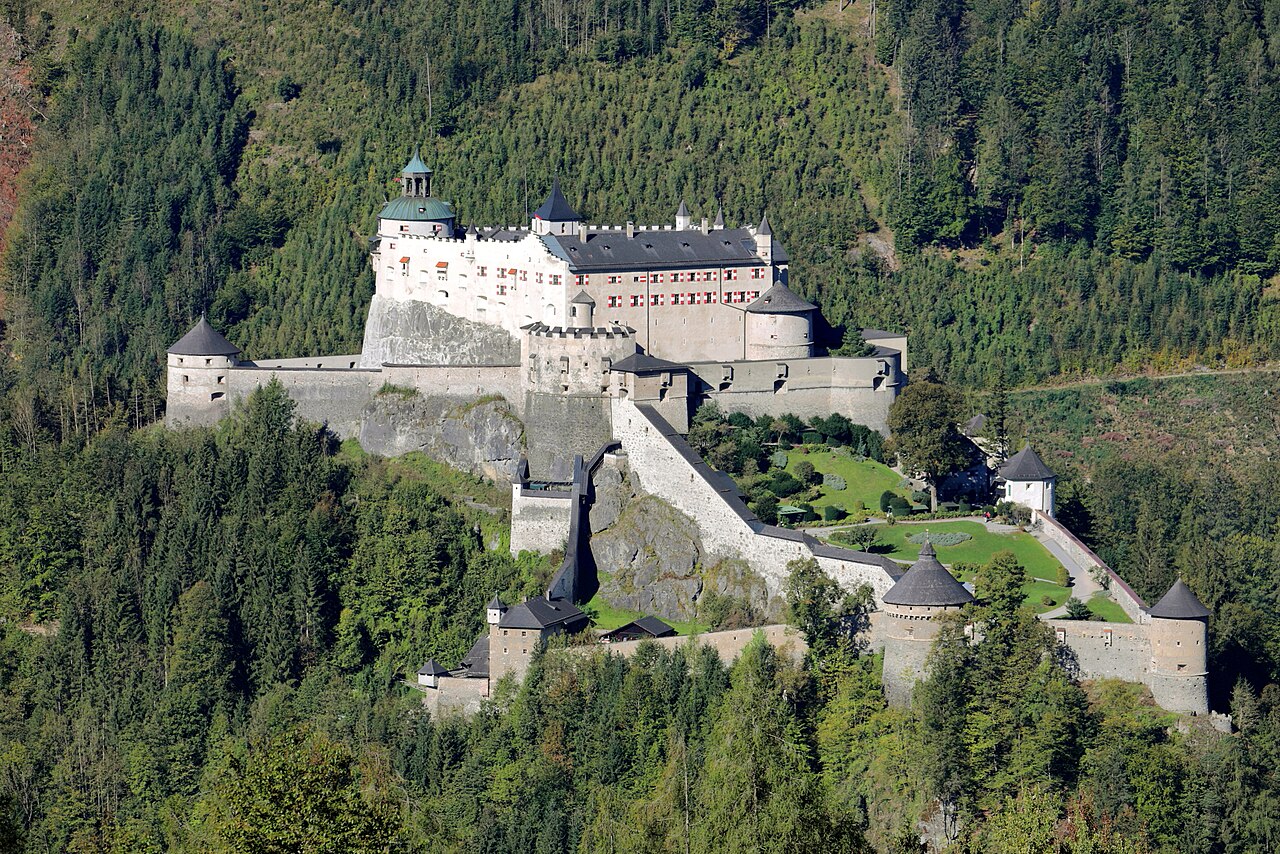
Schloss Höch
Schloss Höch is a notable hill castle situated in the municipality of Flachau, Austria, perched on a gentle hill terrace at approximately 975 meters above sea level near the base of Blümeck peak. Established in the early 12th century by medieval settlers, this fortress originally served to secure the vital route between Altenmarkt and Wagrain, reflecting the strategic military and trade concerns of the period in northern Flachau.
Early history and medieval origins
The castle's earliest documented ownership dates to 1209, marking it as a longstanding seat of local power. Throughout the High and Late Medieval periods, Schloss Höch passed through various noble hands. In 1392, it came under the ownership of Hans Kölderer, whose tenure marked a phase of consolidation. The castle's core medieval structure, including the western section known as the Grafenstock, dates to the early 15th century, incorporating materials from earlier construction phases. This part features a rounded barrel vault entrance hall and a Gothic-style portal leading to a south corner room with a characteristic cross vault ceiling, showcasing medieval architectural techniques.
Renaissance transformation and noble lineage
In 1608, the castle was acquired by Karl Jocher, a wealthy industrialist connected to regional ironworks. Jocher initiated significant renovations that shaped the castle's current horseshoe layout. His son, Adam Jocher, continued these works, introducing Renaissance-style architectural elements completed by 1648. This period saw the addition of an eastern wing with richly decorated interiors, including a dining room, salon, bedroom, and the Grafenstube, all featuring elaborately carved wooden wall paneling, coffered ceilings, period doors, and early 17th-century majolica stoves—ornate ceramic tile heaters glazed in vibrant colors.
By 1657, through marriage, Schloss Höch became part of the holdings of the von Plaz zum Thurn family, who were ennobled as counts in 1696 by Emperor Leopold I. The castle remained a noble residence for centuries, witnessing social and political changes in the region.
Architectural features and interior highlights
The castle complex is arranged around a central main building with two wings forming a distinctive horseshoe shape. Each wing terminates in small towers at the southern corners, contributing to Schloss Höch's unique silhouette. A continuous two-nave hall on the first floor runs along the length of the wings, roofed by a ridge vault supported by two central columns. Ornate doorways dated 1656 connect this hall to the adjoining wings, illustrating the castle’s architectural evolution.
Additional late 19th-century modifications include the installation of a wooden bay window on the west side in 1893 and the construction of a new staircase, reflecting the modernization efforts by Count Hieronymus von Plaz between 1880 and 1893.
Facing the eastern wing, a terrace with arcades—rows of arches supported by columns—provides an elegant open veranda space. The private chapel on the second floor of this wing is rectangular with a cross vault ceiling and features an altarpiece depicting Jesus seated in the lap of Mary. The altarpiece bears the combined coats of arms of the Jocher and Grimming families, symbolizing the castle’s historical lineage.
Modern history and restoration
Significant social change came in 1869 with the abolition of feudal obligations tied to the property, allowing Schloss Höch to become freehold. Between 1880 and 1893, Count Hieronymus von Plaz undertook modernization projects to update the residence. By 1989, the castle had fallen into disrepair until purchased by Alois Rohrmoser, a ski manufacturer. Following Rohrmoser's bankruptcy, the municipality of Flachau acquired the site.
From 2002 to 2007, extensive restoration efforts were conducted to preserve and adapt Schloss Höch primarily for cultural uses. Today, it stands as a protected architectural monument in Austria, celebrated for its blend of medieval and Renaissance features and its historical significance within the region.
Location and strategic importance
Schloss Höch's position on a hill terrace near Blümeck peak afforded it strategic oversight of the surrounding landscape and control over the important route connecting Altenmarkt and Wagrain. This location was critical for defense and the monitoring of trade and travel during medieval times.
Preservation and cultural significance
As a well-preserved example of a hill castle that evolved architecturally from the medieval through the Renaissance periods, Schloss Höch offers valuable insights into regional history and noble lifestyles. Its distinctive horseshoe layout, decorative interiors, and surviving architectural elements like vaults, towers, and the chapel contribute to its status as a cultural landmark.
Visitors today can appreciate the castle's historical layers, from the medieval Gothic portals and vaulted halls to the refined Renaissance wood paneling and majolica stoves. The castle's restoration has ensured that these features remain accessible and informative for cultural and educational purposes.
Frequently asked questions (FAQ)
- What is the best time to visit Schloss Höch?
- The best time to visit Schloss Höch is during the warmer months from late spring to early autumn when the weather is pleasant for exploring the castle and its surroundings.
- Can I tour the interior of Schloss Höch?
- Yes, Schloss Höch is open to visitors and offers tours that showcase its medieval and Renaissance architectural features, including the chapel and richly decorated rooms.
- Is Schloss Höch accessible for visitors with mobility challenges?
- While the castle has undergone restoration, some areas may have limited accessibility due to historic staircases and uneven flooring. It is advisable to check with the municipality of Flachau for specific accessibility information before visiting.
- How did Schloss Höch's architecture evolve over time?
- Schloss Höch began as a medieval fortress in the early 12th century and was transformed in the 17th century with Renaissance additions, including the horseshoe-shaped wings and richly decorated interiors.
- Why is Schloss Höch historically significant?
- Schloss Höch is significant for its continuous noble ownership, architectural evolution from medieval to Renaissance styles, and its strategic location overseeing important trade routes in Austria.
Information
Sources & official resources
Verify the information above using these authoritative references.
Loading map...
Visitor reviews
No reviews yet. Been here? Write the first review and help other travelers!
Write the first reviewVisited this castle? Share your experience
Your review helps other travelers and adds first-hand knowledge to our encyclopedia.