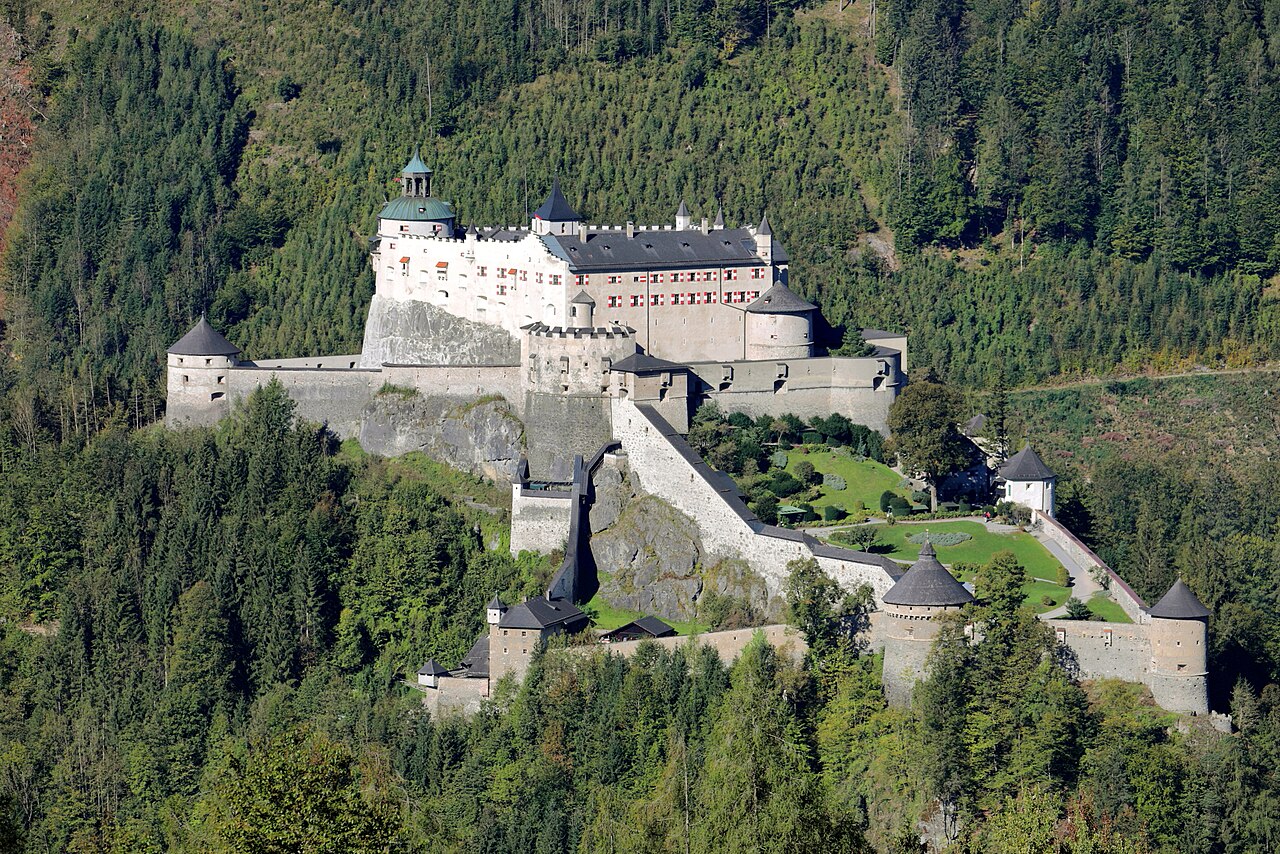
Hohenwerfen Fortress
Hohenwerfen fortress, also known as Erlebnisburg or "Castle of Experience," is a remarkable medieval stronghold perched above the town of Werfen in the Salzach Valley, approximately 40 km south of Salzburg city in Austria. This imposing castle occupies a commanding position atop a 155-meter-high rock, nestled between the majestic mountain ranges of Berchtesgaden and Tennengebirgs, part of the Eastern Alps. Its strategic location at the narrow mountain pass called "Lueg" made it a critical defensive site controlling access through the valley for centuries.
Constructed between 1075 and 1078 by Prince Archbishop Gebhard of Salzburg, Hohenwerfen was built amidst the turbulent period of the imperial investiture controversy, a major conflict between the Church and the Holy Roman Emperor over the appointment of bishops and abbots. Gebhard, an ally of Pope Gregory VII and anti-king Rudolf of Swabia, fortified this site along with other key castles such as Hohensalzburg Castle and the fortress at Petersberg in Friesach to secure the archbishopric's autonomy against King Henry IV. Although Gebhard was expelled in 1077 and only returned in 1086, he died within Hohenwerfen's walls in 1088, marking the castle’s early historical significance.
Medieval fortification and strategic importance
Hohenwerfen's location at the gateway to Salzburg's valley was of immense military and political importance. The valley is naturally enclosed by towering mountain ranges, creating a formidable barrier to invaders. The castle's position allowed it to control the mountain pass, serving as a bulwark against hostile forces and a checkpoint for travelers and traders. Over the centuries, the fortress was continuously expanded and strengthened to adapt to evolving military technologies and political challenges.
Early expansions and medieval role
Between 1127 and 1142, during the reign of Archbishop Konrad I, Hohenwerfen underwent significant strengthening and enlargement to reinforce its defenses. The castle served not only as a military base but also as a residence and hunting lodge for the prince-archbishops of Salzburg. It functioned as a symbol of ecclesiastical power and territorial control within the Holy Roman Empire.
By the 13th and 14th centuries, the fortress's role expanded with the recognition of the Archbishop of Salzburg as a sovereign prince within the empire. This period saw Hohenwerfen become a center of administration and governance, reflecting the growing independence of the Salzburg principality from Bavarian influence.
Adaptations for artillery and Renaissance remodeling
The advent of gunpowder and artillery in the late medieval period necessitated further architectural modifications. In the 15th century, Archbishop Eberhard III of Neuhaus initiated rebuilding efforts to accommodate artillery defenses. The castle's walls were thickened, and towers adapted to withstand cannon fire.
Following the German Peasants' War (1524-1525), during which the castle was besieged and partially destroyed by revolting peasants, extensive reconstruction took place under Prince Archbishop Matthäus Lang. The castle was rebuilt with enhanced fortifications, including new towers and outer walls. The addition of the Torre di Fallturm and other towers in the mid-16th century further strengthened the complex.
In 1563, influenced by Italian military architecture, Prince Archbishop Johann Kuen-Belasy ordered a comprehensive remodeling of Hohenwerfen, introducing state-of-the-art fortification designs to resist firearms and cannon attacks. The St. Sigismund Chapel was rebuilt in the Gothic style between 1565 and 1566, blending medieval religious architecture with Renaissance military innovations. The castle's arsenal, constructed in 1568, now serves as a museum showcasing historic weapons.
Between 1573 and the early 17th century, further enhancements included the construction of a large central keep ordered by Prince Archbishop Johann Jakob and the addition of a powder tower and water reservoir during the reign of Prince Archbishop Paris Lodron. These improvements solidified Hohenwerfen's status as a modern fortress suitable for the era's warfare.
Use as a prison and residence
Throughout its history, Hohenwerfen also functioned as a state prison. Its dungeons held numerous notable prisoners, including Archbishop Adalbert III, who was arrested by his own ministry in 1198, and Prince-Archbishop Wolf Dietrich Raitenau, who died in captivity in 1617 after six years imprisoned within the fortress. The castle's prison walls witnessed the fates of various nobles and political figures, underscoring its role in regional power struggles.
Simultaneously, the fortress served as a residence and hunting lodge for the prince-archbishops, combining military utility with courtly life. Its location amidst the Alpine landscape made it an ideal retreat for hunting expeditions, a tradition maintained through centuries.
Decline and restoration
The Napoleonic Wars and subsequent political changes led to the castle's decline. In 1800, all cannons were removed, and following the secularization of Salzburg in 1803, Hohenwerfen passed to Bavarian control. The Bavarians neglected the castle, allowing it to fall into disrepair. Emperor Francis I of Austria later intervened to prevent its destruction, but it remained largely unused and decayed.
After Salzburg's incorporation into Austria in 1816, Archduke John initiated restoration efforts between 1824 and 1833, motivated by romantic nostalgia for medieval architecture. The castle was repurposed mainly as a hunting base during this period.
In 1876, the fortress was sold to Count Oswald von Thun-Hohenstein, and later, in 1898, Archduke Eugen of Austria acquired it, transforming the complex into a stately home and enriching it with an extensive art and weapons collection.
20th-century history and modern use
In 1931, a fire severely damaged the main building, destroying many exhibits and artifacts. The castle was restored within a year and sold to the Salzburg Reichsgau administration in 1938. After World War II, it served as a training camp for the Austrian Gendarmerie until 1987.
Since opening to the public in 1987, Hohenwerfen has become a popular tourist destination known as an "adventure castle." Visitors can explore its extensive collection of weapons, enjoy guided tours, and experience the historic Salzburg Falconry, which offers daily flight demonstrations of birds of prey. The castle also features an elegant fortress tavern, enhancing the visitor experience.
Architectural features and layout
Hohenwerfen fortress exemplifies a hill castle with a complex architectural evolution spanning from the high medieval period through the renaissance. Its defensive structures include massive curtain walls, multiple towers adapted for artillery, a central keep, and a well-preserved inner courtyard reflecting Renaissance modifications. The blend of Romanesque and Gothic elements, alongside later Renaissance fortifications, illustrates the castle's continuous adaptation to changing military and residential needs.
The castle's location on a rocky outcrop provides natural defenses, augmented by man-made fortifications designed to withstand sieges and cannon fire. The St. Sigismund Chapel remains a notable architectural highlight, showcasing Gothic style within a predominantly military complex.
Cultural significance and tourism
Today, Hohenwerfen fortress stands as a cultural landmark in the Salzburg region, embodying centuries of Austrian history, ecclesiastical power, and military architecture. Its preservation allows visitors to immerse themselves in the medieval and Renaissance periods through its exhibitions, falconry demonstrations, and well-maintained structures.
The castle's integration into the surrounding Alpine landscape offers stunning panoramic views of the Salzach Valley and the surrounding mountains, enhancing its appeal as a tourist destination. Its combination of historical authenticity and engaging activities makes it a unique site for education and leisure.
Frequently asked questions (FAQ)
- How do I get to Hohenwerfen Fortress?
- Hohenwerfen Fortress is located in Werfen, Austria, approximately 40 kilometers south of Salzburg. You can reach the fortress by taking a train to Werfen and then a short taxi ride, or you can drive and take advantage of the parking available near the site.
- What is the historical significance of Hohenwerfen Fortress?
- Hohenwerfen Fortress dates back to the 11th century and served as a royal residence and military stronghold. Its strategic location allowed it to control the surrounding valley, making it a vital part of the region's defense system throughout history.
- When was Hohenwerfen Fortress built?
- Construction of Hohenwerfen Fortress began in 1077, and it was completed in the 13th century. The fortress has undergone various renovations and restorations over the centuries, preserving its medieval architecture and historical significance.
- Can I visit Hohenwerfen Fortress year-round?
- Yes, Hohenwerfen Fortress is open to visitors year-round, but hours may vary by season. It's best to check the official website for the most current opening hours and any seasonal events that may affect access.
- Why is Hohenwerfen Fortress considered an architectural marvel?
- Hohenwerfen Fortress is renowned for its impressive medieval architecture, featuring towering ramparts, a keep, and beautifully preserved interiors. The fortress is built on a rocky outcrop, offering stunning views of the surrounding mountains and valleys, making it a perfect example of medieval military architecture.
- Is it possible to explore the fortress on my own?
- Yes, visitors can explore Hohenwerfen Fortress at their own pace, with various self-guided tours available. However, guided tours are also offered, providing deeper insights into the history and architecture of the fortress.
- What are the ticket prices for Hohenwerfen Fortress?
- Ticket prices for Hohenwerfen Fortress vary, with discounts available for children, students, and families. It's advisable to check the official website for the latest pricing information and any special offers.
- What is the best time to visit Hohenwerfen Fortress?
- The best time to visit Hohenwerfen Fortress is during the spring and early autumn when the weather is mild, and the scenery is at its most beautiful. Summer is also popular, but it can be crowded, especially during peak tourist season.
- Are there any nearby attractions to Hohenwerfen Fortress?
- Yes, there are several nearby attractions, including the Ice Caves in Werfen, the town of Werfen itself, and the stunning Salzach Valley. These sites offer additional opportunities for outdoor activities and exploration in the breathtaking Austrian landscape.
Information
Loading map...
Visitor reviews
No reviews yet. Been here? Write the first review and help other travelers!
Write the first reviewVisited this castle? Share your experience
Your review helps other travelers and adds first-hand knowledge to our encyclopedia.