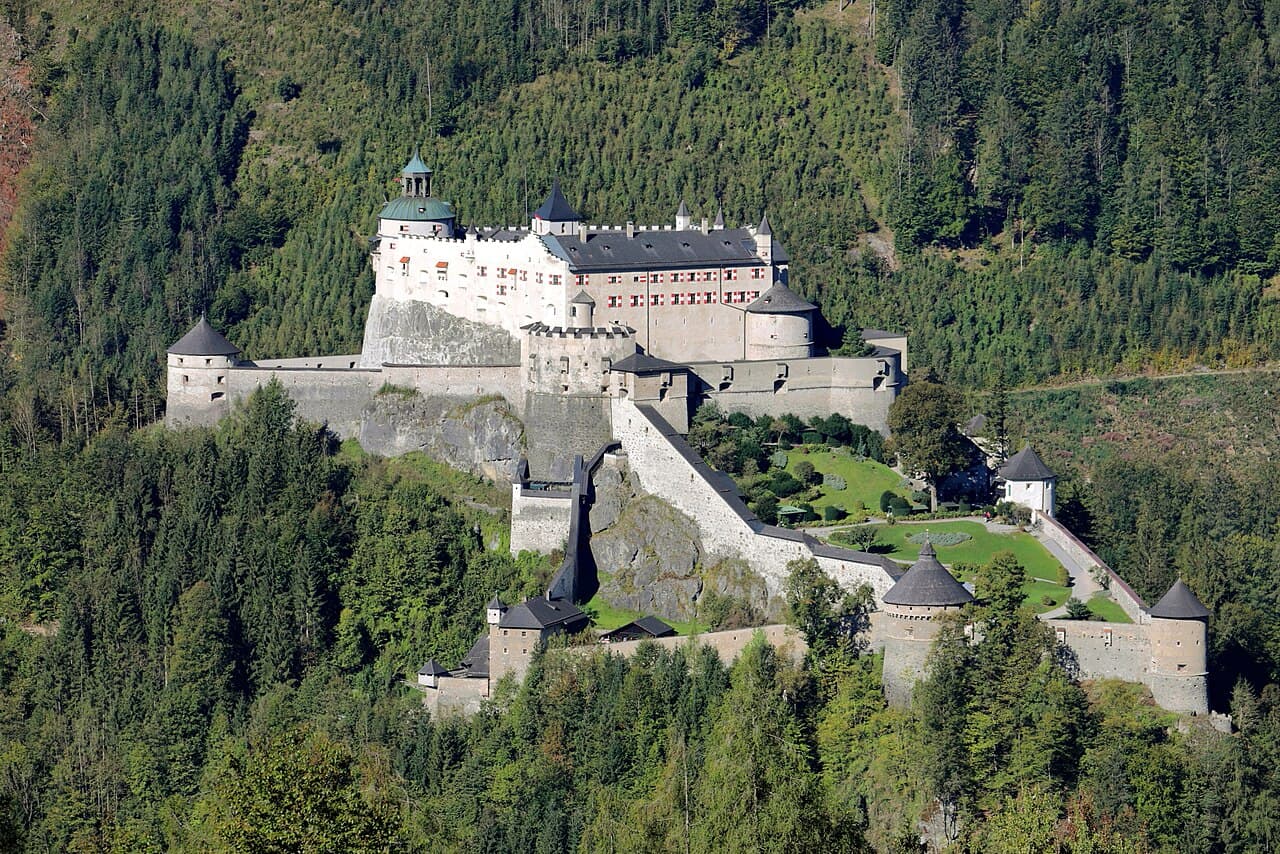
Hohenwerfen Castle
Hohenwerfen Castle stands prominently above the Austrian town of Werfen in the Salzach valley, nestled amidst the dramatic peaks of the Berchtesgaden Alps and the Tennengebirge mountain range. This 11th-century hill castle is a significant medieval fortress with a rich history spanning nearly a millennium. It was constructed between 1075 and 1078 by Archbishop Gebhard of Salzburg during the turbulent period of the Imperial Investiture Controversy. Designed as a strategic bulwark, Hohenwerfen was built alongside its "sister" fortress, Hohensalzburg Castle, and Petersberg Castle in Carinthia to secure the Salzburg archbishopric against the forces of King Henry IV.
The castle's commanding position above the Salzach River valley allowed it to guard the vital Lueg Pass, the only southern route into Salzburg, making it an essential military and trade stronghold. Over the centuries, Hohenwerfen served multiple roles as a military base, residence, hunting retreat, and state prison. Its long-standing connection to the House of Habsburg and later ownership by Archduke Eugen of Austria reflect its importance in Austrian history.
Historical context and construction
The foundation of Hohenwerfen Castle was laid during a period of intense political and religious conflict. Archbishop Gebhard, a staunch supporter of Pope Gregory VII in the Investiture Controversy, commissioned the castle to defend the Salzburg archbishopric against the imperial forces of King Henry IV. Despite its formidable defenses, Gebhard was expelled from Salzburg in 1077 and only returned in 1086, spending his final years at Hohenwerfen until his death in 1088.
Initially, the castle featured a compact ring wall approximately 35 by 35 meters enclosing a small residential building known as a palas and a chapel. In the 12th century, Archbishop Konrad I expanded the fortress, adding a larger palas connected to the chapel, creating a cubic structure with a two-aisled hall in the basement and a grand hall with biforium windows on the upper floor.
Fortifications and adaptations
Throughout the 12th to 17th centuries, Hohenwerfen underwent numerous expansions and fortifications to adapt to evolving military technologies and threats. In the 15th and 16th centuries, the castle was modified to withstand artillery attacks, with the addition of semicircular bastions featuring three-level galleries on the southeast corner. Covered galleries were constructed atop the eastern bastion walls for enhanced defense.
Significant defensive towers such as the Walserturm and the Fallturm were built during this period. The Fallturm, a round tower with thick walls, served as the castle prison. Notably, it had no direct internal connection to the main castle; prisoners were lowered through an opening in the floor, highlighting the fortress's role in regional governance and control.
Role as a prison and residence
Hohenwerfen Castle's function extended beyond military defense. It served as a state prison with a somewhat sinister reputation. Its prison walls confined many criminals under harsh conditions, as well as high-profile noble prisoners such as Archbishop Adalbert III in 1198 and Count Albert of Friesach in 1253. The castle's prison also held Archbishop Wolf Dietrich von Raitenau, who died in captivity in 1611.
Alongside its role as a prison, the castle was a favored residence and hunting retreat for Salzburg's prince-archbishops. Its location amidst rich alpine forests made it ideal for falconry and hunting, traditions that continue to be celebrated today.
Damage and restoration
The castle suffered significant damage during the German Peasants' War in 1525-1526 when rebelling peasants and miners attacked and set fire to the fortress. Archbishop Matthäus Lang von Wellenberg ordered the castle's reconstruction, which included shortening and rebuilding the main bergfried tower, now known as the clock tower.
In 1931, a devastating fire caused further damage. Despite this, the castle was largely restored and later used as a training camp by the Austrian Gendarmerie until 1987. Ownership transitioned through various hands, including Archduke Eugen, who amassed a significant weapons and art collection within the castle.
Architectural features and layout
Hohenwerfen Castle is built on a natural rock spur rising approximately 113 to 155 meters above the Salzach valley floor. Its roughly square layout is dominated by the clock tower, originally a tall defensive bergfried. The castle's entrance was historically protected by a moat and two drawbridges, with the current gate featuring a 16th-century portcullis.
The castle chapel, dedicated to Saint Sigismund, is located on the eastern side of the courtyard within the two-story palas. It is among the oldest surviving parts of the castle, retaining medieval wooden structures supporting a four-ton bell rung on special occasions. The chapel was remodeled in the 17th century in Gothic style, with some Romanesque masonry preserved. Its altar dates to 1650, and it houses a statue of the Virgin Mary with Child from around 1480, the castle's oldest artifact.
The fortress contains a large bell called the Burgahnl, weighing 4,412 kilograms and cast in 1568 in Innsbruck. This bell is rung on major holidays and adds to the castle's historic ambiance.
Defensive structures
- Semicircular bastions with multi-level galleries on the southeast corner
- Artillery towers including the Walserturm and Fallturm
- Covered galleries atop bastion walls
- Moat and drawbridges at the entrance
Interior museums and attractions
Today, Hohenwerfen Castle functions as a museum offering visitors a glimpse into its extensive history. It houses a weapons museum showcasing 700 years of firearms development and a hunting museum documenting hunting traditions since the 13th century. Notably, it is home to Austria's first falconry museum, featuring live demonstrations of birds of prey including eagles, falcons, hawks, and vultures.
The castle grounds also include a gallery with stairs along the southern wall leading from the bastion to the second forecourt, and a cistern built in the early 17th century for water storage. The historic Falconry Centre is a major attraction, offering daily flight demonstrations that celebrate the castle's long-standing falconry heritage.
Cultural significance and present-day use
Hohenwerfen Castle remains a symbol of medieval military architecture and the complex history of Salzburg. Its preservation and restoration allow visitors to experience a fortress that has adapted through centuries of warfare, political change, and cultural development.
The castle is currently owned by relatives of the Habsburg family, the House of Sforza, Count Andreis, who maintain residence within its walls. It serves as a popular tourist destination, combining historical education with engaging cultural events, such as falconry displays and guided tours of its weaponry and hunting collections.
Additionally, Hohenwerfen has appeared in films, further cementing its place in popular culture and attracting visitors worldwide. Its blend of imposing medieval architecture, rich history, and unique falconry tradition make it a must-visit site in the Salzburg region.
Frequently asked questions (FAQ)
- How do I get to Hohenwerfen Castle?
- Hohenwerfen Castle is located in Werfen, Austria, approximately 40 kilometers south of Salzburg. You can reach the castle by car via the A10 motorway or by taking a train to Werfen station, followed by a short taxi ride or a pleasant hike up to the castle.
- What is the historical significance of Hohenwerfen Castle?
- Hohenwerfen Castle dates back to the 11th century and has served various purposes throughout history, including as a royal residence and a fortress. Its strategic position on a ridge allowed it to oversee the surrounding area, playing a crucial role in the defense against invaders.
- When was Hohenwerfen Castle built?
- Construction of Hohenwerfen Castle began in 1077, making it over 900 years old. The castle has undergone numerous renovations and additions over the centuries, reflecting the architectural styles of different periods.
- Can I visit Hohenwerfen Castle year-round?
- Yes, Hohenwerfen Castle is open to visitors year-round, but it's best to check the specific opening hours for the season you plan to visit. During winter, some areas may have limited access due to weather conditions.
- Why is Hohenwerfen Castle a popular tourist attraction?
- Hohenwerfen Castle is renowned for its stunning architecture, breathtaking views of the surrounding mountains, and rich history. Visitors can explore the medieval interiors, enjoy falconry shows, and learn about the castle's past through guided tours.
- Is it possible to attend a falconry show at Hohenwerfen Castle?
- Yes, the castle features regular falconry shows, which are one of its main attractions. These performances showcase the impressive skills of trained birds of prey and provide visitors with an unforgettable experience.
- What are the ticket prices for visiting Hohenwerfen Castle?
- Ticket prices for Hohenwerfen Castle typically range from around €10 for adults to €5 for children, with family tickets available for a discount. Check the official website for the most current pricing and special offers.
- What are the opening hours for Hohenwerfen Castle?
- Hohenwerfen Castle generally opens at 9 AM and closes at 5 PM, but hours may vary depending on the season. It's advisable to verify the specific opening times on the official website before your visit.
- What nearby attractions can I visit while at Hohenwerfen Castle?
- In addition to the castle itself, nearby attractions include the Eisriesenwelt, the world's largest ice cave, and the picturesque village of Werfen. The region also offers numerous hiking trails and opportunities for outdoor activities, making it a perfect destination for nature lovers.
Photo gallery

Information
Website
Visit websiteSources & official resources
Verify the information above using these authoritative references.
Loading map...
Visitor reviews
No reviews yet. Been here? Write the first review and help other travelers!
Write the first reviewVisited this castle? Share your experience
Your review helps other travelers and adds first-hand knowledge to our encyclopedia.


