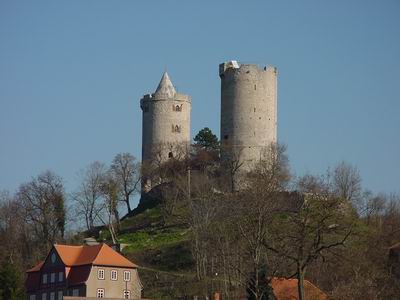
Schloss Greifenstein
Schloss Greifenstein is a distinguished hill castle located in the municipality of Hammelburg, Germany. Constructed in the mid-16th century, it stands as a testament to the architectural and historical developments of the region during the Renaissance period. The castle's origins are firmly dated to around 1565, as evidenced by a keystone bearing this date, marking the construction initiated by the local nobleman Philipp III von Thüngen. Notably, extensive renovations conducted in the late 20th century revealed no remnants of any earlier fortifications, confirming that the castle's foundations were laid entirely during this period.
Architectural evolution and structural features
The castle exhibits the characteristic features of a Renaissance-era hill castle, strategically positioned to oversee the surrounding landscape atop the Hammelburg military training ground. Its robust masonry construction combines regional stone and brick, typical of German castles from the 16th to 18th centuries. The building is multi-storied with thick walls designed for defense and durability, crowned by a pitched roof that contributes to its distinctive silhouette.
In 1726, Schloss Greifenstein underwent significant remodeling, which largely shaped its current appearance. This renovation introduced architectural elements reflecting the styles and building techniques of the early 18th century, blending function with aesthetic appeal. The castle's layout includes fortified walls and residential quarters, though detailed records of the interior design remain limited due to restricted access.
Despite its military associations, the castle does not display extensive fortifications typical of earlier medieval castles, emphasizing its role more as a noble residence than a fortress. The absence of archaeological artifacts or decorative mosaics within the structure further underscores its practical design focus during the Renaissance and subsequent periods.
Historical ownership and cultural significance
The castle's ownership history reflects its importance within regional noble circles. After its construction by Philipp III von Thüngen, the estate passed in 1657 to Generalmajor Hans-Georg von Rußwurm. Following the extinction of the von Rußwurm lineage in 1732, the property was inherited by the von Gleichen family, who adopted the title Reichsfreiherren von Gleichen-Rußwurm.
From 1756, Wilhelm Friedrich Freiherr von Gleichen genannt von Rußwurm, an officer in the margraviate of Bayreuth and a noted naturalist, made the castle his residence. This period marked the beginning of the castle's long-standing connection to cultural and intellectual pursuits.
The castle gained notable literary significance through its association with the celebrated German poet Friedrich Schiller. In 1793, Schiller and his wife visited Schloss Greifenstein during their travels between Weimar and Stuttgart. Later, in 1828, Schiller's youngest daughter Emilie married Heinrich Adalbert von Gleichen-Rußwurm and resided at the castle until her death in 1872, further cementing the familial and cultural ties to the estate.
Schiller's legacy continued through his descendants, particularly his grandson Heinrich Ludwig, an Impressionist painter and professor who lived nearby at Bonnland. By 1895, Schiller's great-grandson Alexander von Gleichen-Rußwurm, a former military officer turned cultural historian, took residence at Schloss Greifenstein. He established the Schiller Archive within the castle, transforming it into a center for the preservation and study of Schiller's works.
The castle during the 20th century and military use
Throughout the 20th century, Schloss Greifenstein underwent several renovations to preserve its structure, notably in 1936 and again in 1982. These efforts maintained the castle's integrity and protected its historical fabric. However, the castle's proximity to the expanding Hammelburg military training area profoundly affected its accessibility and use.
In 1938, military developments necessitated the evacuation of both Schloss Greifenstein and the adjacent village of Bonnland to facilitate the expansion of the training grounds, originally established in 1893. During and after World War II, the castle served as housing for displaced persons, reflecting the turbulent times and the adaptive reuse of historic buildings.
Today, Schloss Greifenstein remains within a restricted military zone, limiting public access. This restricted status has inadvertently contributed to the preservation of the castle by reducing disturbance and maintaining its structural condition. The castle is officially recognized as a protected historic monument, underscoring its cultural and architectural significance within the region.
Location and surroundings
Schloss Greifenstein is situated atop the Hammelburg military training ground, overlooking the site of the former village of Bonnland. This elevated position provided strategic advantages historically and continues to emphasize the castle's prominence in the landscape. The close spatial relationship between the castle and the abandoned village highlights the intertwined history of the estate and its surrounding community.
The castle's setting within a military zone restricts detailed archaeological investigation, and no significant inscriptions or decorative elements have been discovered. Nonetheless, the castle's imposing masonry walls and characteristic pitched roof remain defining features that convey its historical and architectural identity.
Preservation and current condition
Despite limited public access, Schloss Greifenstein is well preserved, owing to multiple renovation campaigns and its protected monument status. The renovations in 1936 and 1982 focused on maintaining the building's structural soundness and preserving its Renaissance and early modern architectural features.
The castle's condition benefits from its location within a restricted military training area, which has limited urban development and modern alterations that could compromise its historic character. Photographic records document the castle's external appearance, although detailed information on interior spaces remains scarce due to access restrictions.
Schloss Greifenstein stands as a remarkable example of a Renaissance hill castle that has adapted through centuries of noble ownership, cultural significance, and military use, maintaining its architectural integrity and historical importance in the region.
Frequently asked questions (FAQ)
- How do I visit Schloss Greifenstein given its location within a military training area?
- Schloss Greifenstein is located within the Hammelburg military training ground, which restricts public access. Visitors should check with local authorities or military administration for any permitted visiting opportunities or special events that allow access.
- What is the historical significance of Schloss Greifenstein?
- Schloss Greifenstein is historically significant as a Renaissance hill castle built in 1565, associated with noble families such as the von Thüngen and von Gleichen-Rußwurm, and linked to the poet Friedrich Schiller through family connections and the Schiller Archive.
- When was Schloss Greifenstein constructed and what architectural style does it represent?
- The castle was constructed around 1565 during the Renaissance period, featuring masonry typical of German castles from the 16th to 18th centuries, with later remodeling in 1726.
- Can I learn about Friedrich Schiller's legacy at Schloss Greifenstein?
- Yes, Schloss Greifenstein housed the Schiller Archive established by Schiller's great-grandson Alexander von Gleichen-Rußwurm, making it an important site for the preservation and study of Schiller's works, although the archive has since been relocated.
- Is Schloss Greifenstein open to the public and what are the visiting hours?
- Due to its location within a restricted military zone, Schloss Greifenstein is generally not open to the public. Visitors should inquire locally for any special access arrangements or events.
Information
Website
Visit websiteSources & official resources
Verify the information above using these authoritative references.
Loading map...
Visitor reviews
No reviews yet. Been here? Write the first review and help other travelers!
Write the first reviewVisited this castle? Share your experience
Your review helps other travelers and adds first-hand knowledge to our encyclopedia.