Trimburg Castle

Trimburg Castle in Elfershausen, Germany
Elfershausen, Germany
High Medieval (11th–13th c.)
Ruins

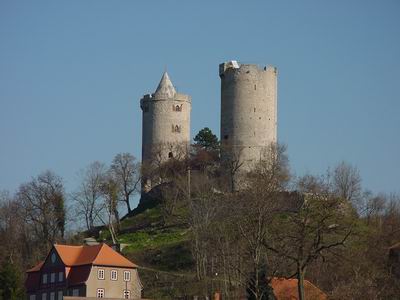
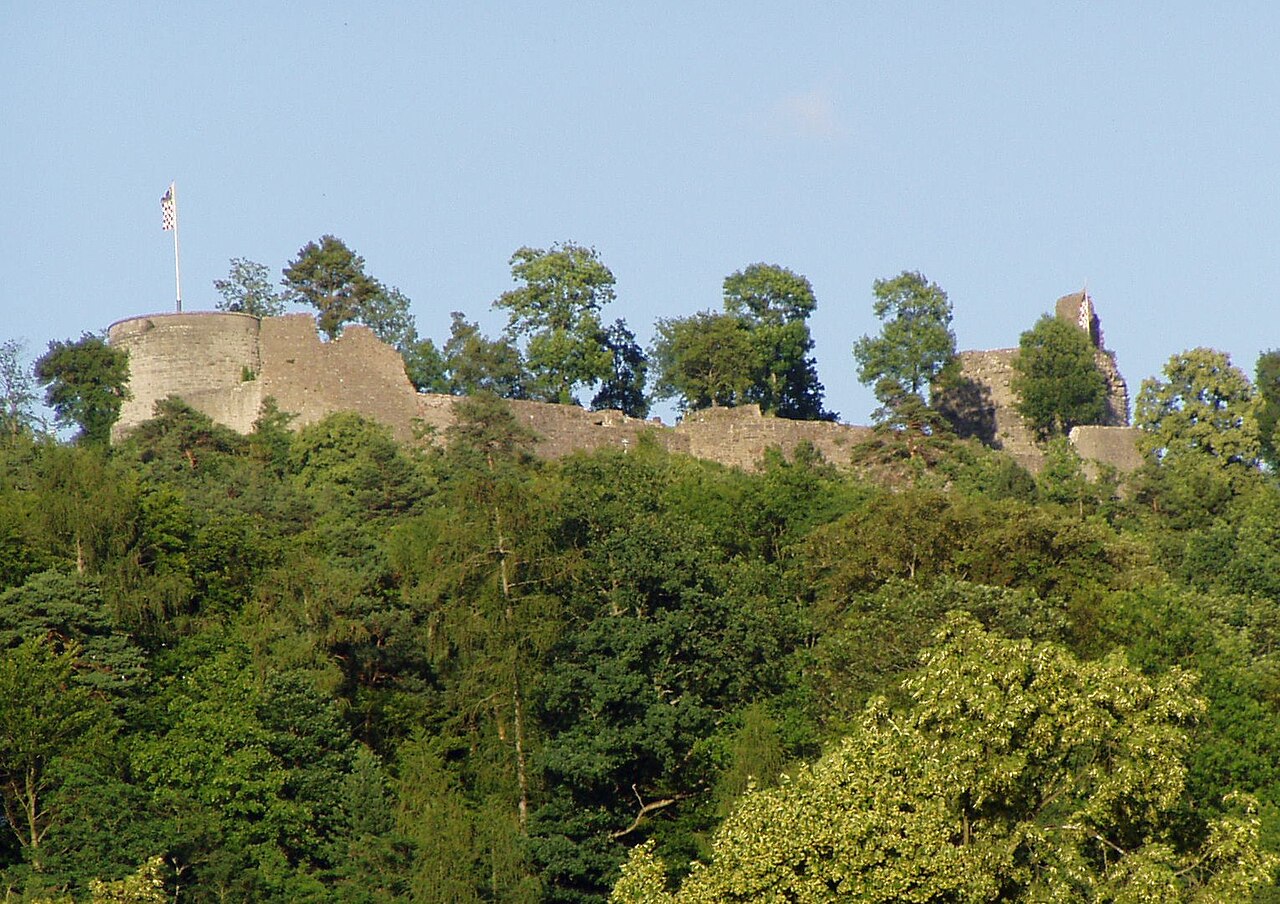
Trimburg Castle is a hilltop fortress located in Elfershausen, in the region of Lower Franconia, Germany. It was originally constructed in 1135 by Gozzwin of Trimberg, marking it as a significant example of high medieval castle architecture. The castle's strategic position atop a hill provided commanding views of the surrounding landscape, a typical feature for fortifications of its era designed for defense and control.

Architectural evolution and structure

The castle's initial complex was composed of three distinct sub-structures, each representing different construction phases over time. The earliest part, known as the Leuchtenburg or Alte Burg, is the oldest surviving section, highlighting the castle's medieval origins. The ruins visible today primarily date from the last significant phase of construction before its decline.

Originally, the castle featured typical medieval defensive elements such as thick stone walls, battlements, and likely a keep or donjon, although detailed records of the early structures are limited. The layered construction phases indicate adaptations to evolving military technologies and residential needs over centuries.

Destruction and rebuilding through conflict

Trimburg Castle endured considerable damage during two major conflicts. In the Peasant's War of 1525, the castle was captured and severely destroyed by insurgent forces. This event marked a pivotal moment in its history, reflecting the widespread social upheaval in Germany during the early 16th century.

Later, during the Thirty Years' War (1618-1648), the castle suffered further destruction. The prolonged conflict devastated many fortifications across the German lands, and Trimburg was no exception. These repeated damages led to significant structural deterioration.

Reconstruction and architectural transformation

Following the wars, the castle was rebuilt from the ground up, adopting a new architectural character more akin to a palace than a purely military fortress. This transformation reflects the changing role of castles in the post-medieval period, shifting from defensive bastions to noble residences emphasizing comfort and status.

Decline and partial dismantling

In the centuries after its reconstruction, the castle's stone materials became a valuable resource for the surrounding communities. Due to local needs and economic factors, parts of Trimburg Castle were systematically dismantled, with stones repurposed for constructing houses and other buildings in nearby towns. This practice was common in many regions where maintaining large medieval fortifications was no longer feasible or necessary.

Today, the castle remains as ruins, preserving elements of its last medieval phase and later palace-style reconstruction. The site offers insight into the architectural evolution from a fortified medieval stronghold to a Renaissance-era noble residence.

Historical significance and cultural heritage

Trimburg Castle stands as an important monument in Lower Franconia, illustrating the region's medieval history and the impact of major European conflicts on local structures. Its layered construction phases provide valuable information on the development of castle architecture from the high medieval period through the Renaissance.

The castle's ruins are a testament to the complex history of feudal power, warfare, and architectural adaptation in Germany. Visitors can explore the remains to appreciate the castle's strategic location and its transformation over nearly a millennium.

Visiting Trimburg Castle

The castle ruins are accessible to the public, offering hiking opportunities and panoramic views of the surrounding countryside. While the site is primarily in a ruined condition, it remains a point of interest for history enthusiasts and those interested in medieval architecture.

The preservation of the ruins allows for educational visits and cultural events, contributing to the appreciation of Germany's medieval heritage.

Frequently asked questions (FAQ)

How do I get to Trimburg Castle?
Trimburg Castle is located in Elfershausen, Germany, easily accessible by car or public transportation. If driving, take the A7 motorway and follow the signs to Elfershausen. For public transport, check local bus schedules that service the area.
What is the historical significance of Trimburg Castle?
Trimburg Castle dates back to the 12th century and is a remarkable example of medieval military architecture. It played a crucial role in regional power struggles during the Middle Ages and has witnessed numerous historical events. Today, it serves as a reminder of the area's rich history.
When was Trimburg Castle built?
Construction of Trimburg Castle began in the 12th century, around 1150, and it has been renovated and expanded since then. Its enduring structure reflects the architectural styles of various periods, showcasing the evolution of castle design over centuries. Visitors can appreciate the blend of history and architecture during their visit.
Can I visit Trimburg Castle year-round?
Yes, Trimburg Castle is open to visitors year-round, although specific opening hours may vary seasonally. It's advisable to check the official website or contact the visitor center for the latest information on hours and any potential closures. This ensures you have the best experience during your visit.
Why is Trimburg Castle a popular tourist attraction?
Trimburg Castle attracts visitors due to its stunning architecture, picturesque views, and rich history. The castle's strategic location offers panoramic views of the surrounding landscape, making it a perfect spot for photography. Additionally, guided tours provide insights into its historical significance, enhancing the visitor experience.
Is it possible to take guided tours of Trimburg Castle?
Yes, guided tours are available at Trimburg Castle, offering a deeper understanding of its history and architecture. These tours are typically led by knowledgeable guides who share fascinating stories and facts about the castle. Check the castle's website for tour schedules and booking information.
What are the ticket prices for visiting Trimburg Castle?
Ticket prices for Trimburg Castle are generally affordable, with discounts available for children and seniors. Prices may vary for guided tours or special events, so it's recommended to check the official website for the most up-to-date information. This allows you to plan your visit accordingly.
What are the opening hours for Trimburg Castle?
Trimburg Castle typically opens at 10 AM and closes at 6 PM, but hours may vary depending on the season. It is essential to verify the current opening hours before your visit, as some days may have adjusted hours for maintenance or special events. This ensures you make the most of your time at the castle.
What nearby attractions should I visit while in Elfershausen?
While in Elfershausen, you can explore nearby attractions such as the picturesque village center and local hiking trails. The surrounding countryside offers beautiful landscapes ideal for outdoor activities. Additionally, nearby historical sites and museums provide further insights into the region's heritage.

Information

Hill Castle

Loading map...

Visitor reviews

No reviews yet. Been here? Write the first review and help other travelers!

Write the first review

Visited this castle? Share your experience

Your review helps other travelers and adds first-hand knowledge to our encyclopedia.

Write a review

(5/5)

0/2000 characters

Your review will be visible after admin approval

Nearby castles

7 km

Kellereischloss

Hammelburg, Germany

Kellereischloss is a notable Baroque palace located in Hammelburg, Bavaria. Constructed between 1726 and 1731, it was designed by Andrea Gallasini (1681-1766), the court architect to Adolphus von Dalberg, the Prince-Abbot of Fulda. The palace stands on a site with a long history as a wine cellar and tax collection point dating back to 1279. The name "Kellereischloss" translates to "Wine Cellar Castle," reflecting its original function and enduring association with wine production in the region.Historical background and significanceThe location of Kellereischloss has been central to Hammelburg's wine trade for centuries. Initially serving as a wine cellar and administrative center for tax collection on wine since the late 13th century, it evolved into a summer residence for the Prince-Abbot of Fulda in the early 18th century. The transformation into a palace was commissioned by Adolphus von Dalberg, who sought a prestigious retreat that reflected his status and the wealth generated by the local wine industry.Adolphus von Dalberg's decision to build Kellereischloss as a summer residence was realized through the work of Andrea Gallasini, an architect renowned for his mastery of Baroque architecture. The Prince-Abbot's satisfaction with the palace is underscored by the fact that he died there in 1737, just a few years after its completion.Architectural features and designKellereischloss exemplifies the Baroque style with its elegant proportions and ornamental details. The palace's design integrates both residential and functional elements, reflecting its dual role as a noble residence and a center for wine storage and administration.One of the palace's most remarkable features is its extensive underground cellars. These giant cellars were capable of storing an impressive volume of wine, reaching a peak at the end of the 18th century when they held 101 wine barrels with a total capacity exceeding 700,000 litres. This vast storage capability highlights the importance of wine production in Hammelburg and the economic role Kellereischloss played in the region.Palace layout and structural elementsThe palace includes a series of reception rooms, private chambers, and administrative offices arranged around courtyards, typical of Baroque palatial architecture. The facades feature decorative stucco work and window frames that emphasize symmetry and grandeur. The roofline is punctuated by dormer windows and chimneys, adding to the visual complexity of the structure.Cellars and wine storage technologyThe cellars beneath Kellereischloss are vaulted and constructed with robust masonry to maintain stable temperatures essential for wine preservation. Their design reflects advanced knowledge of storage conditions necessary for high-quality wine aging. The scale of these cellars was exceptional for the time, underscoring the castle's role as a wine production hub.The cultural and economic role of KellereischlossThroughout the 18th century, Kellereischloss was not only a noble residence but also a symbol of the prosperity brought by the wine industry in Hammelburg. The palace's cellars supported the storage and aging of vast quantities of wine, facilitating trade and taxation. This dual function of residence and wine cellar was somewhat unique among palatial estates of the period.The estate's connection to the Prince-Abbot of Fulda linked it to broader ecclesiastical and political networks, enhancing its significance beyond the local context. The palace remains a testament to the intertwined nature of aristocratic life and economic enterprise in early modern Germany.Preservation and current statusKellereischloss is well preserved and continues to be a point of interest for visitors to Hammelburg. Its architectural integrity and the survival of its extensive cellars offer valuable insights into Baroque architecture and historic wine production practices.Today, the palace serves as a cultural landmark, illustrating the historical importance of wine in the region and the architectural ambitions of the Prince-Abbots of Fulda. Its preservation allows for ongoing study and appreciation of 18th-century palatial design and economic history.

Post-Renaissance (17th–18th c.)
Details
8.3 km
Saaleck Castle — Germany castle

Saaleck Castle

Hammelburg, Germany

Saaleck Castle stands as a remarkable example of a medieval hill castle in the town of Naumburg (Saale), Germany. Perched atop a sharply angled ridge of Muschelkalk (shell limestone) at approximately 172 meters above sea level, it commands sweeping views of the surrounding landscape. The castle's origins trace back to the early 12th century, with its first recorded mention in 1140 linked to Hermannus advocatus de Salek, a local noble charged with protecting church lands. This fortress played a significant role in regional power dynamics, strategically positioned opposite the nearby Rudelsburg fortress, held by the ecclesiastical authorities of the Naumburg bishopric. Historical development and ownership The castle was likely constructed by the Margraves of Meißen as a counterbalance to ecclesiastical power in the region. By circa 1220, control passed to the Schenken of Vargula, a noble family whose notable member, Rudolf II, served as cupbearer to the Landgrave and participated in crusades. Their stewardship lasted over a century until 1344, when the castle was sold to the bishops of Naumburg, who incorporated it into their administrative district, Amt Saaleck. Rudolf Schenk von Saaleck-Nebra, a family member, even served as bishop between 1352 and 1359. Ownership fluctuated in subsequent centuries; in 1396, the castle was pawned back to the Schenken family. By the early 16th century, the main castle was largely abandoned in favor of administrative functions in the outer bailey. The district and castle transferred to Amt Naumburg in 1544, and later to the Albertine Elector August I of Saxony after 1564. Saaleck served as the residence of the local official, the Amtmann, until 1585. Following its administrative decline, the castle fell into ruin, with local farmers quarrying stone well into the 19th century. A historically significant event occurred in 1922 when Saaleck became the last refuge for Erwin Kern and Hermann Fischer, assassins of German Foreign Minister Walther Rathenau. The Nazi regime later commemorated them with a plaque, which was removed in 2000 due to its controversial associations. During the East German period, the castle was repurposed as a residential care home for the elderly. After a period of disuse starting in 1995, the castle was acquired in 2018 by the Marzona Foundation, which plans extensive renovations to transform the site into a design academy focused on sustainability and new technologies, supported by government funding. Architectural features and layout Saaleck Castle is distinguished by its rare dual bergfried towers, each approximately 23 meters tall with walls about two meters thick, underscoring their defensive purpose. The western bergfried was designed for habitation, featuring a medieval garderobe (latrine) and chimney, indicating living quarters within. Early 20th-century modifications added an external staircase and viewing platform, replacing the original roof to enhance visitor access and panoramic views. The eastern bergfried served exclusively defensive functions, with a core structure dating to the Romanesque period, identifiable by its rounded arches and solid masonry. Its upper sections were later remodeled in the Gothic style, featuring pointed arches and architectural refinements typical of late medieval fortifications. The castle's core was enclosed by inner and outer curtain walls that protected various residential buildings, of which remnants remain alongside the inner curtain wall. Defensive features extended beyond these walls, including moats with forewalls or ramparts at the narrow ends of the terrace, and neck ditches with additional ramparts on the eastern side facing Rudelsburg. The outer defenses once encompassed the adjacent village of Saaleck, which was surrounded by walls and ditches, though only faint traces survive today. The dual bergfried layout is uncommon but comparable to other castles such as Münzenberg, Hohandlau, Botenlaube, Kohren, and Thurant, highlighting a distinctive architectural approach to fortification in the region. Strategic and cultural significance Originally, Saaleck Castle functioned as the southernmost stronghold of the Fulda ecclesiastical territory, playing a crucial role in regional defense and administration. Its strategic position on a hilltop ridge allowed control over trade routes and military movements along the Saale River valley. The castle's fortifications were enhanced significantly during the 13th century under Abbot Heinrich von Erthal (1249–1261), who added ditches, walls, and reinforced the shield wall to improve defense. Despite its military importance in the High Middle Ages, Saaleck gradually lost its strategic value by the time of the Peasants' War in the early 16th century. The castle was occupied and devastated by rebels during this conflict, marking a turning point that led to its decline and partial ruin. Subsequent rebuilding efforts in the mid-17th century by Salentin von Sintzig transformed the castle into a retirement residence, reflecting its shift from fortress to domestic use. Today, Saaleck Castle is protected as a landscape-defining historical monument, symbolizing the region's medieval heritage and architectural evolution. Its enduring stone towers and fortifications provide valuable insight into medieval military architecture and the socio-political history of central Germany. Archaeological research and preservation efforts Archaeological investigations at Saaleck have uncovered key features such as the castle well, though comprehensive understanding of all medieval construction phases remains incomplete. The site's layered history presents challenges for archaeologists seeking to distinguish between Romanesque foundations and later Gothic modifications. Preservation and restoration initiatives gained momentum following the castle's acquisition by the Marzona Foundation in 2018. Supported by government funding, these efforts aim to stabilize the ruins and adapt the site for educational and cultural uses, including plans for a design academy emphasizing sustainability and innovative technologies. Saaleck Castle's architectural and historical significance continues to attract scholars, visitors, and conservationists, ensuring that this medieval fortress remains a vital part of Germany's cultural landscape.

High Medieval (11th–13th c.)
Details
9.5 km
Botenlauben Castle — Germany castle

Botenlauben Castle

Bad Kissingen, Germany

Botenlauben Castle is a ruined high medieval castle situated in Reiterswiesen, a district of the Bavarian spa town of Bad Kissingen in Bavaria, Germany. This castle dates back to the 12th century and stands today as a significant archaeological ruin reflecting the military and residential architecture of the High Middle Ages. Historical background and significance The castle was originally constructed in the 12th century, during a period marked by the consolidation of territorial control by regional nobility in the Holy Roman Empire. Botenlauben Castle served as a fortified residence for the local ruling family and played a role in the defense and administration of the surrounding lands. Its strategic location in the region of Bavaria allowed it to control important routes and assert feudal authority. Throughout the High Medieval period, the castle witnessed various historical events, including feudal conflicts and changes in ownership. Over time, it lost its military importance and was eventually abandoned, leading to its current state as a ruin. Architectural features and layout The remains of Botenlauben Castle reveal typical characteristics of 12th-century castle architecture. The castle was built on a raised site, taking advantage of natural terrain for defense. Its design included a keep or donjon, which served as the main fortified tower and last refuge during attacks. Surrounding the keep were curtain walls that enclosed the castle courtyard, providing protection against invaders. The walls were likely equipped with battlements and arrow slits for defense. Evidence of a gatehouse and possibly a moat or ditch can be discerned from the archaeological remains, indicating layered defensive measures. The castle complex would have included residential buildings, storage facilities, and possibly a chapel, although only foundations and partial walls survive today. Current condition and archaeological importance Today, Botenlauben Castle remains as a ruined archaeological site. Its walls and structures have partially collapsed, but enough remains to provide valuable insights into medieval castle construction and feudal life in Bavaria. The site is protected and studied by historians and archaeologists, contributing to the understanding of regional history and medieval fortification techniques. Visitors can explore the ruins, which offer a glimpse into the architectural style and defensive strategies of the High Medieval period. Visiting Botenlauben Castle Located in the spa town of Bad Kissingen, the castle ruins are accessible to the public. The site is a point of interest for tourists interested in medieval history and castle architecture. While the ruins are not fully restored, pathways and informational signage help visitors appreciate the historical context and architectural features. The castle's setting in a scenic part of Bavaria also makes it a pleasant destination for hiking and cultural tourism.

High Medieval (11th–13th c.)
Details