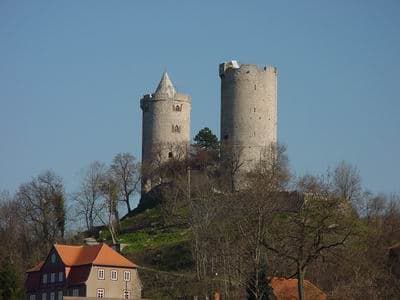
Saaleck Castle
Saaleck Castle stands as a remarkable example of a medieval hill castle in the town of Naumburg (Saale), Germany. Perched atop a sharply angled ridge of Muschelkalk (shell limestone) at approximately 172 meters above sea level, it commands sweeping views of the surrounding landscape. The castle's origins trace back to the early 12th century, with its first recorded mention in 1140 linked to Hermannus advocatus de Salek, a local noble charged with protecting church lands. This fortress played a significant role in regional power dynamics, strategically positioned opposite the nearby Rudelsburg fortress, held by the ecclesiastical authorities of the Naumburg bishopric.
Historical development and ownership
The castle was likely constructed by the Margraves of Meißen as a counterbalance to ecclesiastical power in the region. By circa 1220, control passed to the Schenken of Vargula, a noble family whose notable member, Rudolf II, served as cupbearer to the Landgrave and participated in crusades. Their stewardship lasted over a century until 1344, when the castle was sold to the bishops of Naumburg, who incorporated it into their administrative district, Amt Saaleck. Rudolf Schenk von Saaleck-Nebra, a family member, even served as bishop between 1352 and 1359.
Ownership fluctuated in subsequent centuries; in 1396, the castle was pawned back to the Schenken family. By the early 16th century, the main castle was largely abandoned in favor of administrative functions in the outer bailey. The district and castle transferred to Amt Naumburg in 1544, and later to the Albertine Elector August I of Saxony after 1564. Saaleck served as the residence of the local official, the Amtmann, until 1585.
Following its administrative decline, the castle fell into ruin, with local farmers quarrying stone well into the 19th century. A historically significant event occurred in 1922 when Saaleck became the last refuge for Erwin Kern and Hermann Fischer, assassins of German Foreign Minister Walther Rathenau. The Nazi regime later commemorated them with a plaque, which was removed in 2000 due to its controversial associations.
During the East German period, the castle was repurposed as a residential care home for the elderly. After a period of disuse starting in 1995, the castle was acquired in 2018 by the Marzona Foundation, which plans extensive renovations to transform the site into a design academy focused on sustainability and new technologies, supported by government funding.
Architectural features and layout
Saaleck Castle is distinguished by its rare dual bergfried towers, each approximately 23 meters tall with walls about two meters thick, underscoring their defensive purpose. The western bergfried was designed for habitation, featuring a medieval garderobe (latrine) and chimney, indicating living quarters within. Early 20th-century modifications added an external staircase and viewing platform, replacing the original roof to enhance visitor access and panoramic views.
The eastern bergfried served exclusively defensive functions, with a core structure dating to the Romanesque period, identifiable by its rounded arches and solid masonry. Its upper sections were later remodeled in the Gothic style, featuring pointed arches and architectural refinements typical of late medieval fortifications.
The castle's core was enclosed by inner and outer curtain walls that protected various residential buildings, of which remnants remain alongside the inner curtain wall. Defensive features extended beyond these walls, including moats with forewalls or ramparts at the narrow ends of the terrace, and neck ditches with additional ramparts on the eastern side facing Rudelsburg.
The outer defenses once encompassed the adjacent village of Saaleck, which was surrounded by walls and ditches, though only faint traces survive today. The dual bergfried layout is uncommon but comparable to other castles such as Münzenberg, Hohandlau, Botenlaube, Kohren, and Thurant, highlighting a distinctive architectural approach to fortification in the region.
Strategic and cultural significance
Originally, Saaleck Castle functioned as the southernmost stronghold of the Fulda ecclesiastical territory, playing a crucial role in regional defense and administration. Its strategic position on a hilltop ridge allowed control over trade routes and military movements along the Saale River valley. The castle's fortifications were enhanced significantly during the 13th century under Abbot Heinrich von Erthal (1249–1261), who added ditches, walls, and reinforced the shield wall to improve defense.
Despite its military importance in the High Middle Ages, Saaleck gradually lost its strategic value by the time of the Peasants' War in the early 16th century. The castle was occupied and devastated by rebels during this conflict, marking a turning point that led to its decline and partial ruin. Subsequent rebuilding efforts in the mid-17th century by Salentin von Sintzig transformed the castle into a retirement residence, reflecting its shift from fortress to domestic use.
Today, Saaleck Castle is protected as a landscape-defining historical monument, symbolizing the region's medieval heritage and architectural evolution. Its enduring stone towers and fortifications provide valuable insight into medieval military architecture and the socio-political history of central Germany.
Archaeological research and preservation efforts
Archaeological investigations at Saaleck have uncovered key features such as the castle well, though comprehensive understanding of all medieval construction phases remains incomplete. The site's layered history presents challenges for archaeologists seeking to distinguish between Romanesque foundations and later Gothic modifications.
Preservation and restoration initiatives gained momentum following the castle's acquisition by the Marzona Foundation in 2018. Supported by government funding, these efforts aim to stabilize the ruins and adapt the site for educational and cultural uses, including plans for a design academy emphasizing sustainability and innovative technologies.
Saaleck Castle's architectural and historical significance continues to attract scholars, visitors, and conservationists, ensuring that this medieval fortress remains a vital part of Germany's cultural landscape.
Frequently asked questions (FAQ)
- How do I get to Saaleck Castle in Hammelburg?
- Saaleck Castle is located in Hammelburg, Bavaria. Visitors can reach it by car or local public transportation from nearby cities such as Würzburg. The castle is situated on a hilltop, so be prepared for a short uphill walk to the site.
- What is the historical significance of Saaleck Castle?
- Saaleck Castle was a strategic medieval fortress built in the 11th century, serving as a southern stronghold for the Fulda ecclesiastical territory and playing a key role in regional defense and administration.
- Can I visit the dual bergfried towers at Saaleck Castle?
- The two large bergfried towers are among the castle's main attractions. While the western tower has a viewing platform accessible to visitors, the eastern tower remains primarily a defensive structure and is not open for climbing.
- When was Saaleck Castle built and who were its original builders?
- Saaleck Castle was likely constructed in the early 12th century by the Margraves of Meißen. Its first recorded mention dates to 1140, associated with Hermannus advocatus de Salek, a local noble protecting church lands.
- Is Saaleck Castle open year-round and are there entrance fees?
- As a ruin, Saaleck Castle is generally open to the public year-round with free access. However, visiting hours may vary seasonally, and special events or guided tours might have associated fees.
Photo gallery

Photo by Mewes at German Wikipedia•Public domain
Information
Sources & official resources
Verify the information above using these authoritative references.
Loading map...
Visitor reviews
No reviews yet. Been here? Write the first review and help other travelers!
Write the first reviewVisited this castle? Share your experience
Your review helps other travelers and adds first-hand knowledge to our encyclopedia.



