Schloss Ebergassing
Schloss Ebergassing is a remarkable example of a historic water castle located in the municipality of Ebergassing, in the region of Lower Austria, Austria. With origins dating back to the early 12th century, the castle has witnessed a rich and complex history marked by architectural transformations, noble ownership, military conflicts, and cultural significance. Its evolution from a medieval fortress to a Renaissance residence and later a Baroque palace reflects the broader historical currents of the region and the changing needs of its inhabitants.
Early origins and medieval significance
The earliest records confirm the existence of Schloss Ebergassing as a fortress or castle by the year 1120. Initially constructed as a defensive stronghold, the castle was strategically positioned on a hill and surrounded by a moat fed by the Fischa river, classifying it as a water castle. This moat not only enhanced its defensive capabilities but also contributed to its distinctive landscape setting.
During the medieval period, the castle served as a critical fortification within the feudal landscape of Lower Austria. In the mid-15th century, the castle came under the control of the lords of Wald, a noble family who undertook significant renovations including the reconstruction of the castle chapel. This chapel, dedicated to Saint Ulrich of Augsburg, was rebuilt in the 15th century and remains a key architectural and spiritual feature of the castle complex.
A pivotal moment in the castle's history occurred in 1486 when it was captured by Hungarian troops supported by mercenaries from Vienna following an extended siege. This event underscores the castle's military importance during the turbulent late medieval period, as control over such fortifications was vital for regional power dynamics.
Renaissance transformation under the thanrädl family
From approximately 1540 to 1620, Schloss Ebergassing was owned by the Thanrädl family, originally from Salzburg. During their tenure, the castle underwent a significant transformation from a medieval fortress into a more comfortable and stylistically refined Renaissance residence. This included the addition of a moat that encircled the property, enhancing both its defensive and aesthetic qualities.
The Renaissance modifications introduced by the Thanrädl family reflect broader architectural trends of the period, emphasizing symmetry, proportion, and the integration of residential comfort with defensive features. However, the family's ownership ended due to their Protestant faith, highlighting the religious tensions in Austria during the Reformation and Counter-Reformation eras.
Baroque expansions by the princes of liechtenstein
Following the Thanrädl family's dispossession, Schloss Ebergassing passed into the hands of the Princes of Liechtenstein. The Liechtensteins undertook two major expansions in the Baroque style, first around 1720 and again circa 1760. These expansions significantly altered the castle's appearance and scale, reflecting the Baroque era's emphasis on grandeur, ornamentation, and dramatic architectural forms.
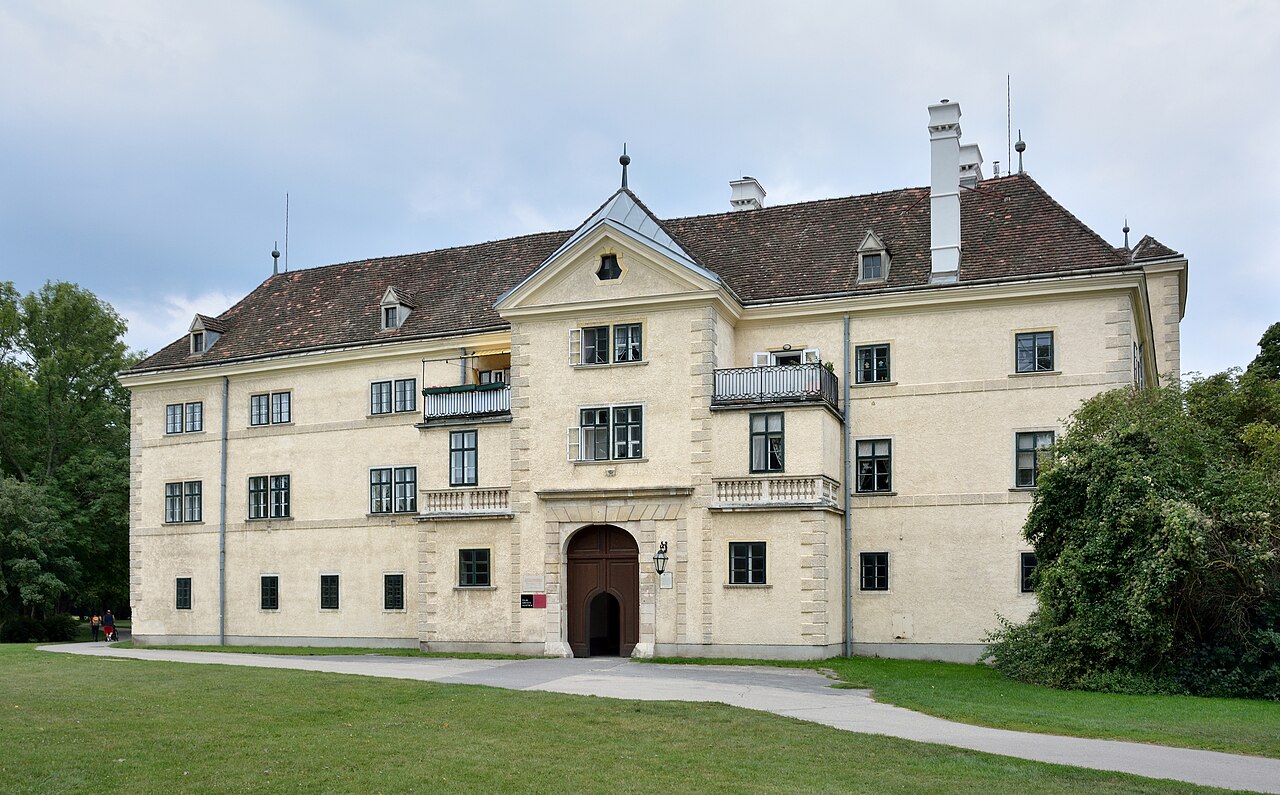
The castle's main façade, facing southeast, was enhanced with Baroque decorative elements, including a lowered round-arch portal and a prominent clock tower rising above the roofline. The entrance is accessed via a masonry bridge crossing the moat, flanked by Baroque-style pedestals that serve as ornamental supports, adding to the castle's stately approach.
On the right side of the building, a stepped-back section reinforced by a large corner buttress mirrors the decorative motifs of the main façade, demonstrating the careful integration of structural and aesthetic considerations during the Baroque renovations.
Cultural connections and later ownership
Between 1788 and 1811, the castle was owned by the von Trattner family. A notable cultural connection during this period is through Therese von Trattner, the second wife of Johann Thomas Edler von Trattner, who was a student of the renowned composer Wolfgang Amadeus Mozart. Mozart dedicated two significant musical works to her: the Sonata No. 14 in C minor, K. 457, and the Fantasia in C minor, K. 475. This association adds a layer of cultural heritage to Schloss Ebergassing, linking it to the broader artistic history of Austria.
20th-century challenges and restoration efforts
The 20th century brought considerable challenges to Schloss Ebergassing. During World War II, the castle suffered heavy damage and looting, which left it uninhabitable and abandoned for a prolonged period. The destruction affected both its structural integrity and the preservation of its historical features.
Restoration efforts began in earnest between 1998 and 2001, aiming to stabilize and conserve the castle's diverse architectural elements. These efforts were crucial in preserving the castle's layered historical legacy, from its medieval core to Renaissance and Baroque modifications. Following restoration, the castle came into the possession of the Sandhofer and Aichelburg-Rumerskirch families, who continue to maintain the property.
Today, Schloss Ebergassing is recognized and protected as a cultural heritage monument by Austrian authorities, ensuring its preservation for future generations and its role as a testament to Austria's rich architectural and historical traditions.
Architectural features and layout
The castle complex is characterized by an irregular four-winged structure forming a trapezoidal courtyard. The three-story wings enclose a rectangular open space, set within a larger park environment that enhances the castle's aesthetic appeal.
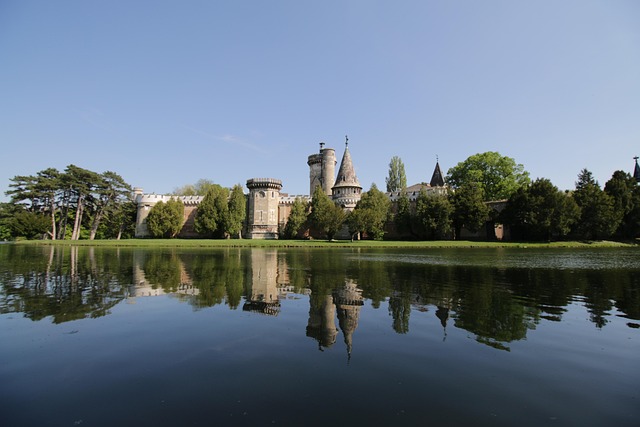
The castle's original function as a water castle is evident in its moat, which is supplied by the Fischa river. Access is granted by a carefully constructed masonry bridge that spans the moat, featuring Baroque-style pedestals that lend an ornamental quality to the entrance.
The main façade is notable for its lowered round-arch portal and the imposing clock tower that rises above the roofline, serving both practical and decorative purposes. The chapel, extending northeast from a slightly recessed section of the main façade, remains a significant architectural and spiritual element. Its dedication to Saint Ulrich of Augsburg was officially recognized under church law in November 2023, underscoring its ongoing religious importance.
Throughout the castle, visitors can observe a harmonious blend of architectural styles. The medieval core survives alongside the Renaissance modifications introduced by the Thanrädl family and the Baroque additions commissioned by the Princes of Liechtenstein. This layering of styles provides a tangible narrative of the castle's historical evolution and the changing tastes and functions over the centuries.
Defensive and residential elements
Originally designed for defense, Schloss Ebergassing incorporates typical medieval fortification features such as the moat and robust masonry walls. However, the Renaissance and Baroque renovations introduced more residential comforts and decorative elements, reflecting a shift from purely military functions to noble residence and status symbol.
Chapel of saint ulrich
The castle chapel, rebuilt in the 15th century by the lords of Wald, is dedicated to Saint Ulrich of Augsburg. This chapel is one of the oldest surviving parts of the complex and serves as a spiritual focal point. Its official recognition in 2023 highlights its enduring religious and cultural significance.
Visiting information and cultural significance
While Schloss Ebergassing remains a private property, its status as a protected cultural heritage monument underscores its importance within Austria's historical and architectural landscape. The castle's rich history, architectural diversity, and connections to notable historical figures and events make it a valuable site for scholars and enthusiasts of medieval and Baroque architecture.
The castle's restoration and preservation efforts ensure that its complex history is accessible and appreciated, contributing to the understanding of regional history and the evolution of noble residences in Austria.
Frequently asked questions (FAQ)
- How do I get to Schloss Ebergassing?
- Schloss Ebergassing is conveniently located just a short drive from Vienna, making it easily accessible by car or public transport. You can take the S-Bahn train to the nearby station and enjoy a pleasant walk to the castle grounds.
- What is the historical significance of Schloss Ebergassing?
- Schloss Ebergassing dates back to the 16th century and is an excellent example of Renaissance architecture in Austria. It has served various purposes over the centuries, including as a noble residence and a site for local administration, showcasing the region's rich history.
- When was Schloss Ebergassing built?
- Construction of Schloss Ebergassing began in the late 1500s, with significant renovations occurring in the 18th century. The castle has maintained its historical charm while adapting to the needs of its time.
- Can I visit Schloss Ebergassing year-round?
- Yes, Schloss Ebergassing is open to visitors throughout the year, although specific opening hours may vary by season. It is advisable to check the official website for the most up-to-date visiting hours and any potential closures.
- Why is the architecture of Schloss Ebergassing notable?
- The architecture of Schloss Ebergassing is notable for its Renaissance design, featuring elegant facades and well-preserved interiors. Visitors can appreciate the intricate details and craftsmanship that reflect the artistic styles of the period.
- Is it possible to host events at Schloss Ebergassing?
- Yes, Schloss Ebergassing offers facilities for hosting various events, including weddings and corporate gatherings. The picturesque surroundings and historical ambiance provide a unique setting for memorable occasions.
- What are the ticket prices for visiting Schloss Ebergassing?
- Ticket prices for Schloss Ebergassing are generally affordable, with discounts available for students and seniors. Children under a certain age may enjoy free admission, making it a great family-friendly destination.
- What is the best time to visit Schloss Ebergassing?
- The best time to visit Schloss Ebergassing is during the spring and fall, when the weather is mild and the gardens are in full bloom. Additionally, these seasons often feature fewer crowds, allowing for a more enjoyable experience.
- Are there nearby attractions to visit along with Schloss Ebergassing?
- Yes, there are several nearby attractions, including charming towns and beautiful parks. Visitors can explore the scenic landscapes and enjoy local dining options that complement their visit to the castle.
Information
Loading map...
Visitor reviews
No reviews yet. Been here? Write the first review and help other travelers!
Write the first reviewVisited this castle? Share your experience
Your review helps other travelers and adds first-hand knowledge to our encyclopedia.